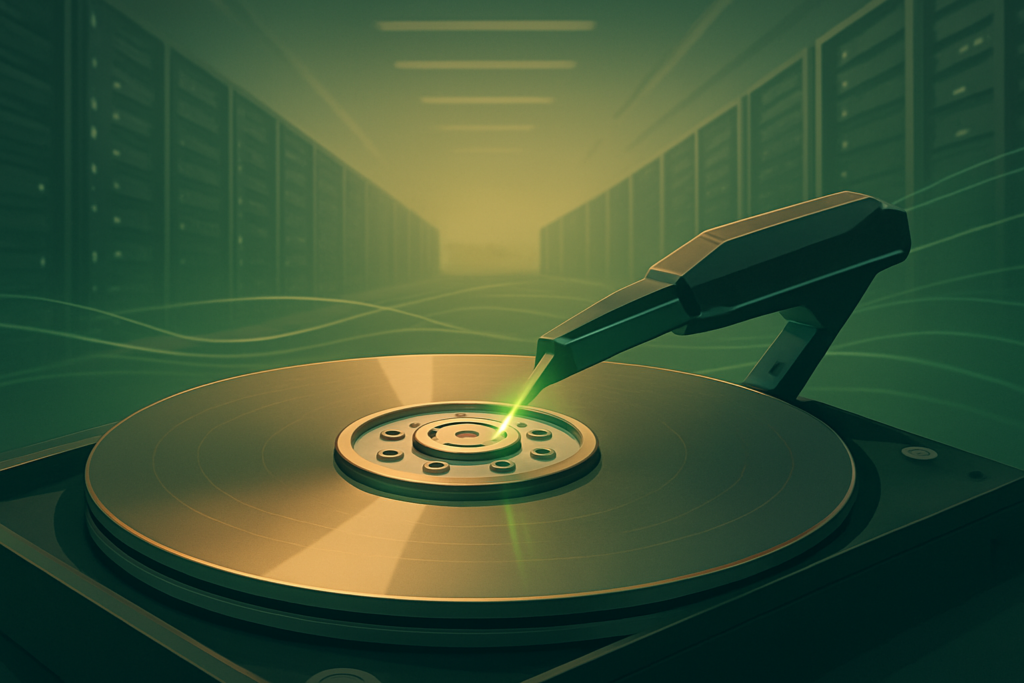
As of December 26, 2025, Seagate Technology Holdings plc (NASDAQ: STX) stands at the epicenter of a "Data Renaissance." While the technology world spent the early 2020s obsessed with processing power (GPUs), 2025 has become the year of the "Data Vault." With the explosion of generative AI models and autonomous systems, the world is generating more data than it can physically store. Seagate, a veteran of the hard disk drive (HDD) industry, has successfully shed its image as a legacy hardware provider to become a critical infrastructure play for the AI era. By betting the company on Heat-Assisted Magnetic Recording (HAMR) technology, Seagate has positioned itself as the indispensable provider of mass-capacity storage for the world’s hyperscale data centers.
Historical Background
Founded in 1978 by Al Shugart and Finis Conner, Seagate has been a cornerstone of the storage industry for nearly five decades. Originally based in Silicon Valley (now headquartered in Dublin, Ireland), the company revolutionized the personal computer market with the ST-506, the first 5.25-inch hard drive. Over the decades, Seagate navigated the tumultuous consolidation of the storage industry, acquiring rivals like Maxtor in 2006 and Samsung’s HDD business in 2011. These strategic moves helped create the current global HDD oligopoly. In the mid-2010s, as Solid State Drives (SSDs) began to dominate the consumer market, Seagate made a pivotal decision: rather than trying to lead in low-capacity flash memory, it would double down on "mass capacity" magnetic storage for the burgeoning cloud computing sector.
Business Model
Seagate’s business model is now bifurcated into two distinct categories:
- Mass Capacity Storage: This is the company’s primary growth engine, representing over 80% of total revenue. It focuses on "Nearline" HDDs—high-capacity drives (ranging from 16TB to the newly released 32TB+ models) designed for the massive data centers of Google, Amazon, and Microsoft.
- Legacy and Other: This includes traditional storage for desktop PCs, laptops, and consumer electronics. While this segment provides steady cash flow, it is in a long-term secular decline as SSDs continue to replace HDDs in smaller consumer devices.
Seagate’s transition to a "build-to-order" (BTO) strategy in 2024 has further refined its model, allowing for tighter inventory management and better pricing power with major cloud clients.
Stock Performance Overview
The year 2025 has been a breakout period for Seagate. After a "storage recession" in late 2022 and 2023 caused by inventory gluts at cloud providers, the stock began a meteoric rise.
- 1-Year Performance: STX has surged over 200% year-to-date in 2025, significantly outperforming the broader S&P 500 and even many of its semiconductor peers.
- 5-Year Performance: Long-term investors have seen the stock nearly triple in value, as the market moved from skepticism about HDD longevity to valuing it as an AI-enabler.
- 10-Year Performance: The decade-long view shows a company that survived the "death of the hard drive" narrative through aggressive R&D and strategic pivoting, ultimately rewarding patient shareholders with both capital gains and consistent dividends.
Financial Performance
In its most recent fiscal reports for 2025 (fiscal year ending June 2025), Seagate demonstrated a powerful recovery. Total revenue for FY2025 reached $9.10 billion, a staggering 39% increase year-over-year. The real story, however, lies in the margins. As the Mozaic 3+ platform (HAMR) entered volume production, Seagate’s non-GAAP gross margins expanded to a decade-high of 37.4% in the final quarter of the fiscal year.
The company reported a non-GAAP EPS of $8.10 for FY2025, up from just $1.29 the previous year. Free cash flow also rebounded strongly to $818 million, allowing the company to maintain its $0.72 per share quarterly dividend while managing its debt obligations.
Leadership and Management
CEO Dave Mosley, who took the helm in 2017, is credited with navigating Seagate through the transition to HAMR. Under his leadership, the company has prioritized R&D in areal density (the amount of data that can be stored on a disk platter) over chasing low-margin market share in the flash market. The management team is viewed as disciplined and technically proficient, with a clear focus on the "Areal Density Roadmap." Governance is generally well-regarded, though the board has had to manage the fallout from past regulatory missteps with transparency and rigorous compliance updates.
Products, Services, and Innovations
Seagate’s "crown jewel" is the Mozaic 3+ platform, which utilizes Heat-Assisted Magnetic Recording (HAMR).
- HAMR Technology: By using a tiny laser to heat the disk surface momentarily, Seagate can write data to significantly smaller grains, bypassing the physical limits of traditional recording methods.
- Mozaic 3+: This platform incorporates 32TB+ drives, featuring iron-platinum superlattice media and 7th-generation spintronic readers.
- Future Pipeline: Seagate has already begun sampling 36TB drives and has a roadmap targeting 40TB by late 2026 and 50TB+ by 2028. This technological lead creates a significant "moat" as competitors struggle to match these densities cost-effectively.
Competitive Landscape
The HDD market is a three-way battle:
- Seagate (STX): Holds approximately 41% of the market and is the undisputed leader in HAMR technology deployment.
- Western Digital (NASDAQ: WDC): Holds roughly 42% of the market. Western Digital’s recent split into two separate entities (Flash and HDD) in 2025 has made it a more focused competitor, but it has lagged Seagate in the transition to HAMR, relying more on Shingled Magnetic Recording (SMR) to extend current capacities.
- Toshiba: Holds the remaining 17%. While a stable player, Toshiba generally follows the technological lead of Seagate and WDC.
Seagate’s competitive edge currently lies in its vertical integration and its "first-mover" advantage in HAMR, which allows it to offer lower total cost of ownership (TCO) for data centers.
Industry and Market Trends
Three macro trends are driving the industry in late 2025:
- AI Model Storage: Large Language Models (LLMs) and video-generative AI require massive datasets for training and archiving. While GPUs do the "thinking," HDDs provide the "memory" where these vast libraries reside.
- Cloud CAPEX Thaw: After two years of cautious spending, hyperscalers (Meta, Google, etc.) have entered a massive "refresh cycle" to upgrade their storage infrastructure for AI readiness.
- Sustainability: High-capacity drives (30TB+) are more energy-efficient per terabyte than older 16TB units, helping data centers meet aggressive ESG and carbon-neutrality targets.
Risks and Challenges
Despite the current tailwinds, Seagate faces several risks:
- SSD Encroachment: While HDDs remain significantly cheaper per terabyte for mass storage, price drops in QLC (Quad-Level Cell) flash memory could eventually threaten the lower end of the mass-capacity market.
- Cyclicality: The storage industry is notoriously cyclical. Any slowdown in AI investment or a global recession could lead to another "inventory correction."
- Operational Risk: HAMR is a highly complex technology. Any manufacturing yield issues or field failures in the 32TB+ drives could be catastrophic for both reputation and the bottom line.
Opportunities and Catalysts
- 40TB Launch: The market is looking toward late 2026 for the first 40TB drives, which would further cement Seagate's TCO lead.
- Edge Computing: As AI moves to the edge (autonomous vehicles, smart cities), new demand for ruggedized, high-capacity storage is emerging.
- Stock Buybacks: With free cash flow rising, there is increasing speculation that Seagate may resume aggressive share repurchases in 2026 once the BIS fine payments are further advanced.
Investor Sentiment and Analyst Coverage
Wall Street sentiment toward STX is at a multi-year high. Most analysts carry "Buy" or "Strong Buy" ratings, viewing Seagate as a "pure-play" on AI infrastructure that trades at a more reasonable valuation than some of the high-flying semiconductor stocks. Institutional ownership remains high, with major players like BlackRock and Vanguard maintaining significant positions. However, some cautious voices note that the 200% YTD run-up may have priced in much of the near-term perfection, leading to a "Moderate Buy" consensus in recent weeks.
Regulatory, Policy, and Geopolitical Factors
Seagate continues to navigate a complex regulatory environment:
- BIS Settlement: Seagate is currently in the third year of its 5-year, $300 million settlement with the U.S. Bureau of Industry and Security for past sales to Huawei. This requires a $15 million quarterly payment and strict compliance audits.
- Export Controls: As U.S.-China tensions persist, Seagate must constantly adjust its sales strategy to comply with evolving restrictions on high-tech exports to the Chinese market, which remains a significant source of demand.
Conclusion
As we close out 2025, Seagate Technology has successfully transformed from a legacy hardware manufacturer into an AI-essential infrastructure company. By mastering HAMR technology and executing a disciplined financial strategy, Seagate has captured the "mass capacity" narrative that defines the modern cloud era. While the risks of cyclicality and geopolitical friction remain ever-present, Seagate's technological roadmap suggests it will remain the dominant force in high-density storage for the remainder of the decade. Investors should keep a close eye on manufacturing yields of the Mozaic 4+ platform and any shifts in hyperscale CAPEX as we head into 2026.
This content is intended for informational purposes only and is not financial advice.