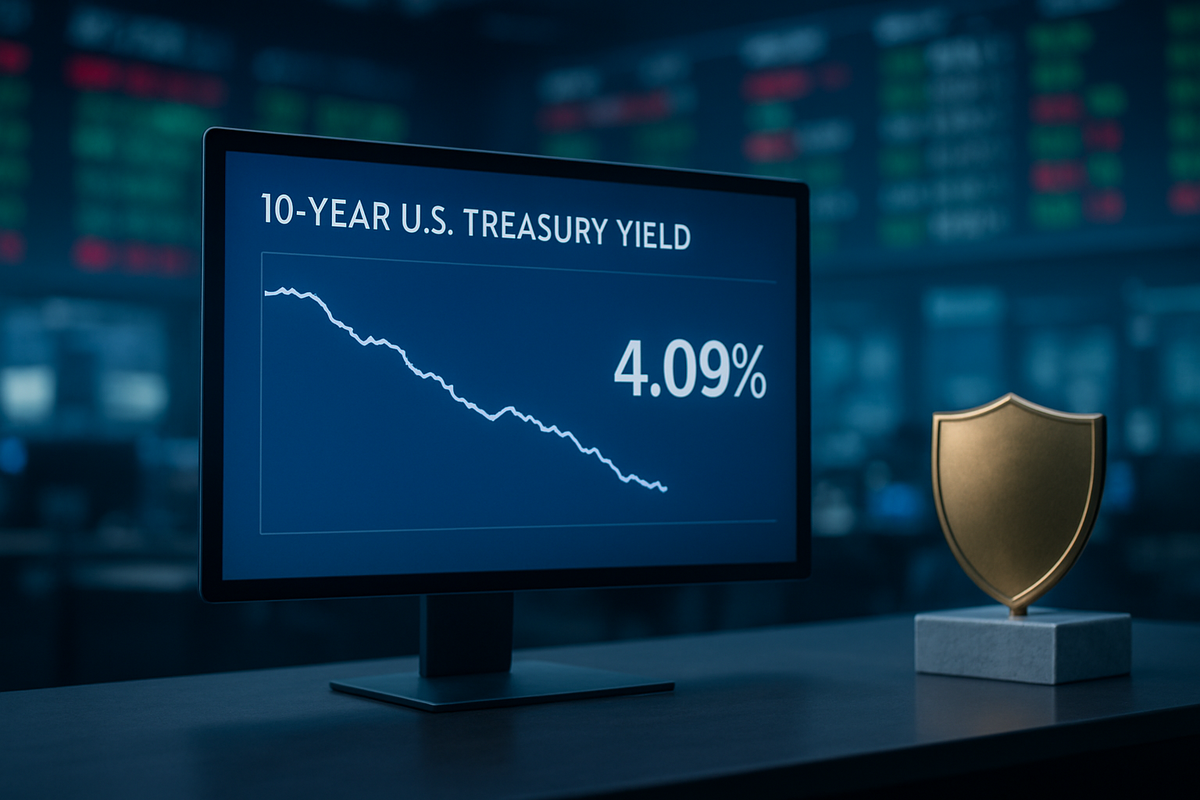
The U.S. bond market witnessed a significant shift in sentiment this February, as the benchmark 10-year Treasury yield drifted down to approximately 4.09%, marking a notable retreat from the highs seen in late 2025. This downward move reflects a growing consensus among investors that the long-standing battle against inflation is entering its final stages, while simultaneously highlighting a renewed "flight to quality" as geopolitical and regulatory uncertainties cloud the global economic horizon.
The decline in yields—which move inversely to bond prices—suggests that the market is increasingly pricing in a more accommodative stance from the Federal Reserve. As the 10-year yield stabilizes near the 4.09% mark, the broader financial ecosystem is recalibrating for a "soft landing" scenario where growth remains positive but modest, and price pressures continue to ease toward the central bank's long-term targets.
A Convergence of Cooling Data and Global Anxiety
The journey to 4.09% was catalyzed by a series of critical economic releases throughout mid-February 2026. The latest Consumer Price Index (CPI) report showed headline inflation slowing to 2.4% year-over-year, a figure that beat market expectations and signaled a decisive cooling from the stickier readings observed in the final quarter of 2025. This was further reinforced by the Core Personal Consumption Expenditures (PCE) index, the Federal Reserve’s preferred inflation metric, which also moderated to 2.4%, effectively giving the "green light" for yields to move lower.
However, the rally in Treasuries was not solely an endorsement of domestic economic health. A significant portion of the buying pressure stemmed from a "risk-off" environment triggered by geopolitical and legal volatility. A landmark U.S. Supreme Court ruling earlier this month, which struck down broad emergency tariff authorities, created a vacuum of trade policy uncertainty. In response, the executive branch’s move to propose new 10%–15% global levies sent jitters through equity markets, prompting institutional investors to seek the relative safety of government debt. Furthermore, a lackluster Q4 2025 GDP print of 1.4%, hampered by a partial government shutdown and slowing consumer spending, provided the fundamental backdrop for the yield decline.
Winners and Losers in a 4% Yield Regime
The shift toward a 4.09% yield environment has created a distinct set of opportunities and challenges across various sectors of the stock market. Major financial institutions, such as Bank of America Corp. (NYSE: BAC) and Wells Fargo & Co. (NYSE: WFC), are navigating a "normalization" of the yield curve. For Bank of America, which is highly asset-sensitive, the stabilization of long-term rates near 4% allows for better margin management as the gap between short-term borrowing costs and long-term lending rates begins to widen. Similarly, JPMorgan Chase & Co. (NYSE: JPM) has seen a resurgence in its investment banking division, as lower rate volatility encourages corporations to resume bond issuance and strategic deal-making.
In the real estate sector, the decline in yields serves as a double-edged sword. Industrial giants like Prologis, Inc. (NYSE: PLD) benefit from lower long-term financing costs for their massive logistics and data center projects. However, "bond proxy" stocks such as American Tower Corp. (NYSE: AMT) and AGNC Investment Corp. (NASDAQ: AGNC) have seen more mixed reactions. While AGNC benefits from stabilized mortgage-backed security (MBS) spreads, American Tower continues to grapple with the high cost of servicing existing debt in a world where 4% is the new floor, rather than the ceiling.
The utility sector, traditional haven for income-seeking investors, is also feeling the impact. NextEra Energy, Inc. (NYSE: NEE) has managed to outperform its peers by leveraging its focus on renewable energy and the burgeoning power demand from AI data centers, which offsets some of the pressure from higher-than-historical interest rates. Conversely, more traditional regulated utilities like Duke Energy Corp. (NYSE: DUK) and The Southern Company (NYSE: SO) are finding their 4% dividend yields are once again competitive with Treasuries, though their capital-intensive grid modernization plans remain sensitive to any sudden spikes in borrowing costs.
The Broader Market Significance and Historical Context
The retreat to 4.09% is more than just a technical move; it represents a fundamental shift in the "higher-for-longer" narrative that dominated 2024 and 2025. Historically, a 10-year yield near 4% has often served as a psychological "pivot point" for the market. By reaching this level in February 2026, the market is effectively signaling that it believes the Federal Reserve has reached a "neutral" policy rate—a state where interest rates are high enough to keep inflation in check but not so high that they trigger a deep recession.
This event fits into a broader trend of "yield curve normalization" after years of inversion. The ripple effects are being felt globally, as lower U.S. yields put downward pressure on the dollar, potentially providing some relief to emerging markets and multinational corporations. However, the regulatory and policy implications cannot be ignored. The recent Supreme Court intervention regarding tariffs suggests a period of heightened legal friction between the branches of government, which could lead to further bouts of market volatility and continued demand for safe-haven assets.
What Lies Ahead: Strategic Pivots and Market Scenarios
Looking forward, the path of the 10-year yield will likely be determined by the durability of the current "soft landing." In the short term, if inflation continues its glide path toward 2%, we may see the 10-year yield test the 3.75% support level. Conversely, if the proposed global levies reignite supply-chain friction and push prices back up, yields could quickly snap back toward 4.5%.
Investors should prepare for a period where "bad news is good news" for bonds, but potentially problematic for equities. If economic growth continues to decelerate as suggested by the 1.4% GDP reading, the Fed may be forced to cut rates more aggressively than currently anticipated. This would necessitate a strategic pivot for income investors, moving away from short-term money market funds and toward longer-duration assets to lock in the current 4% handle before it disappears.
Summary and Outlook for Investors
The drift of the 10-year Treasury yield to 4.09% in February 2026 marks a critical juncture for the U.S. economy. It is a moment defined by the cooling of the post-pandemic inflationary fire, tempered by the cold reality of geopolitical and trade-related uncertainty. For the markets, it provides a much-needed reprieve from the volatility of 2025, but it also signals that the easy gains of the "AI-driven" rally may be giving way to a more disciplined, value-oriented investment environment.
Moving forward, the market appears to be in a delicate balance. Investors should closely monitor upcoming PCE data and any further developments in the trade policy landscape. While the 4.09% yield level currently offers a sense of stability, the volatility of the past three years has taught us that the "safe haven" can quickly become a crowded trade. The coming months will be a test of whether this stabilization is a permanent fixture of a new economic era or merely a temporary pause in a larger cycle of adjustment.
This content is intended for informational purposes only and is not financial advice