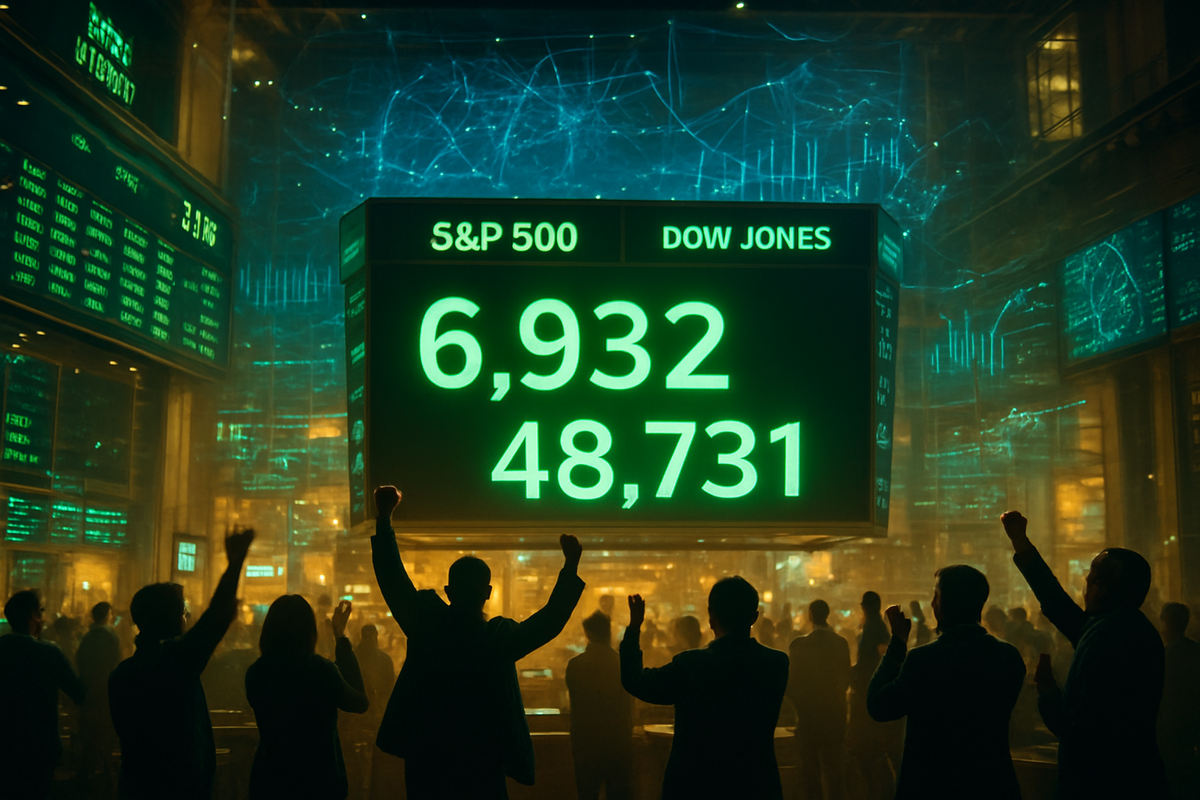
As the final opening bell of 2025 echoes through the canyons of Lower Manhattan, investors are celebrating a year that defied the skeptics and redefined the boundaries of the American bull market. On December 24, 2025, the S&P 500 (NYSE: ^GSPC) notched a fresh all-time high, closing at 6,932.05, while the Dow Jones Industrial Average (NYSE: ^DJI) surged to a record 48,731.16. These milestones cap a year of extraordinary volatility and eventual triumph, marking a total annual gain of approximately 17% for the S&P 500.
The rally, which many have dubbed the "Santa Claus Supercycle," was fueled by a potent cocktail of aggressive Federal Reserve rate cuts, a landmark fiscal stimulus package, and the long-awaited monetization of Artificial Intelligence. While the year was not without its "tariff turmoil" in the spring, the resilient domestic economy and a late-year surge in corporate earnings have positioned the market for a high-velocity entry into 2026.
A Year of Pivots and Policy: The Road to 6,900
The journey to these record highs was anything but linear. The year began with cautious optimism, but the market was blindsided in April 2025 by "Liberation Day," a series of aggressive trade policies that saw the implementation of a 10% universal baseline tariff and 145% duties on Chinese imports. The resulting "April Meltdown" saw the S&P 500 shed nearly 20% of its value in weeks as investors feared a global trade war. However, the tide turned on July 4, 2025, with the signing of the One Big Beautiful Bill Act (OBBBA). This landmark legislation permanently extended the 2017 corporate tax cuts and introduced massive incentives for domestic manufacturing, sparking a "v-shaped" recovery that lasted through the fourth quarter.
Monetary policy provided the secondary engine for this rally. After a prolonged pause, Federal Reserve Chairman Jerome Powell initiated a series of "hawkish cuts" starting in September. The final move of the year came on December 10, when the Fed reduced the benchmark interest rate by 25 basis points to a range of 3.5% to 3.75%. This sixth rate cut of the cycle provided the necessary liquidity to push the Dow past the 48,000 mark and the S&P 500 toward the 7,000 threshold. Corporate earnings further supported the climb; by early December, S&P 500 companies reported third-quarter earnings growth of 12.9%, significantly outpacing the 8% growth forecasted by analysts earlier in the year.
Winners and Losers: The Great AI and Policy Divide
The 2025 rally was a story of two markets: those who leveraged the OBBBA and AI, and those who were crushed by import reliance. Nvidia (NASDAQ: NVDA) remained the undisputed champion of the tech world, becoming the first company in history to surpass a $5 trillion market capitalization in October. The insatiable demand for its Blackwell architecture, fueled by OBBBA-related data center tax credits, made it the bedrock of institutional portfolios. Similarly, Palantir Technologies (NYSE: PLTR) saw its stock price climb over 140% as its Artificial Intelligence Platform (AIP) became the gold standard for enterprise implementation and defense contracts.
In the industrial and financial sectors, the "reshoring" trend created massive winners. Caterpillar (NYSE: CAT) rose over 60% as it provided the power infrastructure for the domestic AI boom, while Nucor (NYSE: NUE) and United States Steel (NYSE: X) thrived behind the protectionist "tariff moat" that priced out foreign competition. The lower-rate environment also breathed new life into the "Big Four" banks. Goldman Sachs (NYSE: GS) saw its shares rise 61% amid a resurgence in M&A activity, and Citigroup (NYSE: C) became a surprise leader, gaining 68% as it successfully integrated AI to streamline its global operations.
Conversely, the year was punishing for retailers and green energy firms. Target (NYSE: TGT) shares plunged more than 30% as the company struggled to absorb the 25% levies on discretionary imports from Mexico and Canada. Nike (NYSE: NKE) and Lululemon (NASDAQ: LULU) also faced significant headwinds, with Nike reporting a $1 billion drag from tariff costs. In the energy sector, NextEra Energy (NYSE: NEE) faced a valuation reset as the OBBBA rolled back wind and solar tax credits, signaling a federal policy retreat from renewable energy in favor of traditional domestic manufacturing and nuclear power.
Wider Significance: AI Monetization and the New Industrialism
The significance of 2025 lies in the transition of Artificial Intelligence from a speculative hype cycle to a tangible productivity driver. Unlike the "AI summer" of 2023, the gains in 2025 were backed by realized revenue. Companies across the Dow, from healthcare to heavy machinery, demonstrated how AI integration could offset rising labor costs and mitigate the inflationary pressures of new tariffs. This "Supercycle" suggests that the U.S. economy is entering a period of high-tech industrialism, where domestic manufacturing is heavily subsidized and digitally optimized.
Furthermore, the market's resilience in the face of the April "Liberation Day" tariffs suggests a fundamental shift in investor psychology regarding trade. The "tariff moat" has become a recognized investment theme, favoring companies with entirely domestic supply chains. This shift aligns with broader geopolitical trends of decoupling from overseas manufacturing, a move that has now been codified by the OBBBA. The historical precedent here is the post-WWII industrial boom, though updated for a world where silicon chips are as vital as steel beams.
The 2026 Outlook: Momentum vs. Macro Challenges
Heading into 2026, the primary question for investors is whether this momentum can be sustained. In the short term, the "Santa Claus rally" appears to have legs, with many analysts projecting the S&P 500 will breach the 7,000 mark in the first quarter of the new year. The lower interest rate environment is expected to trigger a "deal-making frenzy" in the mid-cap space, potentially broadening the rally to include the Russell 2000, which lagged the blue-chip indices for much of 2025.
However, challenges loom on the horizon. While inflation has cooled, the labor market is showing signs of "normalization," with unemployment ticking up to 4.6% in December. Investors will need to watch for "credit normalization" in consumer loan portfolios, particularly as the effects of the OBBBA stimulus begin to bake into the baseline. Strategic pivots will be required for companies that have relied on cheap imports; the "tariff-proof" portfolio will likely remain the dominant strategy for the foreseeable future.
Final Thoughts: A New Benchmark for Success
The record-breaking close of 2025 serves as a testament to the adaptability of the American market. Despite the dual shocks of trade upheaval and a shifting interest rate landscape, the S&P 500 and Dow have reached heights that seemed improbable just twelve months ago. The key takeaway for investors is the importance of "policy-alignment"—those who positioned their portfolios alongside the OBBBA and the AI infrastructure boom were rewarded handsomely, while those tethered to globalist retail models were left behind.
Moving forward, the market remains in a "show-me" phase for AI productivity. While the infrastructure has been built, the next leg of the rally will depend on how effectively the "old economy" companies in the Dow can use these tools to drive margin expansion. Investors should keep a close eye on the Federal Reserve's January meeting and the first-quarter earnings reports of the reshoring titans. For now, the bulls are firmly in control, and the road to 2026 looks paved with both opportunity and the hard-earned lessons of a volatile, historic year.
This content is intended for informational purposes only and is not financial advice.