
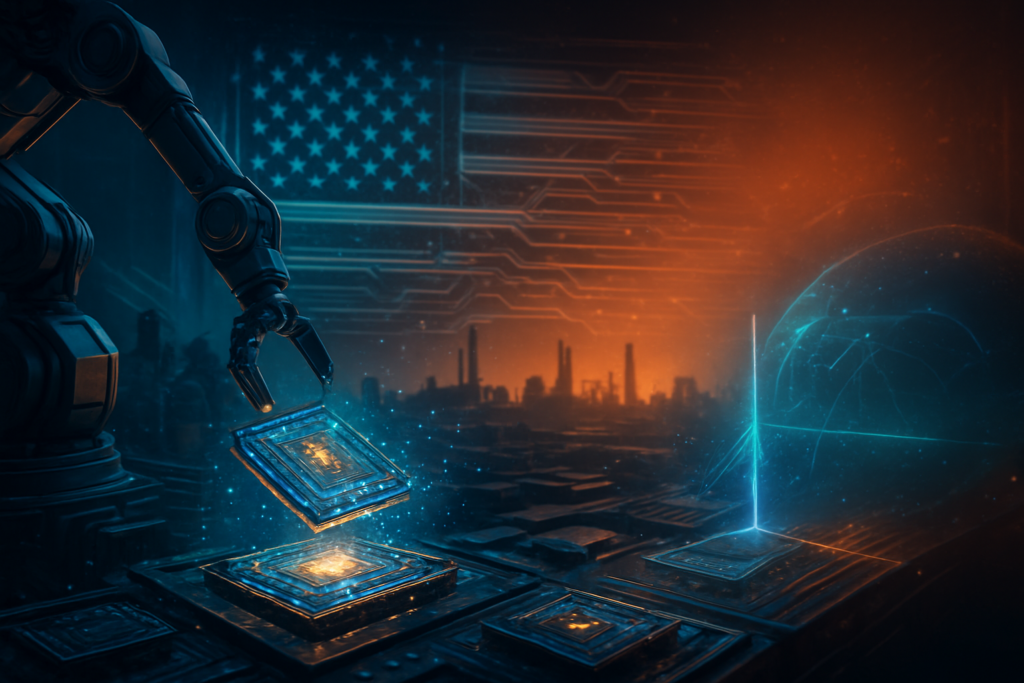
On January 15, 2026, the global semiconductor landscape underwent its most seismic shift in decades as the United States officially implemented the "Silicon Surcharge." This 25% ad valorem tariff, enacted under Section 232 of the Trade Expansion Act of 1962, targets high-end artificial intelligence processors manufactured outside of American soil. Designed as a "revenue-capture" mechanism, the surcharge is intended to directly fund the massive reshoring of semiconductor manufacturing, marking a definitive end to the era of unfettered globalized silicon production and the beginning of what the administration calls "Silicon Sovereignty."
The immediate significance of the surcharge cannot be overstated. By placing a premium on the world’s most advanced computational hardware, the U.S. government has effectively weaponized its market dominance to force a migration of manufacturing back to domestic foundries. For the tech industry, this is not merely a tax; it is a structural pivot. The billions of dollars expected to be collected annually are already earmarked for the "Pax Silica" fund, a multi-billion-dollar federal initiative to subsidize the construction of next-generation 2nm and 1.8nm fabrication plants within the United States.
The Technical Thresholds of "Frontier-Class" Hardware
The Silicon Surcharge is surgically precise, targeting what the Department of Commerce defines as "frontier-class" hardware. Rather than a blanket tax on all electronics, the tariff applies to any processor meeting specific high-performance metrics that are essential for training and deploying large-scale AI models. Specifically, the surcharge hits chips with a Total Processing Performance (TPP) exceeding 14,000 and a DRAM bandwidth higher than 4,500 GB/s. This definition places the industry’s most coveted assets—NVIDIA (NASDAQ: NVDA) H200 and Blackwell series, as well as the Instinct MI325X and MI300 accelerators from AMD (NASDAQ: AMD)—squarely in the crosshairs.
Technically, this differs from previous export controls that focused on denying technology to specific adversaries. The Silicon Surcharge is a broader economic tool that applies even to chips coming from friendly nations, provided the fabrication occurs in foreign facilities. The legislation introduces a tiered system: Tier 1 chips face a 15% levy, while Tier 2 "Cutting Edge" chips—those with TPP exceeding 20,800, such as the upcoming Blackwell Ultra—are hit with the full 25% surcharge.
The AI research community and industry experts have expressed a mixture of shock and resignation. Dr. Elena Vance, a lead architect at the Frontier AI Lab, noted that "while we expected some form of protectionism, the granularity of these technical thresholds means that even minor design iterations could now cost companies hundreds of millions in additional duties." Initial reactions suggest that the tariff is already driving engineers to rethink chip architectures, potentially optimizing for "efficiency over raw power" to duck just under the surcharge's performance ceilings.
Corporate Impact: Strategic Hedging and Market Rotation
The corporate fallout of the Silicon Surcharge has been immediate and volatile. NVIDIA, the undisputed leader in the AI hardware race, has already begun a major strategic pivot. In an unprecedented move, NVIDIA recently announced a $5 billion partnership with Intel (NASDAQ: INTC) to secure domestic capacity on Intel’s 18A process node. This deal is widely seen as a direct hedge against the tariff, allowing NVIDIA to eventually bypass the surcharge by shifting production from foreign foundries to American soil.
While hardware giants like NVIDIA and AMD face the brunt of the costs, hyper-scalers such as Microsoft (NASDAQ: MSFT) and Amazon (NASDAQ: AMZN) have negotiated complex "Domestic Use Exemptions." These carve-outs allow for duty-free imports of chips destined for U.S.-based data centers, provided the companies commit to long-term purchasing agreements with domestic fabs. This creates a distinct competitive advantage for U.S.-based cloud providers over international rivals, who must pay the full 25% premium to equip their own regional clusters.
However, the "Silicon Surcharge" is expected to cause significant disruption to the startup ecosystem. Small-scale AI labs without the lobbying power to secure exemptions are finding their hardware procurement costs rising overnight. This could lead to a consolidation of AI power, where only the largest, most well-funded tech giants can afford the premium for "Tier 2" hardware, potentially stifling the democratic innovation that characterized the early 2020s.
The Pax Silica and the New Geopolitical Reality
The broader significance of the surcharge lies in its role as the financial engine for American semiconductor reshoring. The U.S. government intends to use the revenue to bridge the "cost gap" between foreign and domestic manufacturing. Following a landmark agreement in early January, Taiwan Semiconductor Manufacturing Company (NYSE: TSM), commonly known as TSMC, committed to an additional $250 billion in U.S. investments. In exchange, the "Taiwan Deal" allows TSMC-made chips to be imported at a reduced rate if they are tied to verified progress on the company’s Arizona and Ohio fabrication sites.
This policy signals the arrival of the "Silicon Curtain"—a decoupling of the high-end hardware market into domestic and foreign spheres. By making foreign-made silicon 25% more expensive, the U.S. is creating a "competitive moat" for domestic players like GlobalFoundries (NASDAQ: GFS) and Intel. It is a bold, protectionist gambit that aims to solve the national security risk posed by a supply chain that currently sees 90% of high-end chips produced outside the U.S.
Comparisons are already being made to the 1986 Semiconductor Trade Agreement, but the stakes today are far higher. Unlike the 80s, which focused on memory chips (DRAM), the 2026 surcharge targets the very "brains" of the AI revolution. Critics warn that this could lead to a retaliatory cycle. Indeed, China has already responded by accelerating its own indigenous programs, such as the Huawei Ascend series, and threatening to restrict the export of rare earth elements essential for chip production.
Looking Ahead: The Reshoring Race and the 1.8nm Frontier
Looking to the future, the Silicon Surcharge is expected to accelerate the timeline for 1.8nm and 1.4nm domestic fabrication. By 2028, experts predict that the U.S. could account for nearly 30% of global leading-edge manufacturing, up from less than 10% in 2024. In the near term, we can expect a flurry of "Silicon Surcharge-compliant" product announcements, as chip designers attempt to balance performance with the new economic realities of the 25% tariff.
The next major challenge will be the "talent gap." While the surcharge provides the capital for fabs, the industry still faces a desperate shortage of specialized semiconductor engineers to man these new American facilities. We may see the government introduce a "Semiconductor Visa" program as a companion to the tariff, designed to import the human capital necessary to run the reshored factories.
Predictions for the coming months suggest that other nations may follow suit. The European Union is reportedly discussing a similar "Euro-Silicon Levy" to fund its own domestic manufacturing goals. If this trend continues, the era of globalized, low-cost AI hardware may be officially over, replaced by a fragmented world where computational power is as much a matter of geography as it is of engineering.
Summary of the "Silicon Surcharge" Era
The implementation of the Silicon Surcharge on January 15, 2026, marks the end of a multi-decade experiment in globalized semiconductor supply chains. The key takeaway is that the U.S. government has decided that national security and "Silicon Sovereignty" are worth the price of higher hardware costs. By taxing the most advanced chips from NVIDIA and AMD, the administration is betting that it can force the industry to rebuild its manufacturing base on American soil.
This development will likely be remembered as a turning point in AI history—the moment when the digital revolution met the hard realities of physical borders and geopolitical competition. In the coming weeks, market watchers should keep a close eye on the first quarter earnings reports of major tech firms to see how they are accounting for the surcharge, and whether the "Domestic Use Exemptions" are being granted as widely as promised. The "Silicon Curtain" has fallen, and the race to build the next generation of AI within its borders has officially begun.
This content is intended for informational purposes only and represents analysis of current AI developments.
TokenRing AI delivers enterprise-grade solutions for multi-agent AI workflow orchestration, AI-powered development tools, and seamless remote collaboration platforms.
For more information, visit https://www.tokenring.ai/.