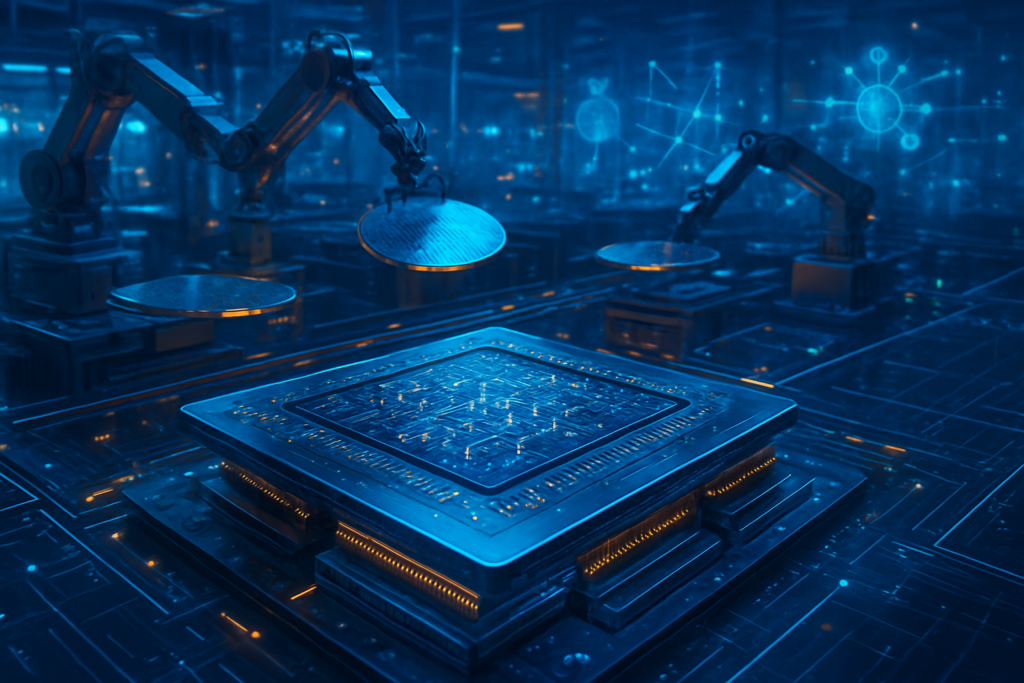
As the artificial intelligence revolution enters its next phase of industrialization, the battle for compute supremacy has shifted from the transistor to the package. Taiwan Semiconductor Manufacturing Company (NYSE: TSM) is aggressively expanding its Chip on Wafer on Substrate (CoWoS) advanced packaging capacity, aiming for a 33% increase by 2026 to satisfy an insatiable global appetite for AI silicon. This expansion is designed to break the primary bottleneck currently stifling the production of next-generation AI accelerators.
NVIDIA Corporation (NASDAQ: NVDA) has emerged as the undisputed anchor tenant of this new infrastructure, reportedly booking over 50% of TSMC’s projected CoWoS capacity for 2026. With an estimated 800,000 to 850,000 wafers reserved, NVIDIA is clearing the path for its upcoming Blackwell Ultra and the highly anticipated Rubin architectures. This strategic move ensures that while competitors scramble for remaining slots, the AI market leader maintains a stranglehold on the hardware required to power the world’s largest large language models (LLMs) and autonomous systems.
The Technical Frontier: CoWoS-L, SoIC, and the Rubin Shift
The technical complexity of AI chips has reached a point where traditional monolithic designs are no longer viable. TSMC’s CoWoS technology, specifically the CoWoS-L (Local Silicon Interconnect) variant, has become the gold standard for integrating multiple logic and memory dies. As of late 2025, the industry is transitioning from the Blackwell architecture to Blackwell Ultra (GB300), which pushes the limits of interposer size. However, the real technical leap lies in the Rubin (R100) architecture, which utilizes a massive 4x reticle design. This means each chip occupies significantly more physical space on a wafer, necessitating the 33% capacity boost just to maintain current unit volume delivery.
Rubin represents a paradigm shift by combining CoWoS-L with System on Integrated Chips (SoIC) technology. This "3D" stacking approach allows for shorter vertical interconnects, drastically reducing power consumption while increasing bandwidth. Furthermore, the Rubin platform will be the first to integrate High Bandwidth Memory 4 (HBM4) on TSMC’s N3P (3nm) process. Industry experts note that the integration of HBM4 requires unprecedented precision in bonding, a capability TSMC is currently perfecting at its specialized facilities.
The initial reaction from the AI research community has been one of cautious optimism. While the technical specs of Rubin suggest a 3x to 5x performance-per-watt improvement over Blackwell, there are concerns regarding the "memory wall." As compute power scales, the ability of the packaging to move data between the processor and memory remains the ultimate governor of performance. TSMC’s ability to scale SoIC and CoWoS in tandem is seen as the only viable solution to this hardware constraint through 2027.
Market Dominance and the Competitive Squeeze
NVIDIA’s decision to lock down more than half of TSMC’s advanced packaging capacity through 2027 creates a challenging environment for other fabless chip designers. Companies like Advanced Micro Devices (NASDAQ: AMD) and specialized AI chip startups are finding themselves in a fierce bidding war for the remaining 40-50% of CoWoS supply. While AMD has successfully utilized TSMC’s packaging for its MI300 and MI350 series, the sheer scale of NVIDIA’s orders threatens to push competitors toward alternative Outsourced Semiconductor Assembly and Test (OSAT) providers like ASE Technology Holding (NYSE: ASX) or Amkor Technology (NASDAQ: AMKR).
Hyperscalers such as Microsoft (NASDAQ: MSFT), Amazon (NASDAQ: AMZN), and Alphabet (NASDAQ: GOOGL) are also impacted by this capacity crunch. While these tech giants are increasingly designing their own custom AI silicon (like Azure’s Maia or Google’s TPU), they still rely heavily on TSMC for both wafer fabrication and advanced packaging. NVIDIA’s dominance in the packaging queue could potentially delay the rollout of internal silicon projects at these firms, forcing continued reliance on NVIDIA’s off-the-shelf H100, B200, and future Rubin systems.
Strategic advantages are also shifting toward the memory manufacturers. SK Hynix, Micron Technology (NASDAQ: MU), and Samsung are now integral parts of the CoWoS ecosystem. Because HBM4 must be physically bonded to the logic die during the CoWoS process, these companies must coordinate their production cycles perfectly with TSMC’s expansion. The result is a more vertically integrated supply chain where NVIDIA and TSMC act as the central orchestrators, dictating the pace of innovation for the entire semiconductor industry.
Geopolitics and the Global Infrastructure Landscape
The expansion of TSMC’s capacity is not limited to Taiwan. The company’s Chiayi AP7 plant is central to this strategy, featuring multiple phases designed to scale through 2028. However, the geopolitical pressure to diversify the supply chain has led to significant developments in the United States. As of December 2025, TSMC has accelerated plans for an advanced packaging facility in Arizona. While Arizona’s Fab 21 is already producing 4nm and 5nm wafers with high yields, the lack of local packaging has historically required those wafers to be shipped back to Taiwan for final assembly—a process known as the "packaging gap."
To address this, TSMC is repurposing land in Arizona for a dedicated Advanced Packaging (AP) plant, with tool move-in expected by late 2027. This move is seen as a critical step in de-risking the AI supply chain from potential cross-strait tensions. By providing "end-to-end" manufacturing on U.S. soil, TSMC is aligning itself with the strategic interests of the U.S. government while ensuring that its largest customer, NVIDIA, has a resilient path to market for its most sensitive government and enterprise contracts.
This shift mirrors previous milestones in the semiconductor industry, such as the transition to EUV (Extreme Ultraviolet) lithography. Just as EUV became the gatekeeper for sub-7nm chips, advanced packaging is now the gatekeeper for the AI era. The massive capital expenditure required—estimated in the tens of billions of dollars—ensures that only a handful of players can compete at the leading edge, further consolidating power within the TSMC-NVIDIA-HBM triad.
Future Horizons: Beyond 2027 and the Rise of Panel-Level Packaging
Looking beyond 2027, the industry is already eyeing the next evolution: Chip-on-Panel-on-Substrate (CoPoS). As AI chips continue to grow in size, the circular 300mm silicon wafer becomes an inefficient medium for packaging. Panel-level packaging, which uses large rectangular glass or organic substrates, offers the potential to process significantly more chips at once, potentially lowering costs and increasing throughput. TSMC is reportedly experimenting with this technology at its later-phase AP7 facilities in Chiayi, with mass production targets set for the 2028-2029 timeframe.
In the near term, we can expect a flurry of activity around HBM4 and HBM4e integration. The transition to 12-high and 16-high memory stacks will require even more sophisticated bonding techniques, such as hybrid bonding, which eliminates the need for traditional "bumps" between dies. This will allow for even thinner, more powerful AI modules that can fit into the increasingly cramped environments of edge servers and high-density data centers.
The primary challenge remaining is the thermal envelope. As Rubin and its successors pack more transistors and memory into smaller volumes, the heat generated is becoming a physical limit. Future developments will likely include integrated liquid cooling or even "optical" interconnects that use light instead of electricity to move data between chips, further evolving the definition of what a "package" actually is.
A New Era of Integrated Silicon
TSMC’s aggressive expansion of CoWoS capacity and NVIDIA’s massive pre-orders mark a definitive turning point in the AI hardware race. We are no longer in an era where software alone defines AI progress; the physical constraints of how chips are assembled and cooled have become the primary variables in the equation of intelligence. By securing the lion's share of TSMC's capacity, NVIDIA has not just bought chips—it has bought time and market stability through 2027.
The significance of this development cannot be overstated. It represents the maturation of the AI supply chain from a series of experimental bursts into a multi-year industrial roadmap. For the tech industry, the focus for the next 24 months will be on execution: can TSMC bring the AP7 and Arizona facilities online fast enough to meet the demand, and can the memory manufacturers keep up with the transition to HBM4?
As we move into 2026, the industry should watch for the first risk production of the Rubin architecture and any signs of "over-ordering" that could lead to a future inventory correction. For now, however, the signal is clear: the AI boom is far from over, and the infrastructure to support it is being built at a scale and speed never before seen in the history of computing.
This content is intended for informational purposes only and represents analysis of current AI developments.
TokenRing AI delivers enterprise-grade solutions for multi-agent AI workflow orchestration, AI-powered development tools, and seamless remote collaboration platforms.
For more information, visit https://www.tokenring.ai/.