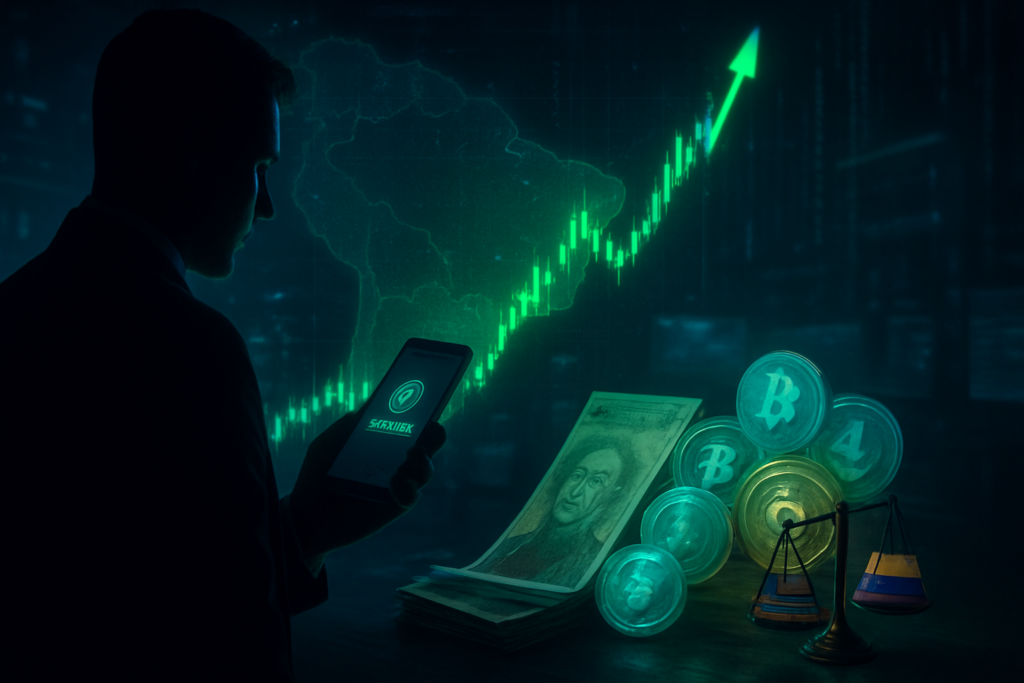
The world of decentralized finance is no stranger to "whales" and high-stakes gambles, but a single series of trades executed in the final hours of January 2, 2026, has sent shockwaves through Washington and the global prediction market industry. Just hours before U.S. Special Operations forces launched "Operation Absolute Resolve" to capture Venezuelan leader Nicolás Maduro, an anonymous trader turned a modest $32,000 position into a staggering $436,000 windfall.
The capture of Maduro, announced by the White House in the early hours of January 3, 2026, was the resolution event for several high-liquidity contracts on Polymarket. While the geopolitical world scrambled to react to the fall of the Caracas regime, the prediction market community was focused on a wallet address starting with 0x31a56e. The timing of the bets—placed less than four hours before the first explosions were reported in the Venezuelan capital—has led to widespread allegations of insider trading and a direct challenge to the integrity of decentralized forecasting platforms.
The Market: What's Being Predicted
The focus of the controversy is the "Maduro out by January 31, 2026?" contract on Polymarket, a decentralized platform that has seen a massive surge in institutional interest following a $2 billion investment from the Intercontinental Exchange (NYSE: ICE). At the start of the year, the market viewed the departure of Maduro as a "black swan" event. Shares for a "Yes" outcome were trading at a mere 7 to 8 cents, implying a market-calculated probability of less than 10%.
Trading volume on the Maduro-related suite of contracts exceeded $150 million in the first week of January alone. The platform offered several ways to play the Venezuelan crisis, including contracts on whether Maduro would be in U.S. custody, whether an invasion would occur, and even the specific date of his first court appearance in Manhattan. As the "Burdensome-Mix" account (the handle associated with the 0x31a56e wallet) began aggressively buying "Yes" shares on January 2, the odds began to tick upward, though they never crossed 15% before the news of the raid broke.
The resolution criteria for the "Maduro out" market were stringent: it required a definitive change in the head of state recognized by the U.S. State Department or the physical removal of Maduro from the presidential palace. When the Delta Force raid successfully extracted Maduro from the Miraflores Palace at 1:00 AM ET on January 3, the market entered a "lock" state, eventually resolving in favor of the "Yes" holders.
Why Traders Are Betting
The suspicious nature of the "Maduro Trade" stems from the sheer precision of the timing. The trader, who created their account only on December 26, 2025, executed their final significant wager at 9:58 PM ET on January 2. At that moment, there was no public news indicating a military operation was imminent. In fact, most mainstream geopolitical analysts were focused on a possible diplomatic summit scheduled for later in the month.
The trader's strategy involved diversifying $32,000 across several interlinked outcomes. They bet heavily on "Maduro out" and "Maduro in U.S. custody," while simultaneously taking smaller positions in the "U.S. invasion" contract. By spreading the bets, the user maximized their potential payout while keeping individual contract price movements from alerting the broader market too early.
Unlike traditional forecasting methods—which rely on diplomatic cables, troop movements, and satellite imagery—this trader appeared to have the ultimate "alpha": the exact timeline of a classified military operation. This has reignited the debate over whether prediction markets are truly "wisdom of the crowd" or merely a "marketplace for leaks."
Broader Context and Implications
This event has catalyzed a massive regulatory backlash. On January 5, 2026, Representative Ritchie Torres (D-NY) introduced the Public Integrity in Financial Prediction Markets Act of 2026. The proposed legislation seeks to apply SEC-style insider trading rules to prediction markets, making it a federal crime for government employees or contractors to trade on non-public information. "What we saw with the Maduro Trade wasn't genius—it was a leak," Torres stated during a floor speech.
The controversy also highlights a growing rift in the Polymarket community regarding the "Invasion" contract. While Maduro was captured in a military raid involving 75 casualties, Polymarket’s resolution committee ruled that the "U.S. Invasion" contract would resolve as "No." The committee argued that a "snatch-and-extract" mission did not meet the definition of an invasion, which requires an intent to establish territorial control. This "semantic freeze" has led to accusations that the platform is manipulating outcomes to protect liquidity providers from massive payouts to "informed" traders.
The involvement of the Intercontinental Exchange (NYSE: ICE) as a major backer of Polymarket adds a layer of institutional complexity. While traditional exchanges are strictly regulated, decentralized platforms like Polymarket have operated in a gray area. The Maduro incident may force these platforms to adopt rigorous "Know Your Customer" (KYC) standards and monitoring tools similar to those used on the New York Stock Exchange.
What to Watch Next
All eyes are now on the Department of Justice (DOJ) and the Commodity Futures Trading Commission (CFTC), which have reportedly opened a joint inquiry into the "Burdensome-Mix" wallet. Blockchain analysis from firms like Chainalysis has already tracked the $436,000 payout to several mainstream U.S. exchanges, suggesting that the identity of the trader may be uncovered sooner rather than later if a subpoena is issued.
Additionally, the passage of the Torres bill will be a critical milestone for the industry. If enacted, it could lead to the first-ever "insider trading" prosecution in the history of decentralized prediction markets. This would set a legal precedent that could either legitimize the industry by purging bad actors or stifle it by making traders fear that any successful "high-conviction" bet will trigger a federal investigation.
Finally, the resolution of the "Invasion" contract remains a point of contention. Several large-scale traders have threatened to sue Polymarket, arguing that the resolution committee's definition was too narrow and ignored the reality of the military engagement on the ground.
Bottom Line
The "Maduro Trade" is a watershed moment for prediction markets. On one hand, it proves that these markets are incredibly efficient at incorporating information—the price moved toward the truth before the world knew it. On the other hand, it exposes a glaring vulnerability: if the source of that information is an illegal leak, the market ceases to be a tool for public insight and becomes a vehicle for corruption.
As we move further into 2026, the industry must find a balance between its decentralized roots and the necessary guardrails of financial integrity. Whether "Burdensome-Mix" is a lucky gambler or a high-ranking intelligence officer, their trade has ensured that prediction markets will never be viewed the same way again. The Maduro capture was a triumph for U.S. foreign policy, but for the world of forecasting, it may be the start of a long and difficult regulatory winter.
This article is for informational purposes only and does not constitute financial or betting advice. Prediction market participation may be subject to legal restrictions in your jurisdiction.
PredictStreet focuses on covering the latest developments in prediction markets.
Visit the PredictStreet website at https://www.predictstreet.ai/.