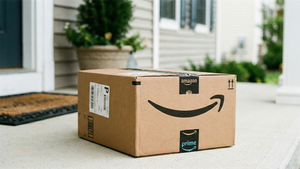
As of December 24, 2025, Amazon.com, Inc. (NASDAQ: AMZN) stands as a paradigm of corporate reinvention. Once a fledgling online bookstore, it has evolved into a global utility—providing the digital backbone for the internet through Amazon Web Services (AWS) and the physical backbone for global commerce. In 2025, the narrative around Amazon has shifted from mere "efficiency" to "intelligent scale," as the company integrates generative artificial intelligence (GenAI) across its entire ecosystem while navigating a complex regulatory landscape. This article explores the dual engines of Cloud and Retail that drive the world's most influential commercial enterprise.
Historical Background
Founded in July 1994 by Jeff Bezos in a Bellevue, Washington garage, Amazon’s initial mission was to be "Earth's most customer-centric company." After its IPO in 1997, the company survived the dot-com bubble by pivoting from books to electronics, toys, and eventually the "Everything Store."
The most significant transformations occurred in the mid-2000s. In 2005, the launch of Amazon Prime revolutionized consumer loyalty through subscription-based shipping. In 2006, the internal need for scalable infrastructure birthed AWS, a move that pioneered the cloud computing industry. Over the last decade, Amazon has expanded into physical retail through the acquisition of Whole Foods (2017) and built a logistics network that rivals national postal services.
Business Model
Amazon’s business model is a diversified portfolio of high-growth technology and high-volume retail. Its revenue streams are categorized into several key segments:
- Online Stores & Third-Party (3P) Seller Services: The core retail engine. While Amazon sells its own inventory (1P), more than 60% of unit sales now come from third-party sellers who pay for marketplace access and fulfillment services.
- Amazon Web Services (AWS): The company’s primary profit engine. It provides on-demand cloud platforms to individuals, companies, and governments.
- Advertising Services: A rapidly growing high-margin segment that monetizes shopper intent data through sponsored products and brand placements.
- Subscription Services: Primarily Amazon Prime, which provides a recurring revenue base and drives ecosystem lock-in.
- Physical Stores: Centered around Whole Foods Market and Amazon Fresh.
Stock Performance Overview
Over the last decade, Amazon has been one of the market's most consistent wealth creators.
- 10-Year Performance: Since late 2015, the stock has surged over 600%, significantly outperforming the S&P 500.
- 5-Year Performance: The 5-year horizon reflects a more volatile path, including the post-pandemic "hangover" of 2022. However, shares recovered strongly, posting a gain of approximately 45% over the 2020–2025 period.
- 1-Year Performance: In 2025, the stock has traded near all-time highs, ending the year with a year-to-date return of approximately 44%, driven by re-accelerating AWS growth and record retail margins.
Financial Performance
Amazon’s financial health in 2025 reflects a successful transition from the capital-heavy expansion phase to an optimized cash-flow machine.
- Revenue: For the full year 2024, revenue hit approximately $638 billion, up 11% year-over-year.
- AWS Growth: In late 2025, AWS maintained a 19% year-over-year growth rate, with annual revenue exceeding $107 billion.
- Profitability: Operating income reached $68.6 billion in 2024, a testament to the "regionalization" of its logistics network which lowered the cost-to-serve.
- Cash Flow: Free cash flow improved dramatically to over $38 billion, allowing for aggressive reinvestment in AI and satellite internet without straining the balance sheet.
Leadership and Management
Under CEO Andy Jassy, who succeeded Jeff Bezos in 2021, Amazon has undergone a cultural and operational shift. Jassy, the former head of AWS, has prioritized operational discipline and high-margin services.
His 2025 strategy focuses on a "no bureaucracy" initiative, aiming to increase the ratio of individual contributors to managers by 15% by early 2026. This flattening of the organization is intended to speed up decision-making in the face of rapid AI developments. The leadership team remains veteran-heavy, with key figures like Doug Herrington leading Worldwide Amazon Stores and Matt Garman leading AWS.
Products, Services, and Innovations
Innovation in 2025 is synonymous with Artificial Intelligence and Connectivity:
- Amazon Nova: Amazon’s family of foundation models, which now powers everything from Alexa’s conversational upgrades to supply chain forecasting.
- Custom Silicon: To reduce reliance on NVIDIA (NASDAQ: NVDA), Amazon has deployed its Trainium3 and Inferentia2 chips, offering AWS customers better price-performance for training AI models.
- Project Kuiper: Amazon’s low-Earth orbit satellite constellation. As of late 2025, production launches have accelerated, with commercial beta service expected to begin soon, targeting underserved broadband markets.
- Rufus: An AI-powered shopping assistant that has fundamentally changed the search experience on the Amazon mobile app.
Competitive Landscape
Amazon faces a "two-front war" in its primary segments:
- Cloud Competition: AWS holds a ~32% market share but faces intense pressure from Microsoft (NASDAQ: MSFT) Azure and Alphabet (NASDAQ: GOOGL) Google Cloud, both of which have aggressive AI integrations.
- Retail Competition: In the U.S., Walmart (NYSE: WMT) remains a formidable omni-channel rival. Globally, Amazon is defending its value segment against ultra-low-cost Chinese platforms like Temu (PDD Holdings) and Shein. In response, Amazon launched "Amazon Haul" in late 2024 to capture the budget-conscious Gen Z demographic.
Industry and Market Trends
The macro environment of 2025 is defined by "The Efficiency Cycle." Enterprise customers are no longer just migrating to the cloud; they are optimizing for AI. Meanwhile, in retail, the trend is toward "Hyper-Personalization." Consumers expect AI to curate their shopping lists and anticipate their needs. Additionally, the tightening of trade loopholes (like the de minimis exception for small overseas packages) has shifted the competitive dynamics back in favor of domestic logistics giants like Amazon.
Risks and Challenges
- Antitrust Litigation: The FTC’s landmark lawsuit against Amazon is a persistent overhang. A trial is slated for late 2026, which could potentially target the company’s "buy box" algorithms and Prime bundling.
- Labor Relations: Amazon continues to face pressure regarding warehouse working conditions and unionization efforts (e.g., ALU).
- Execution Risk in AI: If Amazon's "Nova" models fail to keep pace with OpenAI or Anthropic (despite Amazon's multi-billion dollar investment in the latter), AWS could lose market share.
Opportunities and Catalysts
- Advertising Expansion: Amazon’s ad business is currently a $60 billion annual run-rate segment. With the integration of ads into Prime Video and the growth of Sponsored Brands, this remains a massive margin-accretive catalyst.
- Supply Chain as a Service: Amazon is increasingly offering its logistics network to non-Amazon sellers (Supply Chain by Amazon), turning a cost center into a third-party revenue stream.
- Healthcare: Through One Medical and Amazon Pharmacy, the company is slowly but surely building a presence in the multi-trillion dollar healthcare sector.
Investor Sentiment and Analyst Coverage
Wall Street remains overwhelmingly bullish on AMZN. As of December 2025, the consensus rating is a "Strong Buy," with a median price target of approximately $295. Analysts point to the "margin "gap" closing between Amazon and other big tech peers, as AWS and Advertising represent a larger portion of the total revenue mix. Institutional ownership remains high, with major positions held by Vanguard, BlackRock, and State Street.
Regulatory, Policy, and Geopolitical Factors
Amazon is a primary target of the European Union’s Digital Markets Act (DMA), which requires "gatekeepers" to ensure interoperability and avoid self-preferencing. Geopolitically, the U.S.-China trade tensions benefit Amazon’s domestic fulfillment model over direct-from-China competitors. However, any further regulation of AI data centers (energy usage or data privacy) could impact AWS’s margins.
Conclusion
Amazon enters 2026 as a significantly more efficient and technologically advanced company than it was at the start of the decade. By successfully defending its retail dominance against discount rivals and re-accelerating its cloud division through custom AI silicon, the company has proved its resilience. While regulatory clouds linger on the horizon, the "flywheel" remains intact: AWS and Advertising provide the capital, while Retail provides the scale and data. For investors, the key metric to watch will be the continued expansion of operating margins and the successful commercialization of Project Kuiper.
This content is intended for informational purposes only and is not financial advice.