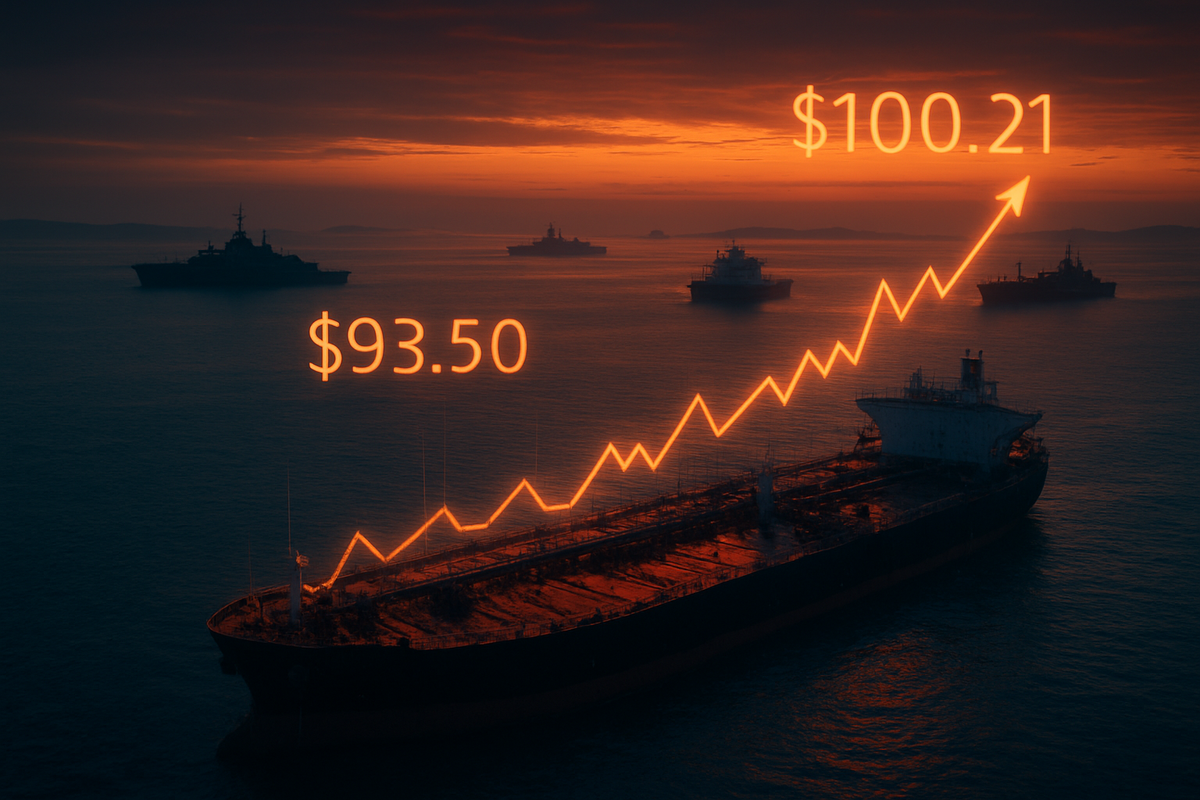
On this Tuesday, March 17, 2026, the global energy landscape is standing at a historic precipice. Following the effective closure of the Strait of Hormuz nearly three weeks ago, the International Energy Agency (IEA) has officially activated the largest coordinated emergency oil release in its 52-year history. A staggering 400 million barrels of crude oil are being flooded into a parched global market in a desperate bid to decouple global economic stability from the escalating conflict in the Middle East.
The immediate market reaction has been a display of "volatile stabilization." After peaking near $126 earlier this month, Brent Crude (ICE: BZ=F) was trading at $100.21 per barrel this morning, while West Texas Intermediate (NYMEX: CL=F) sat at $93.50. While these prices represent a slight retreat from the panic-driven highs of the initial blockade, analysts warn that the 400-million-barrel buffer acts only as a temporary "ventilator" for a global economy gasping for the 20 million barrels of daily supply currently trapped behind Iranian lines.
The Siege of Hormuz: A Timeline of Escalation
The current crisis traces its origins to February 28, 2026, when a series of targeted strikes—collectively known as "Operation Epic Fury"—were launched by U.S. and Israeli forces against Iranian nuclear and drone facilities. In a swift and devastating countermove, Tehran deployed sea mines, swarm-drone technology, and coastal missile batteries to shutter the Strait of Hormuz. By March 3, major shipping insurers had suspended all coverage for the Persian Gulf, effectively cutting off 20% of the world’s daily oil consumption.
The result has been a logistical nightmare of unprecedented proportions. Approximately 150 tankers are currently stranded, and regional energy hubs like the port of Fujairah have been rendered inactive by persistent security threats. The IEA’s decision to release 400 million barrels—with the United States contributing 172 million barrels from its Strategic Petroleum Reserve—is intended to bridge the gap while military efforts to de-mine the waterway continue. However, the physical challenge of redirecting this reserve oil to Asian markets, which rely on the Middle East for 75% of their needs, remains a significant bottleneck that is keeping the "war premium" on prices firmly in place.
Market Bifurcation: The Corporate Winners and Losers
The 2026 oil shock has created a stark divide across the equity markets. The defense sector has emerged as the primary "geopolitical hedge." Lockheed Martin (NYSE: LMT) shares reached record highs this week as the company fast-tracked orders for missile interceptors, while Northrop Grumman (NYSE: NOC) and RTX Corporation (NYSE: RTX) have seen their order books swell amidst the regional rearmament. Palantir Technologies (NYSE: PLTR) has also seen a significant uptick in valuation, with its AI-driven battlefield analytics becoming central to the coalition's naval operations in the Gulf.
Conversely, the "losers" list is dominated by fuel-sensitive industries. The aviation sector is currently in a "world of hurt." American Airlines (NASDAQ: AAL), which entered the year largely unhedged on fuel costs, has seen its profit projections decimated. United Airlines (NASDAQ: UAL) and Delta Air Lines (NYSE: DAL) have also faced double-digit stock declines as jet fuel prices mirror the surge in Brent. Logistics giants like FedEx (NYSE: FDX) and UPS (NYSE: UPS) have been forced to implement record fuel surcharges, leading to fears of a "transportation tax" that could stifle global trade even if the oil supply is eventually restored.
Energy majors are navigating a complex landscape. While ExxonMobil (NYSE: XOM) and Chevron (NYSE: CVX) are technically benefiting from $100 oil, the operational risks are extreme. BP (NYSE: BP) was forced to evacuate its non-Iraqi staff from the Rumaila field last week following drone strikes, underscoring that for the "Supermajors," high prices are currently being offset by the risk of total asset loss in the conflict zone.
A New Paradigm for Energy Security
This event marks a fundamental shift in how the world views energy security. The 2026 crisis is already being compared to the 1973 oil embargo, but with a modern twist: the weaponization of maritime chokepoints through low-cost drone technology. The IEA’s massive intervention signifies that the era of "just-in-time" energy delivery is over, replaced by a "just-in-case" strategy that prioritizes massive strategic buffers.
The broader significance lies in the potential "turbocharging" of the energy transition. NextEra Energy (NYSE: NEE) recently raised its earnings outlook, citing a surge in demand for renewables as a matter of national security. However, the transition is not uniform; even solar leaders like First Solar (NASDAQ: FSLR) have faced short-term headwinds as supply chain disruptions and macroeconomic uncertainty delay large-scale capital deployments. Policymakers are now facing a dual mandate: secure fossil fuel flows in the short term while aggressively de-risking the grid through nuclear and renewable expansion to prevent a repeat of this March 17 volatility.
The Road Ahead: De-escalation or Decoupling?
The short-term outlook depends entirely on the naval theater. If the U.S.-led coalition can successfully clear the Strait of Hormuz by April, the IEA’s 400-million-barrel release will have served its purpose as a stabilizing bridge. However, if the blockade persists through the summer, the 400-million-barrel reserve—which covers roughly 20 days of the disrupted supply—will be exhausted, potentially sending Brent prices toward the $200 mark.
Market participants should prepare for a period of "strategic decoupling" from Middle Eastern energy. We are likely to see a permanent shift in trade routes, with increased reliance on Atlantic Basin crude and trans-continental pipelines that bypass maritime chokepoints. For investors, the volatility of March 17, 2026, serves as a reminder that "geopolitical risk" is no longer a peripheral concern but a core driver of portfolio performance.
Final Assessment: A Fragile Balance
As of mid-day March 17, 2026, the global economy is in a state of suspended animation. The IEA has fired its largest shot, providing a $100-per-barrel ceiling for now, but the underlying fire in the Strait of Hormuz remains unextinguished. The key takeaway for the market is that while the IEA can provide liquidity, it cannot provide security.
Moving forward, investors must keep a close watch on the "Hormuz Clearing Rate"—the speed at which mines are removed and tanker traffic resumes. The performance of non-Hormuz tanker companies like Frontline (NYSE: FRO) and the stability of the refining sector will be the "canaries in the coal mine" for the next quarter. Today’s $93.50 WTI may look like a bargain if diplomacy fails, or an expensive peak if a ceasefire is reached. In the 2026 energy market, the only certainty is that the era of cheap, stable energy has been put on indefinite hold.
This content is intended for informational purposes only and is not financial advice.