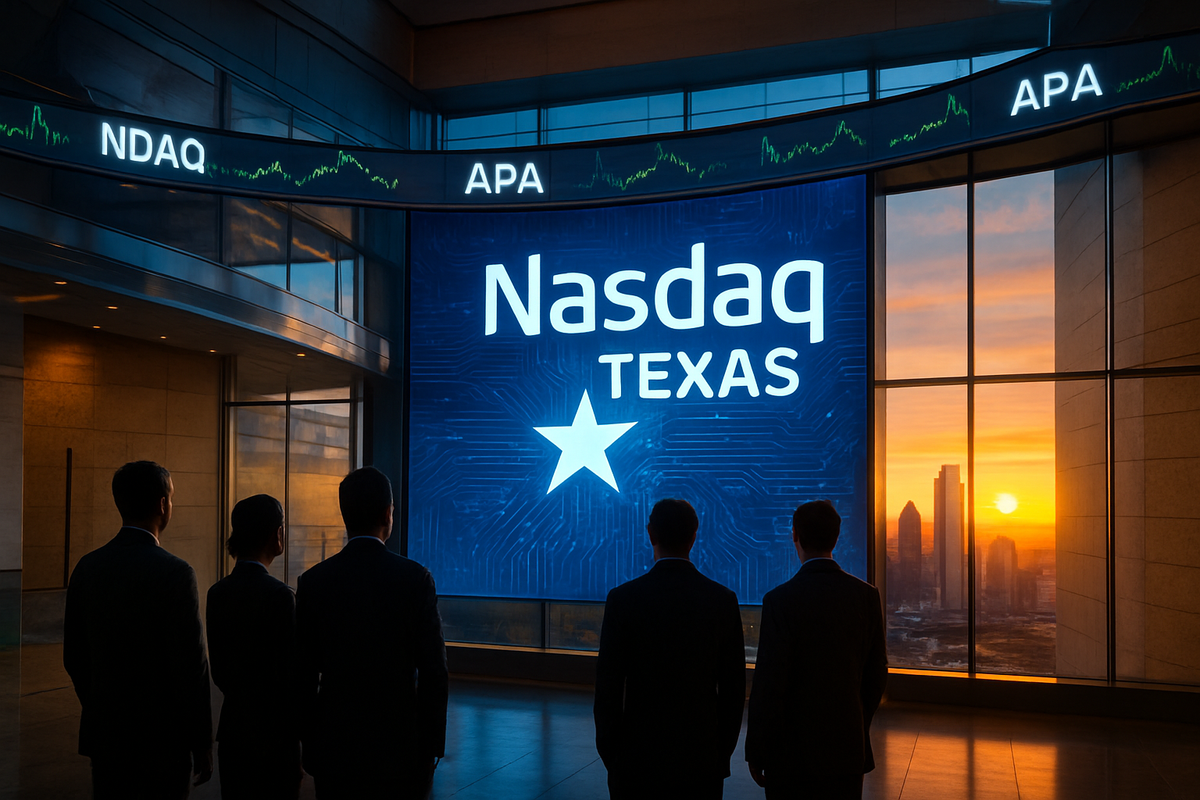
The landscape of American high finance shifted definitively toward the Sunbelt last week as Nasdaq, Inc. (NasdaqGS: NDAQ) officially pulled the curtain back on "Nasdaq Texas," a new regional exchange hub designed to capture the exploding wealth and corporate migration to the Lone Star State. In a move that signals a historic departure from the century-long centralization of markets in New York City, Houston-based energy giant APA Corporation (Nasdaq: APA) became the inaugural marquee firm to dual-list on the new venue, setting a precedent for what analysts are calling the "regionalization" of US financial infrastructure.
The immediate implications are profound: by establishing a fully functional, SEC-approved exchange headquartered in Dallas, Nasdaq has effectively preempted the much-hyped Texas Stock Exchange (TXSE), which is backed by heavyweights like BlackRock, Inc. (NYSE: BLK) and Citadel Securities. This strategic "first-mover" advantage provides Texas-based corporations with a localized platform that combines Nasdaq’s global technological reach with a governance and legal framework rooted in the Texas Business Court system—a direct challenge to the long-standing dominance of Delaware’s corporate Chancery.
A Historic Launch at the Alamo
The launch of Nasdaq Texas was nothing short of cinematic. On March 5, 2026, just six days ago, the exchange held its first "Closing Bell" ceremony at The Alamo in San Antonio. The timing was deliberate, coinciding with the eve of the 1806 anniversary of the historic battle, symbolizing a new kind of independence for Texas capital. The path to this moment began on November 12, 2025, when Nasdaq first announced its intent to create a Texas-specific exchange during a high-profile industry event in the Permian Basin. Since then, the exchange worked at a feverish pace to secure regulatory approvals and court the state’s largest energy, technology, and aerospace firms.
APA Corporation, the parent company of Apache Corp, emerged as the most critical early adopter. By dual-listing, APA maintains its primary listing on the Nasdaq Global Select Market while simultaneously carrying the "Nasdaq Texas" designation. This "unified liquidity" model is a technological breakthrough; unlike traditional dual listings that can fragment trading volume, Nasdaq Texas uses a shared order book. This ensures that investors can trade APA shares seamlessly across both venues without the risk of price discrepancies or reduced liquidity, while allowing the company to signal its commitment to the Texas economy.
Key stakeholders at the launch included APA CEO John J. Christmann IV and Nasdaq leadership, who emphasized that this wasn't just a branding exercise. The move follows years of corporate migration to Texas, where the lack of state income tax and a burgeoning tech scene in Austin have turned the state into the world’s eighth-largest economy. Initial market reaction has been cautiously optimistic, with APA shares seeing a slight "Alamo Premium"—a bump in trading volume from regional retail and institutional players eager to support the first home-grown listing of this scale.
Winners and Losers in the New Exchange War
Nasdaq stands out as the primary winner in this development. By launching ahead of the TXSE, Nasdaq has secured its territory and proved that legacy exchanges can pivot faster than many anticipated. The move effectively "out-Texased" the competition, capturing the narrative of the Texas financial boom before the TXSE could even begin its first day of trading. APA Corporation also wins by strengthening its "hometown" identity, which could prove invaluable for local talent acquisition and regional investor relations in a state that prides itself on local loyalty.
On the other side of the ledger, the Intercontinental Exchange, Inc. (NYSE: ICE), parent of the New York Stock Exchange (NYSE), finds itself in a defensive posture. Although they rebranded a regional electronic exchange as "NYSE Texas" in 2025, the lack of a high-profile, inaugural dual-listing like APA's has left them playing catch-up in the prestige department. Perhaps the biggest "loser" in this trend, however, is the state of Delaware. For decades, Delaware has been the default home for US corporations. The rise of Nasdaq Texas, coupled with the state’s new specialized Business Courts, provides a viable alternative for companies looking to escape Delaware’s increasingly scrutinized judicial system.
Financial intermediaries and local Texas banks also stand to gain. Firms like Charles Schwab Corporation (NYSE: SCHW), which moved its headquarters to Westlake, Texas, years ago, are well-positioned to serve as the primary conduits for this new regional liquidity. Conversely, smaller electronic communication networks (ECNs) that lack the scale to integrate with these new regional designations may find themselves squeezed as liquidity begins to pool around these high-profile "state-identity" hubs.
The Regionalization of US Infrastructure
The emergence of Nasdaq Texas is the clearest evidence yet of a broader trend: the de-centralization of the US financial system. For over a century, the "Wall Street" moniker defined not just a location, but a monopoly on capital. Today, the rise of "Y’all Street" reflects a shift in where wealth is created and where it wants to be managed. This event mirrors historical precedents such as the regional exchanges of the mid-20th century in cities like Philadelphia and Chicago, which eventually consolidated into the national giants we know today. However, the current trend is the reverse—a fragmentation driven by digital technology and a desire for localized governance.
Regulatory and policy implications are significant. The SEC’s approval of Nasdaq Texas as a dual-listing venue suggests a willingness to allow more competition in the exchange space, provided that market transparency and liquidity remain intact. This could trigger a ripple effect where other high-growth states, such as Florida or North Carolina, seek their own regional exchange hubs. Furthermore, the competition between the Texas Business Courts and Delaware's Chancery could lead to a "race to the top" (or bottom, depending on one's perspective) regarding corporate liability and shareholder rights.
The move also highlights a pivot in how public companies view their relationship with geography. In the age of remote work and global capital, "place" was supposed to matter less. Instead, the APA dual-listing suggests that for energy and infrastructure firms, being physically and legally tethered to a pro-industry jurisdiction like Texas offers a protective "moat" against the ESG (Environmental, Social, and Governance) pressures often associated with coastal financial centers.
What Comes Next for the Texas Market
In the short term, the market will be laser-focused on the operational success of Nasdaq Texas. If trading volumes for APA and its subsequent peers remain robust without increasing volatility, it will validate the "unified liquidity" model. We expect a flurry of additional announcements in the coming months as mid-cap energy firms and Austin-based tech companies weigh the benefits of a Texas designation. The next major milestone will be the operational debut of the TXSE later in 2026; the battle for the "soul of Texas finance" will truly begin when companies have to choose between a Nasdaq-backed venue and the independent, BlackRock-supported alternative.
Long-term, this could lead to a strategic pivot in how all major US exchanges operate. We may see a "hub-and-spoke" model where a central global engine powers various regional "front-ends" tailored to local legal and cultural preferences. Strategic adaptations will be required from institutional investors, who must now adjust their routing algorithms to account for regional designations, and from legal teams, who will need to become experts in Texas business law alongside Delaware's.
The biggest challenge will be maintaining the momentum. Regional exchanges historically fail when they cannot offer something distinct from the national incumbents. Nasdaq Texas's reliance on the Texas Business Courts is its secret weapon, but its success depends entirely on how those courts rule in their first few landmark cases. If the legal environment proves to be as stable and pro-business as advertised, the migration of corporate headquarters to Texas will only accelerate.
Closing Thoughts for Investors
The launch of Nasdaq Texas and the APA dual listing marks the end of the New York-centric era of American markets. It is a bold bet that the future of capital lies in the diversification of its infrastructure. For APA Corporation, this is a homecoming that aligns its stock ticker with its drill bits in the Permian Basin. For Nasdaq, it is a masterclass in defensive innovation, protecting its turf against upstarts by leaning into the cultural and economic zeitgeist of the South.
As we move forward into the remainder of 2026, investors should watch for the "follow-on effect." The success of this venture will be measured by the number of S&P 500 firms that follow APA’s lead. If we see a mass migration of listings to Texas-designated venues, it will signal a permanent change in the cost of capital and the nature of corporate governance in America. For now, "Y'all Street" is officially open for business, and the bell ringing at the Alamo is a sound that will likely echo across the financial world for years to come.
This content is intended for informational purposes only and is not financial advice.