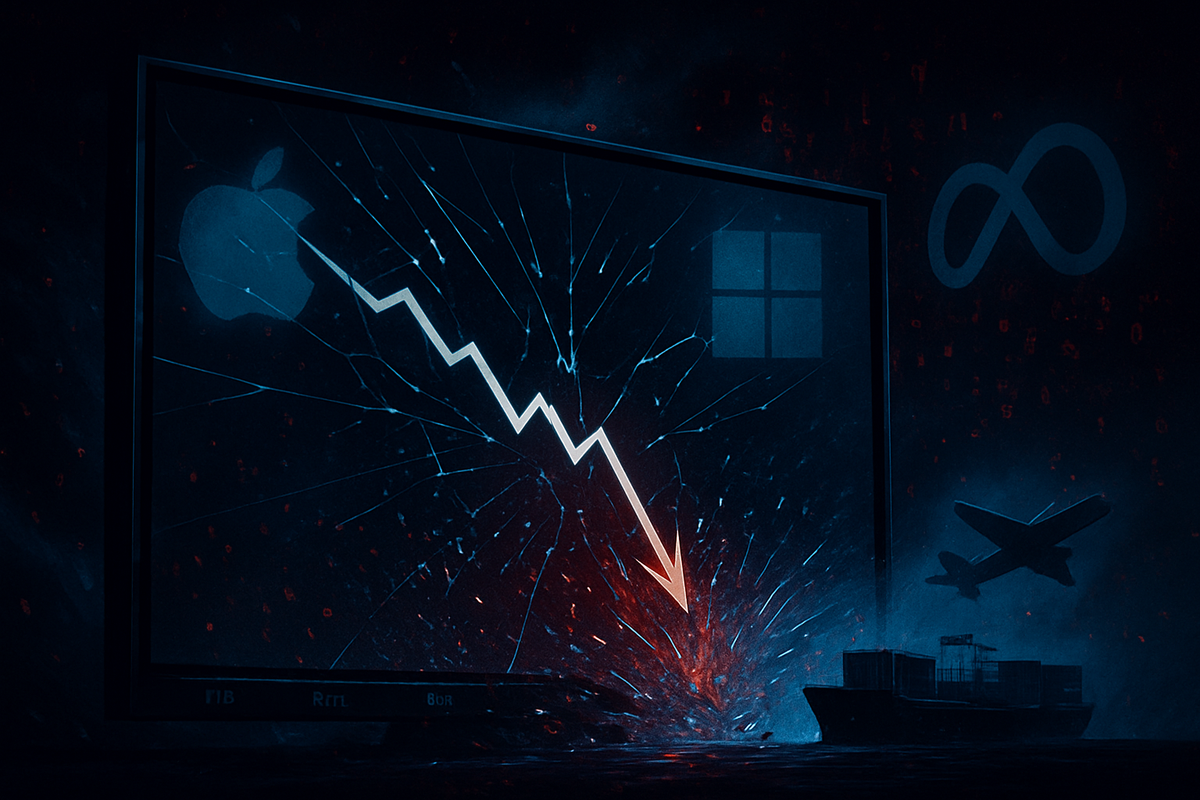
As investors and analysts navigate the geopolitical turbulence of early 2026, the market is casting a wary eye back at the "Spring Sell-Off" of 2025—a period that fundamentally reshaped the trajectory of the world’s most powerful technology companies. This time last year, the "Magnificent 7" saw a collective erasure of nearly $2 trillion in market value during a frantic window between late February and early March. The pullback was not merely a technical correction; it was a violent collision between the "AI at any cost" euphoria of 2024 and the harsh realities of global trade policy, regulatory crackdowns, and a sudden leap in AI efficiency that threatened to commoditize the very hardware fueling the boom.
Today, on January 27, 2026, as the market prepares for a pivotal earnings week and faces new "risk-off" pressures from the Greenland trade dispute, the lessons of that 2025 correction remain more relevant than ever. The events of February and March 2025 served as a "white-knuckle" moment for the industry, exposing the fragility of "priced-for-perfection" valuations and ushering in a new era of AI realism. For companies like Apple, Microsoft, and Meta, the 2025 pullback was a transformative crucible that forced a pivot from visionary promises to operational discipline.
The "White Knuckle" Correction: A Timeline of the 2025 Tech Slump
The descent began in mid-February 2025, triggered by a "perfect storm" of macroeconomic and industry-specific shocks. The primary catalyst was the emergence of "DeepSeek," a Chinese-developed AI model that claimed to match the performance of top-tier U.S. models at a fraction of the compute cost. This "efficiency shock" sent shockwaves through the market, specifically targeting Nvidia Corp. (NASDAQ: NVDA), which saw its valuation shed 20% in weeks as investors questioned the sustainability of massive capital expenditures on expensive GPU clusters. By March 10, 2025, the Roundhill Magnificent Seven ETF (NASDAQ: MAGS) recorded its worst single-session performance since its inception, plunging 5.2% in a day that traders now refer to as "Black Monday 2.0."
The pressure was compounded by a drastic shift in U.S. trade policy. In late February, the administration announced aggressive 125% tariff threats on Chinese-origin hardware, sparking a logistical frenzy. Major stakeholders, including Apple Inc. (NASDAQ: AAPL) and Microsoft Corp. (NASDAQ: MSFT), found themselves in a race against time to relocate supply chains or stockpile inventory. While inflation remained "sticky" at 2.6%, the Federal Reserve’s refusal to cut rates in early March added a layer of interest-rate sensitivity that punished high-growth tech valuations. This combination of "AI exhaustion" and "Tariff Chaos" led to a total drawdown of over 10.5% for the Mag 7 group in March alone, marking the end of the uninhibited tech rally.
Titans Under Pressure: Apple, Microsoft, and Meta Face the Music
Among the elite seven, Apple Inc. (NASDAQ: AAPL) bore the brunt of the supply chain anxiety. In a move that underscored the desperation of the moment, Apple reportedly chartered a massive cargo airlift in March 2025 to move over 1.5 million iPhones from India to the U.S. to bypass impending duties. Simultaneously, internal delays in their "Personalized Siri" AI suite—pushed to 2026 due to unacceptable error rates—led to a 20% year-to-date correction by the end of March. For a company usually defined by seamless execution, the spring of 2025 was a rare moment of visible vulnerability.
Microsoft Corp. (NASDAQ: MSFT) and Meta Platforms Inc. (NASDAQ: META) faced their own "cost-of-innovation" reckoning. Microsoft’s stock fell 7% in a single session following its late January report, despite beating most metrics, because it missed its Azure growth target by a razor-thin 0.6%. Gene Munster of Deepwater Asset Management noted at the time that the market had developed a "hyper-sensitivity to AI ROI." Meanwhile, Meta faced a $70 billion capital expenditure outlook that spooked investors, compounded by the delay of its frontier AI model, "Avocado," and a $228 million European regulatory fine. While Meta remained the most resilient of the group—finishing the quarter down only 2%—the narrative had shifted from "Meta's Year of Efficiency" to "Meta's Decade of Spending."
A New Era of AI Realism: Lessons from the 2025 Pullback
The significance of the 2025 pullback extends beyond mere stock prices; it marked the end of the "hype cycle" and the beginning of the "utility cycle" in artificial intelligence. This event fits into the broader historical precedent of the mid-1990s internet boom, where initial excitement was followed by a "shakeout" of companies unable to monetize the new technology. The 2025 correction forced the "S&P 493" (the rest of the index) into the spotlight, as capital rotated out of concentrated tech and into undervalued sectors like regional banks, utilities, and small-cap stocks represented by the Russell 2000.
Regulatory and policy implications also reached a boiling point during this period. The European Union’s aggressive enforcement of the Digital Markets Act (DMA), which led to nearly $1 billion in combined fines for Apple and Meta in early 2025, signaled that the era of "regulatory immunity" for Big Tech was over. Furthermore, the tariff-induced supply chain disruptions forced a permanent pivot toward "friend-shoring" in India and Vietnam, a move that continues to affect the margins of hardware companies in 2026. The 2025 pullback was the market’s way of pricing in the geopolitical risk that had been largely ignored during the 2023-2024 bull run.
The Road to 2026: Is History Repeating?
As we look toward the remainder of 2026, the ghosts of the 2025 pullback continue to haunt the markets. The current "Greenland Dispute" and the subsequent 10-25% tariff threats against European allies mirror the "Tariff Chaos" of last February. However, the strategic pivots made by the Magnificent 7 in the wake of 2025 have left them better prepared. Microsoft has diversified its compute sources, and Alphabet Inc. (NASDAQ: GOOGL) has emerged as a leader in AI efficiency, leading the group with a 7.1% gain so far this year.
The short-term outlook remains cautious as we enter the heart of the Q4 2025 earnings season this week. With four of the Mag 7 reporting, investors are looking for "proof of life" in AI profitability rather than just "proof of concept." The market opportunity now lies in "AI integration" rather than "AI infrastructure," as the hardware-heavy focus of 2024 has been replaced by a search for software-driven margins. The scenario for 2026 is one of divergence: the "Magnificent 7" is no longer a monolith, and the companies that successfully navigated the 2025 correction are now the ones leading a more sustainable, albeit slower, growth path.
The Resilient Bull and the Road Ahead
The 2025 "Spring Sell-Off" was a necessary, if painful, correction that drained the excess from a burgeoning AI bubble. The key takeaway for investors is that concentration is a double-edged sword; while the Magnificent 7 can drive index-wide gains, they also harbor the greatest capacity for rapid, synchronized declines. The market moving forward into 2026 is one defined by "quality and efficiency"—companies must now prove they can grow earnings while managing ballooning CapEx and a fractured geopolitical landscape.
In the coming months, investors should closely watch the Federal Reserve’s response to the current "Greenland" volatility and whether the tariff threats of 2026 will cause a repeat of the 2025 shipping frenzy. While the tech bull cycle remains intact for the long term, as noted by Wedbush's Dan Ives, the "white-knuckle" periods are now a standard feature of the market. The transition from the "Mag 7" to a more diversified market leadership is well underway, and those who learned the lessons of February 2025 are likely the ones who will thrive in the uncertainties of 2026.
This content is intended for informational purposes only and is not financial advice.