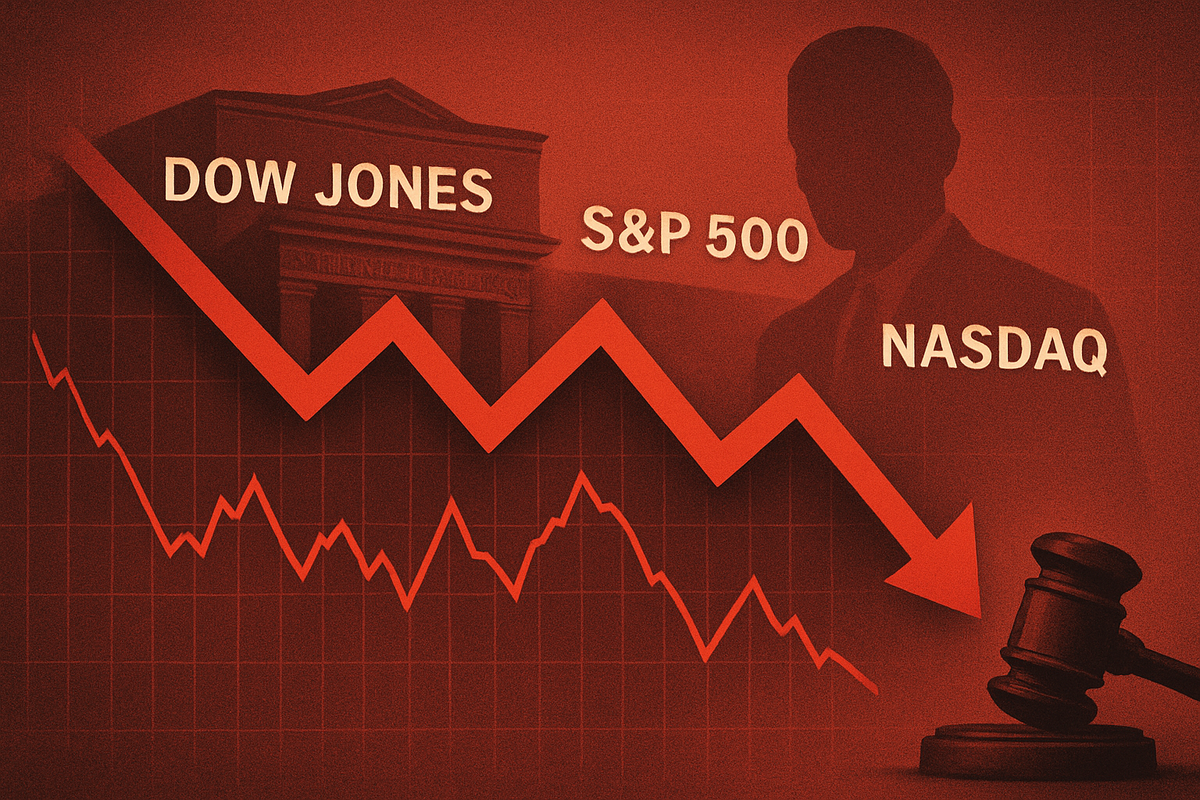
New York, NY – December 8, 2025 – Major U.S. stock indices, including the Dow Jones Industrial Average, S&P 500, and Nasdaq Composite, registered declines today as investors adopted a cautious stance ahead of a pivotal Federal Reserve decision. The market's apprehension reflects deep uncertainty surrounding the central bank's next move on monetary policy, with traders and analysts scrutinizing every economic signal for clues on future interest rate trajectory.
The subdued trading session saw a broad-based retreat, signaling a "risk-off" mood across Wall Street. With inflation concerns persisting and the labor market showing mixed signals, the looming Federal Open Market Committee (FOMC) announcement has become the focal point, overshadowing other economic news and corporate earnings reports. The market's current volatility underscores the significant impact that the Fed's rhetoric and actions have on investor confidence and asset valuations.
Anticipation Builds as Fed Decision Looms Large
Today's market downturn is the culmination of weeks of heightened anticipation and speculative positioning leading up to the Federal Reserve's crucial monetary policy meeting. The Federal Open Market Committee (FOMC), the central bank's primary policymaking body, convenes for eight regularly scheduled meetings each year, and the current session has drawn intense scrutiny. The timeline leading to this moment has been characterized by a steady stream of economic data releases, each contributing to the market's evolving expectations.
In the weeks preceding this decision, investors have closely watched key economic indicators such as the Personal Consumption Expenditures (PCE) price index, the Fed's preferred measure of inflation, alongside the Consumer Price Index (CPI). Recent readings have shown inflation remaining stubbornly above the Fed's 2% target, fueling concerns that the central bank may need to maintain a restrictive monetary policy for longer or even consider further tightening. Simultaneously, employment data, including the unemployment rate and non-farm payrolls, has been closely monitored for signs of either a resilient or weakening labor market, both of which carry implications for wage growth and inflationary pressures.
The Federal Reserve Chairman, who also chairs the FOMC, plays a pivotal role in guiding monetary policy discussions and communicating the committee's stance to the public. Their public statements and the official policy statement released after the meeting are dissected for any shifts in language or forward guidance. The market's current jitters reflect the uncertainty about whether the Fed will signal a pause, a continued hawkish stance, or a more dovish pivot, all of which have profound implications for borrowing costs, corporate earnings, and overall economic growth. The "blackout period," during which Fed officials refrain from public comments, further amplifies market speculation in the days leading up to the announcement.
Initial market reactions have been predictably cautious, with investors de-risking their portfolios. Technology and growth stocks, often more sensitive to interest rate expectations due to their reliance on future earnings, have seen particular pressure. The broader market's decline suggests a collective anxiety about the potential for higher-for-longer interest rates, which could dampen economic activity and corporate profitability.
Companies Poised to Win or Lose in a Shifting Rate Environment
The impending Federal Reserve decision carries significant implications for a diverse array of public companies, creating both potential winners and losers depending on the central bank's chosen path. A hawkish stance, implying higher interest rates or a prolonged period of elevated rates, generally benefits sectors like banking and insurance while posing challenges for highly leveraged companies and growth-oriented technology firms. Conversely, a more dovish pivot, suggesting rate cuts or a more accommodative stance, typically provides a tailwind for growth stocks and companies sensitive to consumer spending.
Financial institutions, such as JPMorgan Chase & Co. (NYSE: JPM) and Bank of America Corp. (BAC), often stand to benefit from higher interest rates. An increase in the federal funds rate typically translates to a wider net interest margin (NIM) for banks, as the rates they charge on loans (e.g., mortgages, credit cards) rise faster than the interest they pay on deposits. This can boost their profitability and strengthen their balance sheets. Similarly, insurance companies like MetLife Inc. (NYSE: MET) could see improved investment income from their fixed-income portfolios in a higher-rate environment.
On the other hand, sectors heavily reliant on borrowing for expansion or consumer discretionary spending face headwinds. Technology giants such as Apple Inc. (NASDAQ: AAPL) and Microsoft Corp. (NASDAQ: MSFT), while robust, can see their valuations pressured by higher discount rates applied to their future earnings in a rising rate environment. Smaller, high-growth technology firms, often unprofitable and dependent on venture capital or debt for funding, become particularly vulnerable as borrowing costs increase and investor appetite for riskier assets diminishes. Companies with significant debt loads, irrespective of sector, also face higher interest expenses, which can erode profitability.
The housing and automotive sectors are also highly sensitive. Homebuilders like D.R. Horton Inc. (NYSE: DHI) and automotive manufacturers such as General Motors Co. (NYSE: GM) could see demand soften if mortgage rates and auto loan rates climb, making big-ticket purchases less affordable for consumers. Conversely, a signal for rate cuts could ignite renewed interest in these sectors, stimulating demand and boosting sales. Investors are keenly watching the Fed's language for cues on how these dynamics might play out in the coming quarters.
Broader Economic Implications and Historical Context
The Federal Reserve's impending decision extends far beyond the immediate market fluctuations, carrying significant implications for broader industry trends, economic growth, and even global financial stability. The central bank's stance on interest rates is a critical lever in managing inflation and employment, and its actions ripple through every facet of the economy, influencing everything from consumer borrowing costs to corporate investment decisions.
In the current environment, the Fed's decision will be viewed through the lens of ongoing inflation concerns and the resilience of the labor market. A continued hawkish posture, aimed at taming inflation, could further tighten financial conditions, potentially slowing economic growth and increasing the risk of a recession. This would affect industries broadly, impacting consumer discretionary spending, capital expenditure by businesses, and the overall pace of economic expansion. Conversely, a more accommodative stance, while potentially easing immediate economic pressures, could reignite inflationary forces, presenting a different set of challenges.
The potential ripple effects are extensive. For instance, tighter monetary policy in the U.S. can strengthen the U.S. dollar, making American exports more expensive and impacting multinational corporations like Coca-Cola Co. (NYSE: KO) and Procter & Gamble Co. (NYSE: PG) that derive a significant portion of their revenue from international markets. Emerging markets, often sensitive to U.S. interest rate changes, could also experience capital outflows and currency depreciation. Regulatory bodies will also be closely monitoring the Fed's decision, as it could influence future policy considerations regarding financial stability and consumer protection.
Historically, periods of significant monetary policy shifts have often been accompanied by increased market volatility. Comparisons are being drawn to previous cycles of aggressive rate hikes, such as those in the early 1980s under Paul Volcker, or more recently, the post-financial crisis tapering debates. While each economic cycle is unique, these historical precedents offer insights into how markets and the economy can react to sustained efforts by the Fed to either cool an overheating economy or stimulate growth. The challenge for the Fed lies in achieving a "soft landing" – bringing inflation down without triggering a severe economic downturn.
The Road Ahead: Navigating Post-Decision Scenarios
As the market awaits the Federal Reserve's verdict, the road ahead presents a spectrum of short-term and long-term possibilities, demanding strategic pivots and adaptability from investors and corporations alike. The immediate aftermath of the announcement is likely to be characterized by heightened volatility, as markets digest the Fed's policy statement, the Chairman's press conference, and any shifts in forward guidance.
In the short term, if the Fed delivers a more hawkish message than anticipated, signaling a longer period of high rates or even further hikes, we could see continued pressure on equity markets, particularly growth stocks, and a further strengthening of the U.S. dollar. Conversely, a surprisingly dovish tone, indicating a potential pause or future rate cuts, could trigger a relief rally across risk assets. Companies will need to quickly assess the implications for their borrowing costs, capital expenditure plans, and consumer demand.
Looking further ahead, the Fed's decision will shape the economic landscape for months to come. A sustained period of restrictive monetary policy could lead to a more pronounced economic slowdown, potentially pushing the economy into a recession. In such a scenario, defensive sectors like utilities and consumer staples, represented by companies such as NextEra Energy Inc. (NYSE: NEE) and Walmart Inc. (NYSE: WMT), might outperform. However, if the Fed manages to engineer a soft landing, gradually bringing inflation down without stifling growth, it could set the stage for a more sustained market recovery in the latter half of 2026.
Strategic pivots will be essential. Companies may need to re-evaluate their debt structures, focus on cost efficiencies, and potentially scale back expansion plans in a higher-rate environment. Investors, too, will need to adjust their portfolios, perhaps favoring value stocks over growth, or increasing allocations to fixed-income assets if bond yields become more attractive. Emerging market opportunities or challenges will also depend on the global impact of the Fed's decision, requiring careful consideration of international diversification.
Wrapping Up: A Market at the Crossroads
Today's market downturn, driven by the anticipation of a crucial Federal Reserve decision, underscores the central bank's unparalleled influence on financial markets and the broader economy. The key takeaway is the profound uncertainty surrounding the Fed's next move, which has led to a collective "wait and see" approach among investors, resulting in a broad-based retreat across the Dow, S&P 500, and Nasdaq. The ongoing battle against inflation, coupled with the Fed's dual mandate of price stability and maximum employment, places the market at a critical crossroads.
Moving forward, the market's trajectory will be heavily dictated by the Federal Reserve's immediate policy announcement and its accompanying forward guidance. A hawkish stance could prolong market volatility and economic headwinds, while a more dovish pivot could inject renewed optimism. Investors should prepare for continued fluctuations and potentially significant shifts in sector performance depending on the Fed's interpretation of economic data and its commitment to its inflation targets.
The lasting impact of this decision will resonate throughout 2026 and beyond, shaping corporate strategies, consumer behavior, and global capital flows. What investors should watch for in the coming months includes not only the immediate market reaction but also subsequent economic data releases, particularly on inflation and employment, as well as any further communications from Fed officials. These will provide crucial insights into the long-term path of monetary policy and the overall health of the economy. The prudent investor will remain agile, diversified, and informed, ready to adapt to the evolving economic landscape shaped by the Federal Reserve's powerful hand.
This content is intended for informational purposes only and is not financial advice