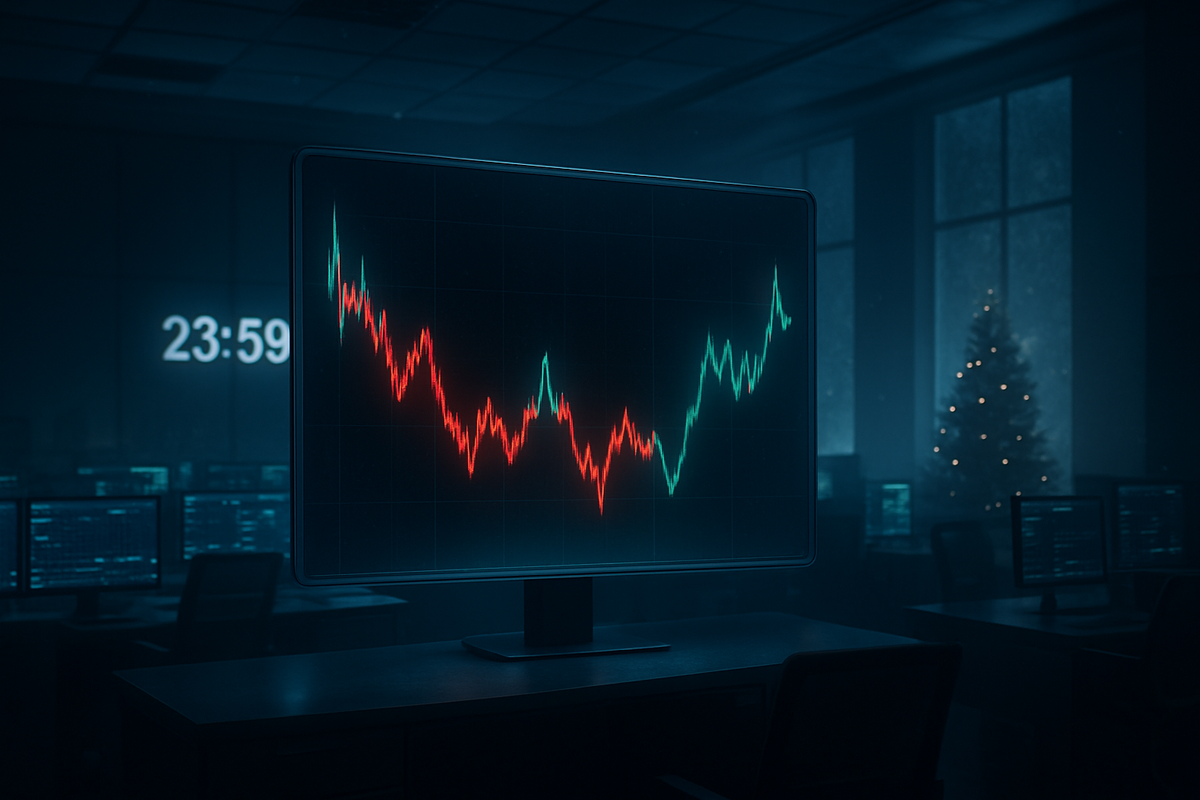
As the sun sets on the final trading sessions of 2025, the global financial markets are entering a period of deceptive calm. With many institutional desks shuttered for the holidays and trading volumes plummeting by as much as 50%, the remaining "thin" market has become a playground for extreme volatility. While the traditional "Santa Claus Rally" remains a historical hope, the current environment is fraught with unique 2025-specific risks—ranging from a looming "fiscal cliff" in Washington to a tense naval blockade in South America—that could turn a quiet afternoon into a liquidity-driven flash crash.
For investors, the final days of December are less about fundamental shifts and more about the mechanics of the market. With fewer buyers and sellers at the table, even modest orders can trigger outsized price movements. This "liquidity vacuum" means that bid-ask spreads are widening across major indices like the SPDR S&P 500 ETF Trust (NYSE Arca: SPY) and the Invesco QQQ Trust (NASDAQ: QQQ), making the cost of entry higher and the risk of "slippage" a very real threat for those attempting to rebalance portfolios before the year-end buzzer.
The Ghost of Liquidity Past: Why December 2025 is Different
The week between Christmas and New Year’s Day has historically been a low-volume affair, but 2025 presents a particularly volatile cocktail of events. On Wednesday, December 24, U.S. markets are scheduled for an early close at 1:00 PM ET, a window that often sees the lowest participation of the year. However, this year’s "quiet tape" is being challenged by a series of high-stakes deadlines. Most notably, the "Fiscal Cliff" of 2025 looms on December 31, as major provisions of the 2017 Tax Cuts and Jobs Act and enhanced ACA subsidies are set to expire. Legislative gridlock in D.C. has left the market guessing, and in a thin environment, any headline regarding a "no-deal" scenario could trigger a rapid, mechanical sell-off.
Furthermore, the final week of 2025 is not devoid of economic data. Following the final U.S. Q3 GDP reading and Consumer Confidence reports on December 23, the market is hypersensitive to "hard landing" fears. While the S&P 500 is hovering near the psychological 7,000 level, the lack of market depth means that algorithms—rather than humans—are largely in control of price action. These automated systems are programmed to react to volatility, which can create a feedback loop where a small price drop triggers a cascade of selling, as seen in previous "flash crash" events during holiday sessions.
Winners and Losers: Strategic Plays in a Volatile Window
In the energy sector, the contrast between industry leaders has sharpened. ExxonMobil (NYSE: XOM) has emerged as a defensive winner, buoyed by a strategic update that added $5 billion to its expected earnings without increasing capital expenditure. In contrast, Chevron (NYSE: CVX) has faced downward pressure due to ongoing arbitration hurdles regarding its merger with Hess Corporation. In a thin market, XOM’s robust buyback program has acted as a stabilizer, while CVX has been more susceptible to year-end tax-loss harvesting by institutional investors.
The "AI Kings" continue to dominate the narrative, though with varying degrees of holiday resilience. Nvidia (NASDAQ: NVDA) remains the market’s "liquidity king," with demand for its Blackwell systems providing a fundamental floor that prevents the stock from drifting too far during low-volume sessions. Microsoft (NASDAQ: MSFT), meanwhile, has served as a "liquidity buffer," with its massive market cap allowing it to absorb institutional block trades that would otherwise disrupt smaller names. However, the risk for tech-heavy portfolios lies in the "AI jitters"—if any negative news regarding 2026 AI profitability emerges during this week, the QQQ could see rapid gap-downs as liquidity vanishes.
Retail giants are also under the microscope following a record-breaking $1 trillion holiday shopping season. Walmart (NYSE: WMT) has been the undisputed fundamental winner, capturing market share through its value-plus strategy and AI-driven logistics. Amazon (NASDAQ: AMZN), while hitting all-time highs, has shown higher sensitivity to sentiment shifts. For market makers like Virtu Financial (NASDAQ: VIRT), the low-volume period is a double-edged sword. While wider spreads can increase profitability per trade, the risk of "toxic" inventory—stocks that crash when volume returns in January—forces these firms to utilize aggressive algorithmic hedging and "quote canceling" strategies to protect their capital.
Geopolitics and the "Jan 2" Reversal Risk
Beyond the balance sheets, the wider significance of this year's thin trading is tied to escalating geopolitical tensions. The U.S. blockade of Venezuelan oil tankers in late December has sent shockwaves through the energy markets, with oil and gold prices testing multi-year highs. In a normal market, such news might be absorbed gradually; in a thin holiday market, a single naval incident could cause an immediate and violent spike in commodity-linked equities. Similarly, trade war escalations with China, involving retaliatory dairy tariffs on the EU, are casting a long shadow over the 2026 outlook.
Historically, the "Santa Claus Rally" provides a 1.3% average gain for the S&P 500 during the final five days of December and the first two of January. However, the 2025 context suggests a potential "Jan 2 Reversal." As institutions return to full strength on the first trading day of the new year, they often rebalance portfolios and realize gains from the previous year’s rally. Given that the S&P 500 has surged approximately 17% in 2025, the incentive for profit-taking is high. If the thin trading of late December pushes prices artificially high, the "snap-back" in early January could be particularly painful for retail investors who bought into the year-end hype.
The Road to 2026: What Comes Next?
As we look toward the first quarter of 2026, the primary challenge for the market will be transitioning from a "liquidity-driven" environment back to one driven by fundamentals. The strategic pivots required by major tech firms to prove AI profitability will be the dominant theme. Investors should watch for a shift in central bank policy; with the Bank of Japan hiking rates and the ECB signaling an end to easing, the era of "easy money" is facing a coordinated global tightening. This shift will likely increase bond yields and put further pressure on high-valuation growth stocks.
In the short term, the "Fiscal Cliff" resolution—or lack thereof—will dictate the market's opening tone for 2026. If a deal is reached to extend tax credits, we could see a relief rally that carries the SPY well past the 7,000 mark. Conversely, a failure to act could lead to a significant contraction in consumer spending and a re-evaluation of the "soft landing" narrative. Market participants must remain agile, as the low-liquidity environment of late December often serves as a "pre-shock" for the trends that will define the coming year.
Navigating the Final Bell
The key takeaway for the final days of 2025 is caution. While the headlines may suggest a quiet end to a blockbuster year, the underlying mechanics of the market are currently fragile. The combination of low volume, widening spreads, and significant geopolitical and fiscal overhangs means that "thin trading" is anything but boring. Investors should be wary of chasing late-season rallies and instead focus on the quality of their holdings and their exposure to sudden liquidity shocks.
Moving forward, the market will be defined by how it handles the return of institutional volume in January. Watch for the "Jan 2" price action as a barometer for 2026 sentiment. If the market holds its gains despite the return of sellers, it will signal continued confidence in the AI-driven expansion. If not, the "liquidity vacuum" of December 2025 may be remembered as the peak of the cycle. For now, the best strategy is to monitor the "Fiscal Cliff" negotiations and the headlines from the South American coast, as these will be the true drivers of the market's final moves of the year.
This content is intended for informational purposes only and is not financial advice.