Market projected to grow from USD 8.1 Billion in 2026 to USD 85.0 Billion by 2036, driven by Industry 4.0 adoption, smart city infrastructure, and expansion of ultra-low-latency 5G connectivity.
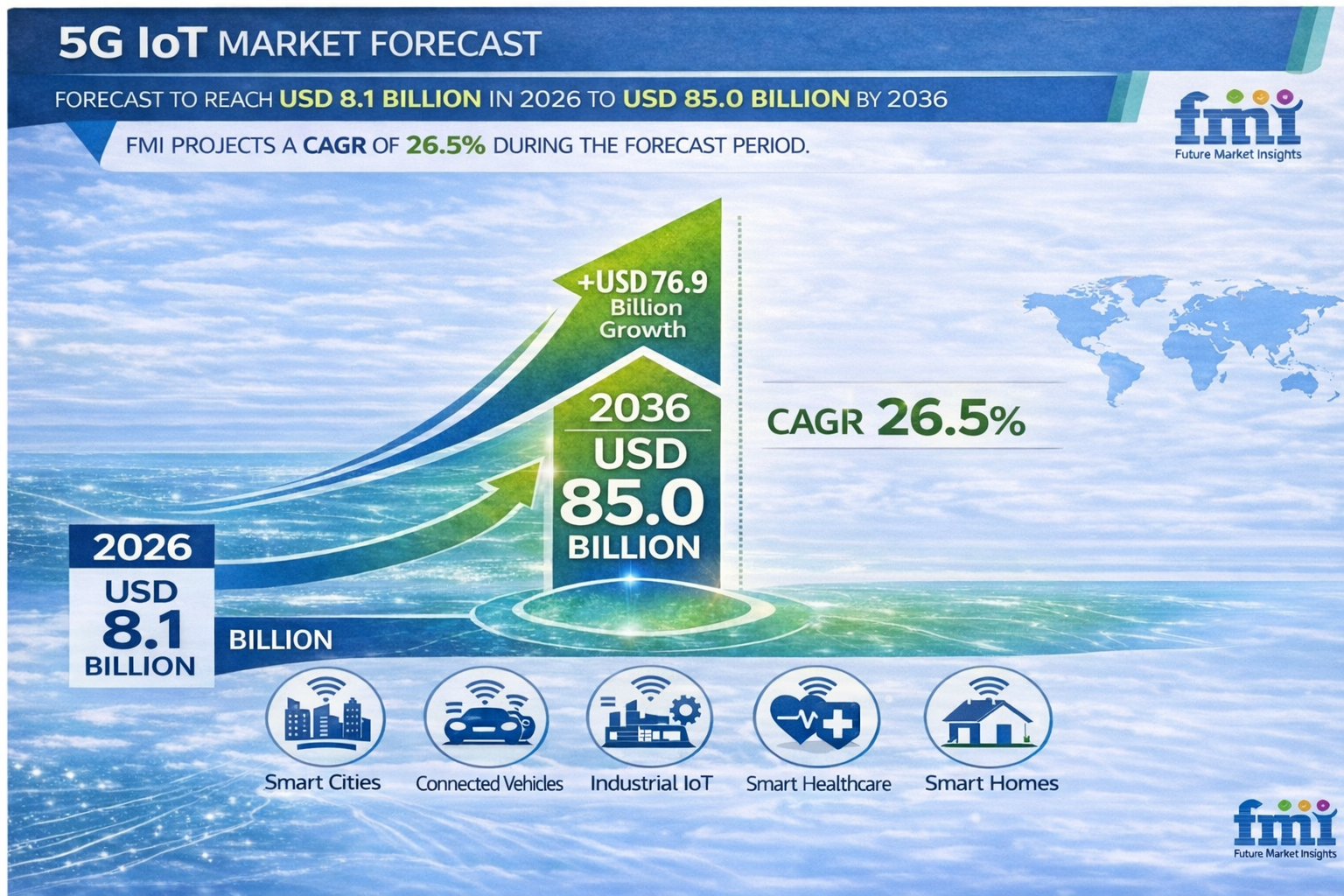
NEWARK, DE / ACCESS Newswire / March 13, 2026 / The global 5G IoT market is entering a transformative expansion phase as next-generation connectivity reshapes industrial automation, smart infrastructure, and connected device ecosystems. Valued at USD 6.2 billion in 2025, the market is projected to reach USD 8.1 billion in 2026 and expand dramatically to USD 85.0 billion by 2036, registering a CAGR of 26.5% during the forecast period.
This rapid expansion reflects the convergence of 5G connectivity, edge computing, and IoT device ecosystems, enabling ultra-reliable low-latency communication and massive machine-type connectivity. Enterprises across manufacturing, energy, logistics, healthcare, and smart city infrastructure are increasingly deploying 5G-enabled IoT solutions to support real-time automation, predictive analytics, and mission-critical operations.
With billions of connected devices expected to come online over the next decade, the 5G IoT ecosystem is evolving into a foundational layer for digital transformation across industries.
Get Access of Report Sample:
https://www.futuremarketinsights.com/reports/sample/rep-gb-14542
Market Value Analysis: Industrial Automation and Smart Infrastructure Driving Demand
Between 2026 and 2030, the 5G IoT market is expected to witness accelerated deployment as telecommunications providers expand 5G Standalone networks and enterprises implement private 5G connectivity solutions within industrial environments.
Industry 4.0 initiatives are pushing factories toward fully connected production systems where machines, robots, and sensors exchange data in real time. This environment requires deterministic wireless connectivity, low latency, and high device density - capabilities that traditional wireless networks cannot consistently provide.
The second phase of market expansion between 2030 and 2036 will be supported by the widespread integration of edge computing platforms, which process data closer to devices and reduce dependence on centralized cloud infrastructure.
The combination of network slicing, edge computing, and AI-enabled IoT devices will allow enterprises to deploy highly specialized digital infrastructure tailored to industry-specific applications.
Technology Evolution: 5G and Edge Computing Enable Massive Device Connectivity
The rapid adoption of 5G IoT solutions is supported by several key technology advancements that enable real-time communication between billions of devices.
Modern 5G IoT platforms integrate multiple advanced technologies including:
• 5G Standalone (SA) network architecture enabling ultra-low-latency communication
• Network slicing technology that allocates dedicated bandwidth for mission-critical applications
• Edge computing nodes processing data locally to reduce latency and bandwidth usage
• AI-enabled IoT devices capable of real-time analytics and automation
• Massive machine-type communication (mMTC) supporting extremely high device density
Together, these technologies enable large-scale IoT deployments across industrial environments, transportation networks, energy systems, and urban infrastructure.
An industry analyst explains:
"5G IoT represents a fundamental shift in digital infrastructure. Instead of simply connecting devices, the technology enables real-time control systems where machines, sensors, and analytics platforms operate in synchronized ecosystems."
Industry Adoption: Enterprises Deploy Private 5G Networks
Many enterprises are deploying private 5G networks to maintain control over connectivity, security, and performance within mission-critical environments.
Manufacturing facilities, ports, and logistics hubs are among the earliest adopters, leveraging private networks to support autonomous vehicles, robotic automation, and predictive maintenance systems.
Industrial IoT deployments enabled by 5G allow organizations to:
• Monitor equipment performance in real time
• Enable machine-to-machine communication across production lines
• Deploy AI-powered predictive maintenance systems
• Improve supply chain visibility and automation
• Support autonomous robotics and logistics vehicles
These capabilities are significantly improving productivity and operational efficiency across industrial sectors.
Segment Spotlight
Hardware Components Lead Market Segment (41.7%)
Hardware components - including IoT modules, edge gateways, sensors, and radio devices - account for approximately 41.7% of the market, reflecting the physical expansion of connected infrastructure required to support large-scale IoT networks.
As enterprises deploy millions of connected devices across factories, utilities, and smart city networks, demand for AI-ready chipsets and compact communication modules is rapidly increasing.
5G Standalone Networks Dominate Network Type (55.3%)
5G Standalone (SA) architecture represents around 55.3% of the market, as it enables core capabilities required for industrial IoT such as network slicing, ultra-low latency, and deterministic connectivity.
SA networks remove dependence on legacy 4G cores, allowing telecommunications providers to deliver fully virtualized, cloud-native 5G services designed for enterprise environments.
Regional Insights: Key Growth Markets
Country |
CAGR (2026-2036) |
Key Growth Drivers |
|---|---|---|
China |
30.5% |
Large-scale industrial digitization and massive IoT infrastructure |
India |
28.0% |
Smart city initiatives and rapid 5G network expansion |
United Kingdom |
26.5% |
Government investment in digital infrastructure |
Germany |
25.0% |
Industry 4.0 leadership and manufacturing automation |
United States |
22.0% |
Enterprise 5G adoption and private network deployment |
Asia-Pacific is expected to emerge as the largest growth hub, driven by rapid industrial automation, smart city projects, and aggressive 5G infrastructure investment across China, India, Japan, and South Korea.
Smart Cities and Industrial Automation Fuel Market Expansion
Smart city development is one of the most powerful growth drivers for 5G IoT infrastructure.
Urban planners are deploying large-scale sensor networks to monitor traffic systems, environmental conditions, public safety infrastructure, and energy distribution networks.
5G connectivity enables real-time monitoring of:
• Traffic congestion and autonomous transportation systems
• Energy grid performance and smart utility networks
• Environmental monitoring sensors
• Public safety communication systems
• Connected healthcare infrastructure
These deployments require ultra-reliable wireless communication capable of supporting millions of connected devices across densely populated environments.
Competitive Landscape: Telecom and Technology Firms Expanding Ecosystems
The 5G IoT market includes a diverse ecosystem of telecommunications operators, semiconductor companies, cloud platform providers, and IoT solution developers.
Leading companies operating in the market include:
China Mobile Limited
AT&T Inc.
Verizon Communications Inc.
T-Mobile US, Inc.
Vodafone Group Plc
Ericsson AB
Huawei Technologies Co., Ltd.
Nokia Corporation
Samsung Electronics Co., Ltd.
Qualcomm Technologies, Inc.
Intel Corporation
Cisco Systems, Inc.
Microsoft Corporation (Azure)
Amazon Web Services, Inc.
Google LLC
Strategic partnerships between telecom operators, cloud hyperscalers, and industrial technology providers are accelerating deployment of scalable 5G IoT ecosystems worldwide.
Future Outlook: 5G IoT Becoming Core Infrastructure for Digital Economies
Looking toward 2036, the 5G IoT market is expected to become a foundational technology supporting autonomous systems, smart cities, industrial automation, and real-time data ecosystems.
Key trends shaping the future market include:
• Expansion of private 5G networks for enterprises
• Integration of AI-driven edge computing platforms
• Growth of industrial digital twins and predictive analytics
• Deployment of autonomous vehicles and robotic logistics systems
• Development of 5G-Advanced and next-generation IoT devices
As digital transformation accelerates across industries, 5G IoT infrastructure will play a central role in enabling hyper-connected, intelligent systems that power the next generation of global economic growth.
For an in-depth analysis of evolving formulation trends and to access the complete strategic outlook for the 5G IoT Market through 2036, visit the official report page at: https://www.futuremarketinsights.com/reports/5g-iot-market
Brows More Technology Industry Reports:
Food Recall Readiness & Mock Recall Management Platforms Market - https://www.futuremarketinsights.com/reports/food-recall-readiness-and-mock-recall-management-platforms-market
Network Equipment Market - https://www.futuremarketinsights.com/reports/network-equipment-market
Electric Linear Actuator Market - https://www.futuremarketinsights.com/reports/electric-linear-actuator-market
3D Printing in Aerospace and Defense Market - https://www.futuremarketinsights.com/reports/3d-printing-in-aerospace-and-defense-market
Waste Management Market - https://www.futuremarketinsights.com/reports/waste-management-market
About Future Market Insights (FMI)
Future Market Insights (FMI) is a leading provider of market intelligence and consulting services, serving clients in over 150 countries. Headquartered in Delaware, USA, with a global delivery center in India and offices in the UK and UAE, FMI delivers actionable insights to businesses across industries including automotive, technology, consumer products, manufacturing, energy, and chemicals.
An ESOMAR-certified research organization, FMI provides custom and syndicated market reports and consulting services, supporting both Fortune 1,000 companies and SMEs. Its team of 300+ experienced analysts ensures credible, data-driven insights to help clients navigate global markets and identify growth opportunities.
For Press & Corporate Inquiries
Rahul Singh
AVP - Marketing and Growth Strategy
Future Market Insights, Inc.
+91 8600020075
For Sales - sales@futuremarketinsights.com
For Media - Rahul.singh@futuremarketinsights.com
For web - https://www.futuremarketinsights.com/
SOURCE: Future Market Insights, Inc.
View the original press release on ACCESS Newswire