In a definitive shift for the artificial intelligence industry, Anthropic has moved beyond the era of static text generation and into the realm of autonomous action. With the introduction and subsequent evolution of its "Computer Use" capability for the Claude 3.5 Sonnet model—and its recent integration into the powerhouse Claude 4 series—the company has fundamentally changed how humans interact with software. No longer confined to a chat interface, Claude can now "see" a digital desktop, move a cursor, click buttons, and type text, effectively operating a computer in the same manner as a human professional.
This development marks the transition from Generative AI to "Agentic AI." By treating the computer screen as a visual environment to be navigated rather than a set of code-based APIs to be integrated, Anthropic has bypassed the traditional "walled gardens" of software. As of January 6, 2026, what began as an experimental public beta has matured into a cornerstone of enterprise automation, enabling multi-step workflows that span across disparate applications like spreadsheets, web browsers, and internal databases without requiring custom integrations for each tool.
The Mechanics of Digital Agency: How Claude Navigates the Desktop
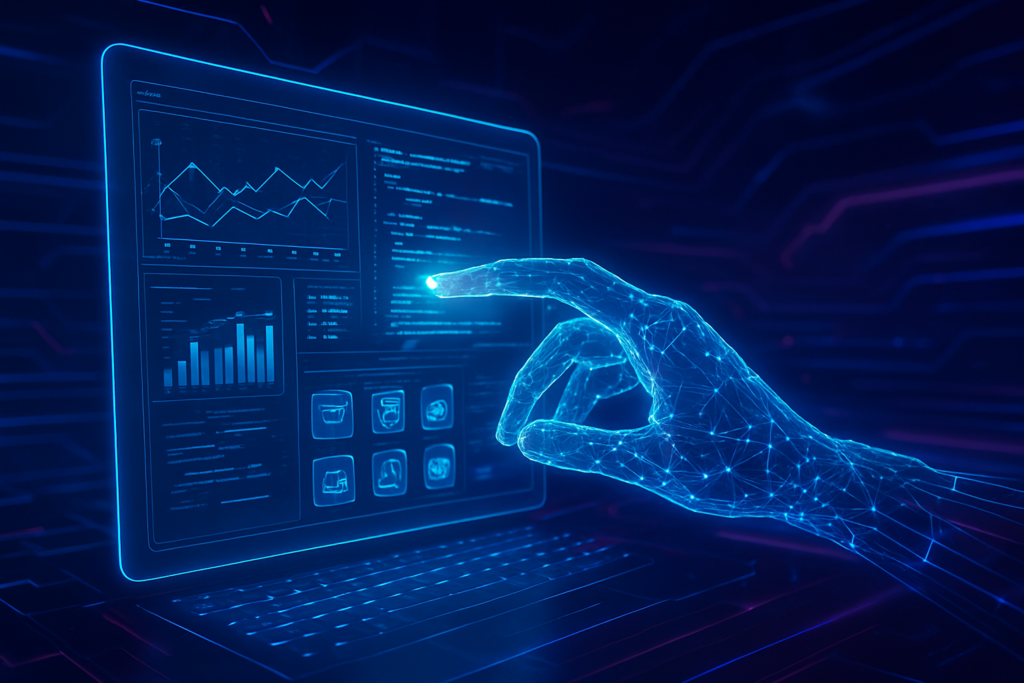
The technical breakthrough behind "Computer Use" lies in its "General Skill" approach. Unlike previous automation attempts that relied on brittle scripts or specific back-end connectors, Anthropic trained Claude 3.5 Sonnet to interpret the Graphical User Interface (GUI) directly. The model functions through a high-frequency "vision-action loop": it captures a screenshot of the current screen, analyzes the pixel coordinates of UI elements, and generates precise commands for mouse movements and keystrokes. This allows the model to perform complex tasks—such as researching a lead on LinkedIn, cross-referencing their history in a CRM, and drafting a personalized outreach email—entirely through the front-end interface.
Technical specifications for this capability have advanced rapidly. While the initial October 2024 release utilized the computer_20241022 tool version, the current Claude 4.5 architecture employs sophisticated spatial reasoning that supports high-resolution displays and complex gestures like "drag-and-drop" and "triple-click." To handle the latency and cost of processing constant visual data, Anthropic utilizes an optimized base64 encoding for screenshots, allowing the model to "glance" at the screen every few seconds to verify its progress. Industry experts have noted that this approach is significantly more robust than traditional Robotic Process Automation (RPA), as the AI can "reason" its way through unexpected pop-ups or UI changes that would typically break a standard script.
The AI research community initially reacted with a mix of awe and caution. On the OSWorld benchmark—a rigorous test of an AI’s ability to perform human-like tasks on a computer—Claude 3.5 Sonnet originally scored 14.9%, a modest but groundbreaking figure compared to the sub-10% scores of its predecessors. However, as of early 2026, the latest iterations have surged past the 60% mark. This leap in reliability has silenced skeptics who argued that visual-based navigation would be too prone to "hallucinations in action," where an agent might click the wrong button and cause irreversible data errors.
The Battle for the Desktop: Competitive Implications for Tech Giants
Anthropic’s move has ignited a fierce "Agent War" among Silicon Valley’s elite. While Anthropic has positioned itself as the "Frontier B2B" choice, focusing on developer-centric tools and enterprise sovereignty, it faces stiff competition from OpenAI, Microsoft (NASDAQ: MSFT), and Alphabet (NASDAQ: GOOGL). OpenAI recently scaled its "Operator" agent to all ChatGPT Pro users, focusing on a reasoning-first approach that excels at consumer-facing tasks like travel booking. Meanwhile, Google has leveraged its dominance in the browser market by integrating "Project Jarvis" directly into Chrome, turning the world’s most popular browser into a native agentic environment.
For Microsoft (NASDAQ: MSFT), the response has been to double down on operating system integration. With "Windows UFO" (UI-Focused Agent), Microsoft aims to make the entire Windows environment "agent-aware," allowing AI to control native legacy applications that lack modern APIs. However, Anthropic’s strategic partnership with Amazon (NASDAQ: AMZN) and its availability on the AWS Bedrock platform have given it a significant advantage in the enterprise sector. Companies are increasingly choosing Anthropic for its "sandbox-first" mentality, which allows developers to run these agents in isolated virtual machines to prevent unauthorized access to sensitive corporate data.
Early partners have already demonstrated the transformative potential of this tech. Replit, the popular cloud coding platform, uses Claude’s computer use capabilities to allow its "Replit Agent" to autonomously test and debug user interfaces. Canva has integrated the technology to automate complex design workflows, such as batch-editing assets across multiple browser tabs. Even in the service sector, companies like DoorDash (NASDAQ: DASH) and Asana (NYSE: ASAN) have explored using these agents to bridge the gap between their proprietary platforms and the messy, un-integrated world of legacy vendor websites.
Societal Shifts and the "Agentic" Economy
The wider significance of "Computer Use" extends far beyond technical novelty; it represents a fundamental shift in the labor economy. As AI agents become capable of handling routine administrative tasks—filling out forms, managing calendars, and reconciling invoices—the definition of "knowledge work" is being rewritten. Analysts from Gartner and Forrester suggest that we are entering an era where the primary skill for office workers will shift from "execution" to "orchestration." Instead of performing a task, employees will supervise a fleet of agents that perform the tasks for them.
However, this transition is not without significant concerns. The ability for an AI to control a computer raises profound security and safety questions. A model that can click buttons can also potentially click "Send" on a fraudulent wire transfer or "Delete" on a critical database. To mitigate these risks, Anthropic has implemented "Safety-by-Design" layers, including real-time classifiers that block the model from interacting with high-risk domains like social media or government portals. Furthermore, the industry is gravitating toward a "Human-in-the-Loop" (HITL) model, where high-stakes actions require a physical click from a human supervisor before the agent can proceed.
Comparisons to previous AI milestones are frequent. Many experts view the release of "Computer Use" as the "GPT-3 moment" for robotics and automation. Just as GPT-3 proved that language could be modeled at scale, Claude 3.5 Sonnet proved that the human-computer interface itself could be modeled as a visual environment. This has paved the way for a more unified AI landscape, where the distinction between a "chatbot" and a "software user" is rapidly disappearing.
The Roadmap to 2029: What Lies Ahead
Looking toward the next 24 to 36 months, the trajectory of agentic AI suggests a "death of the app" for many use cases. Experts predict that by 2028, a significant portion of user interactions will move away from native application interfaces and toward "intent-based" commands. Instead of opening a complex ERP system, a user might simply tell their agent, "Adjust the Q3 budget based on the new tax law," and the agent will navigate the necessary software to execute the request. This "agentic front-end" could make software complexity invisible to the end-user.
The next major challenge for Anthropic and its peers will be "long-horizon reliability." While current models can handle tasks lasting a few minutes, the goal is to create agents that can work autonomously for days or weeks—monitoring a project's progress, responding to emails, and making incremental adjustments to a workflow. This will require breakthroughs in "agentic memory," allowing the AI to remember its progress and context across long periods without getting lost in "context window" limitations.
Furthermore, we can expect a push toward "on-device" agentic AI. As hardware manufacturers develop specialized NPU (Neural Processing Unit) chips, the vision-action loop that currently happens in the cloud may move directly onto laptops and smartphones. This would not only reduce latency but also enhance privacy, as the screenshots of a user's desktop would never need to leave their local device.
Conclusion: A New Chapter in Human-AI Collaboration
Anthropic’s "Computer Use" capability has effectively broken the "fourth wall" of artificial intelligence. By giving Claude the ability to interact with the world through the same interfaces humans use, Anthropic has created a tool that is as versatile as the software it controls. The transition from a beta experiment in late 2024 to a core enterprise utility in 2026 marks one of the fastest adoption curves in the history of computing.
As we look forward, the significance of this development in AI history cannot be overstated. It is the moment AI stopped being a consultant and started being a collaborator. While the long-term impact on the workforce and digital security remains a subject of intense debate, the immediate utility of these agents is undeniable. In the coming weeks and months, the tech industry will be watching closely as Claude 4.5 and its competitors attempt to master increasingly complex environments, moving us closer to a future where the computer is no longer a tool we use, but a partner we direct.
This content is intended for informational purposes only and represents analysis of current AI developments.
TokenRing AI delivers enterprise-grade solutions for multi-agent AI workflow orchestration, AI-powered development tools, and seamless remote collaboration platforms.
For more information, visit https://www.tokenring.ai/.