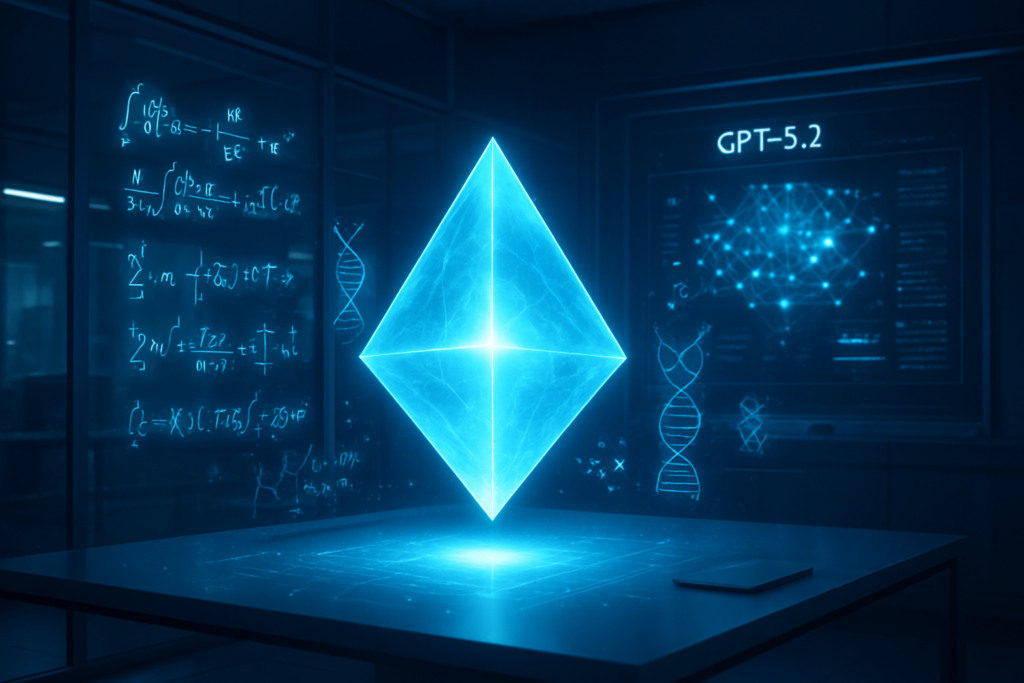
In a landmark move that signals the verticalization of artificial intelligence into specialized professional domains, OpenAI officially launched Prism today, January 28, 2026. Described as an "AI-native scientific workspace," Prism is a free platform designed to centralize the entire research lifecycle—from hypothesis generation and data analysis to complex LaTeX manuscript drafting—within a single, collaborative environment.
The launch marks the debut of GPT-5.2, OpenAI’s latest frontier model architecture, which has been specifically fine-tuned for high-level reasoning, mathematical precision, and technical synthesis. By integrating this powerful engine into a free, cloud-based workspace, OpenAI aims to remove the administrative and technical friction that has historically slowed scientific discovery, positioning Prism as the "operating system for science" in an era increasingly defined by rapid AI-driven breakthroughs.
Prism represents a departure from the general-purpose chat interface of previous years, offering a structured environment built on the technology of Crixet, a LaTeX-centric startup OpenAI (MSFT:NASDAQ) quietly acquired in late 2025. The platform’s standout feature is its native LaTeX integration, which allows researchers to edit technical documents in real-time with full mathematical notation support, eliminating the need for local compilers or external drafting tools. Furthermore, a "Visual Synthesis" feature allows users to upload photos of whiteboard sketches, which GPT-5.2 instantly converts into publication-quality TikZ or LaTeX code.
Under the hood, GPT-5.2 boasts staggering technical specifications tailored for the academic community. The model features a 400,000-token context window, roughly equivalent to 800 pages of text, enabling it to ingest and analyze entire bodies of research or massive datasets in a single session. On the GPQA Diamond benchmark—a gold standard for graduate-level science reasoning—GPT-5.2 scored an unprecedented 93.2%, surpassing previous records held by its predecessors. Perhaps most critically for the scientific community, OpenAI claims a 26% reduction in hallucination rates compared to earlier iterations, a feat achieved through a new "Thinking" mode that forces the model to verify its reasoning steps before generating an output.
Early reactions from the AI research community have been largely positive, though tempered by caution. "The integration of multi-agent collaboration within the workspace is a game-changer," says Dr. Elena Vance, a theoretical physicist who participated in the beta. Prism allows users to deploy specialized AI agents to act as "peer reviewers," "statistical validators," or "citation managers" within a single project. However, some industry experts warn that the ease of generating technical prose might overwhelm already-strained peer-review systems with a "tsunami of AI-assisted submissions."
The release of Prism creates immediate ripples across the tech landscape, particularly for giants like Alphabet Inc. (GOOGL:NASDAQ) and Meta Platforms, Inc. (META:NASDAQ). For years, Google has dominated the "AI for Science" niche through its DeepMind division and tools like AlphaFold. OpenAI’s move to provide a free, high-end workspace directly competes with Google’s recent integration of Gemini 3 into Google Workspace and the specialized AlphaGenome models. By offering Prism for free, OpenAI is effectively commoditizing the workflow of research, forcing competitors to pivot from simply providing models to providing comprehensive, integrated platforms.
The strategic advantage for OpenAI lies in its partnership with Microsoft (MSFT:NASDAQ), whose Azure infrastructure powers the heavy compute requirements of GPT-5.2. This launch also solidifies the market position of Nvidia (NVDA:NASDAQ), whose Blackwell-series chips are the backbone of the "Reasoning Clusters" OpenAI uses to minimize hallucinations in Prism’s "Thinking" mode. Startups in the scientific software space, such as those focusing on AI-assisted literature review or LaTeX editing, now face a "platform risk" as OpenAI’s all-in-one solution threatens to render standalone tools obsolete.
While the personal version of Prism is free, OpenAI is clearly targeting the lucrative institutional market with "Prism Education" and "Prism Enterprise" tiers. These paid versions offer data siloing and enhanced security—crucial features for research universities and pharmaceutical giants that are wary of leaking proprietary findings into a general model’s training set. This tiered approach allows OpenAI to dominate the grassroots research community while extracting high-margin revenue from large organizations.
Prism’s launch fits into a broader 2026 trend where AI is moving from a "creative assistant" to a "reasoning partner." Historically, AI milestones like GPT-3 focused on linguistic fluency, while GPT-4 introduced multimodal capabilities. Prism and GPT-5.2 represent a shift toward epistemic utility—the ability of an AI to not just summarize information, but to assist in the creation of new knowledge. This follows the path set by AI-driven coding agents in 2025, which fundamentally changed software engineering; OpenAI is now betting that the same transformation can happen in the hard sciences.
However, the "democratization of science" comes with significant concerns. Some scholars have raised the issue of "cognitive dulling," fearing that researchers might become overly dependent on AI for hypothesis testing and data interpretation. If the AI "thinks" for the researcher, there is a risk that human intuition and first-principles understanding could atrophy. Furthermore, the potential for AI-generated misinformation in technical fields remains a high-stakes problem, even with GPT-5.2's improved accuracy.
Comparisons are already being drawn to the "Google Scholar effect" or the rise of the internet in academia. Just as those technologies made information more accessible while simultaneously creating new challenges for information literacy, Prism is expected to accelerate the volume of scientific output. The question remains whether this will lead to a proportional increase in the quality of discovery, or if it will simply contribute to the "noise" of modern academic publishing.
Looking ahead, the next phase of development for Prism is expected to involve "Autonomous Labs." OpenAI has hinted at future integrations with robotic laboratory hardware, allowing Prism to not only design and document experiments but also to execute them in automated facilities. Experts predict that by 2027, we may see the first major scientific prize—perhaps even a Nobel—awarded for a discovery where an AI played a primary role in the experimental design and data synthesis.
Near-term developments will likely focus on expanding Prism’s multi-agent capabilities. Researchers expect to see "swarm intelligence" features where hundreds of small, specialized agents can simulate complex biological or physical systems in real-time within the workspace. The primary challenge moving forward will be the "validation gap"—developing robust, automated ways to verify that an AI's scientific claims are grounded in physical reality, rather than just being specialists within its training data.
The launch of OpenAI’s Prism and GPT-5.2 is more than just a software update; it is a declaration of intent for the future of human knowledge. By providing a high-precision, AI-integrated workspace for free, OpenAI has essentially democratized the tools of high-level research. This move positions the company at the center of the global scientific infrastructure, effectively making GPT-5.2 a primary collaborator for the next generation of scientists.
In the coming weeks, the tech world will be watching for the industry’s response—specifically whether Google or Meta will release a competitive open-source workspace to counter OpenAI’s walled-garden approach. As researchers begin migrating their projects to Prism, the long-term impact on academic integrity, the speed of innovation, and the very nature of scientific inquiry will become the defining story of 2026. For now, the "scientific method" has a new, incredibly powerful assistant.
This content is intended for informational purposes only and represents analysis of current AI developments.
TokenRing AI delivers enterprise-grade solutions for multi-agent AI workflow orchestration, AI-powered development tools, and seamless remote collaboration platforms.
For more information, visit https://www.tokenring.ai/.