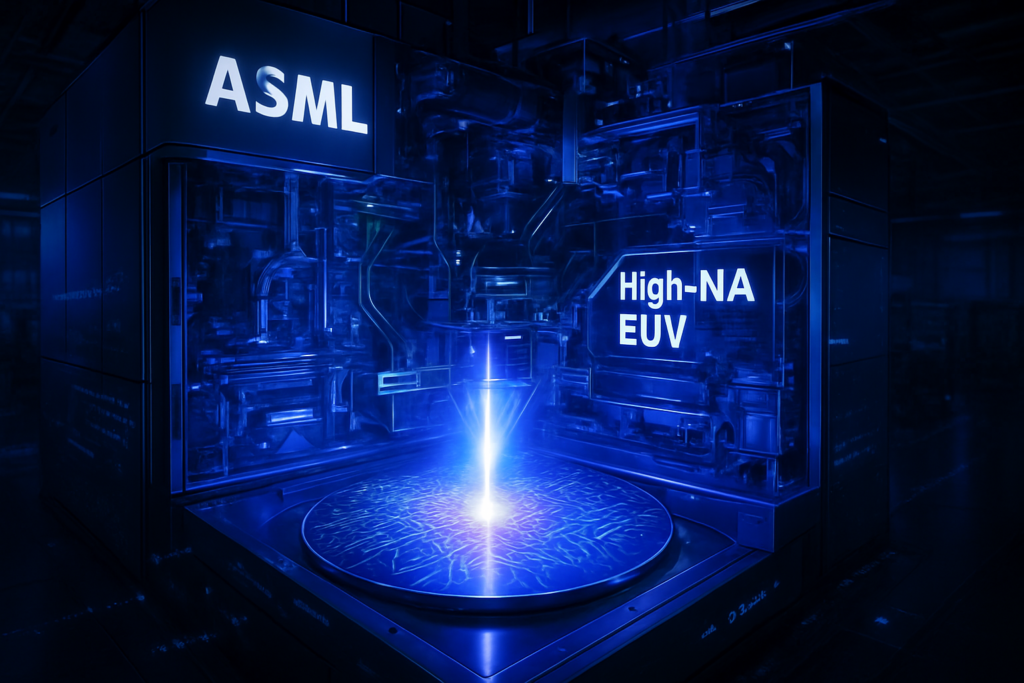
As of January 13, 2026, the global semiconductor landscape has reached a historic inflection point. Intel Corp (NASDAQ: INTC) has officially transitioned its 18A (1.8-nanometer) process node into High-Volume Manufacturing (HVM), marking the first time in over a decade that the American chipmaker has arguably leapfrogged its primary rivals in manufacturing technology. This milestone is underpinned by the strategic deployment of High Numerical Aperture (High-NA) Extreme Ultraviolet (EUV) lithography, a revolutionary printing technique that allows for unprecedented transistor density and precision.
The immediate significance of this development cannot be overstated. By being the first to integrate ASML Holding (NASDAQ: ASML) Twinscan EXE:5200B scanners into its production lines, Intel is betting that it can overcome the "yield wall" that has plagued sub-2nm development. While competitors have hesitated due to the astronomical costs of the new hardware, Intel’s early adoption is already bearing fruit, with the company reporting stable 18A yields that have cleared the 65% threshold—making mass-market production of its next-generation "Panther Lake" and "Clearwater Forest" processors economically viable.
Precision at the Atomic Scale: The 0.55 NA Advantage
The technical leap from standard EUV to High-NA EUV is defined by the increase in numerical aperture from 0.33 to 0.55. This shift allows the ASML Twinscan EXE:5200B to achieve a resolution of just 8nm, a massive improvement over the 13.5nm limit of previous-generation machines. In practical terms, this enables Intel to print features that are 1.7x smaller than before, contributing to a nearly 2.9x increase in overall transistor density. For the first time, engineers are working with tolerances where a single stray atom can determine the success or failure of a logic gate.
Unlike previous approaches that required complex "multi-patterning"—where a single layer of a chip is printed multiple times to achieve the desired resolution—High-NA EUV allows for single-exposure patterning of the most critical layers. This reduction in process steps is the secret weapon behind Intel’s yield improvements. By eliminating the cumulative errors inherent in multi-patterning, Intel has managed to improve its 18A yields by approximately 7% month-over-month throughout late 2025. The new scanners also boast a record-breaking 0.7nm overlay accuracy, ensuring that the dozens of atomic-scale layers in a modern processor are aligned with near-perfect precision.
Initial reactions from the semiconductor research community have been a mix of awe and cautious optimism. Analysts at major firms have noted that while the transition to High-NA involves a "half-field" mask size—effectively halving the area a scanner can print in one go—the EXE:5200B’s throughput of 175 to 200 wafers per hour mitigates the potential productivity loss. The industry consensus is that Intel has successfully navigated the steepest part of the learning curve, gaining operational knowledge that its competitors have yet to even begin acquiring.
A $380 Million Barrier to Entry: Shifting Industry Dynamics
The primary deterrent for High-NA adoption has been the staggering price tag: approximately $380 million (€350 million) per machine. This cost represents more than just the hardware; it includes a massive logistical tail, requiring specialized fab cleanrooms and a six-month installation period led by hundreds of ASML engineers. Intel’s decision to purchase the lion's share of ASML's early production run has created a temporary monopoly on the most advanced manufacturing capacity in the world, effectively building a "moat" made of capital and specialized expertise.
This strategy has placed Taiwan Semiconductor Manufacturing Company (NYSE: TSM) in an uncharacteristically defensive position. TSMC has opted to extend its existing 0.33 NA tools for its A14 node, utilizing advanced multi-patterning to avoid the high capital expenditure of High-NA. While this conservative approach protects TSMC’s short-term margins, it leaves them trailing Intel in High-NA operational experience by an estimated 24 months. Meanwhile, Samsung Electronics (KRX: 005930) continues to struggle with yield issues on its 2nm Gate-All-Around (GAA) process, further delaying its own High-NA roadmap until at least 2028.
For AI companies and tech giants, Intel’s resurgence offers a vital second source for cutting-edge silicon. As the demand for AI accelerators and high-performance computing (HPC) chips continues to outpace supply, Intel’s Foundry services are becoming an attractive alternative to TSMC. By providing a "High-NA native" path for its upcoming 14A node, Intel is positioning itself as the premier partner for the next generation of AI hardware, potentially disrupting the long-standing dominance of the "TSMC-only" supply chain for top-tier silicon.
Sustaining Moore’s Law in the AI Era
The deployment of High-NA EUV is more than just a corporate victory for Intel; it is a vital sign for the longevity of Moore’s Law. As the industry moved toward the 2nm limit, many feared that the physical and economic barriers of lithography would bring the era of rapid transistor scaling to an end. High-NA EUV effectively resets the clock, providing a clear technological roadmap into the 1nm (10 Angstrom) range and beyond. This fits into a broader trend where the "Angstrom Era" is defined not just by smaller transistors, but by the integration of advanced packaging and backside power delivery—technologies like Intel’s PowerVia that work in tandem with High-NA lithography.
However, the wider significance of this milestone also brings potential concerns regarding the "geopolitics of silicon." With High-NA tools being so expensive and rare, the gap between the "haves" and the "have-nots" in the semiconductor world is widening. Only a handful of companies—and by extension, a handful of nations—can afford to participate at the leading edge. This concentration of power could lead to increased market volatility if supply chain disruptions occur at the few sites capable of housing these $380 million machines.
Compared to previous milestones, such as the initial introduction of EUV in 2019, the High-NA transition has been remarkably focused on the US-based manufacturing footprint. Intel’s primary High-NA operations are centered in Oregon and Arizona, signaling a significant shift in the geographical concentration of advanced chipmaking. This alignment with domestic manufacturing goals has provided Intel with a strategic tailwind, as Western governments prioritize the resilience of high-end semiconductor supplies for AI and national security.
The Road to 14A and Beyond
Looking ahead, the next two to three years will be defined by the maturation of the 14A (1.4nm) node. While 18A uses a "hybrid" approach with High-NA applied only to the most critical layers, the 14A node is expected to be "High-NA native," utilizing the technology across a much broader range of the chip’s architecture. Experts predict that by 2027, the operational efficiencies gained from High-NA will begin to lower the cost-per-transistor once again, potentially sparking a new wave of innovation in consumer electronics and edge-AI devices.
One of the primary challenges remaining is the evolution of the mask and photoresist ecosystem. High-NA requires thinner resists and more complex mask designs to handle the higher angles of light. ASML and its partners are already working on the next iteration of the EXE platform, with rumors of "Hyper-NA" (0.75 NA) already circulating in R&D circles for the 2030s. For now, the focus remains on perfecting the 18A ramp and ensuring that the massive capital investment in High-NA translates into sustained market share gains.
Predicting the next move, industry analysts expect TSMC to accelerate its High-NA evaluation as Intel’s 18A products hit the shelves. If Intel’s "Panther Lake" processors demonstrate a significant performance-per-watt advantage, the pressure on TSMC to abandon its conservative stance will become overwhelming. The "Lithography Wars" are far from over, but in early 2026, Intel has clearly seized the high ground.
Conclusion: A New Leader in the Silicon Race
The strategic deployment of High-NA EUV lithography in 2026 marks the beginning of a new chapter in semiconductor history. Intel’s willingness to shoulder the $380 million cost of early adoption has paid off, providing the company with a 24-month head start in the most critical manufacturing technology of the decade. With 18A yields stabilizing and high-volume manufacturing underway, the "Angstrom Era" is no longer a theoretical roadmap—it is a production reality.
The key takeaway for the industry is that the "barrier to entry" at the leading edge has been raised to unprecedented heights. The combination of extreme capital requirements and the steep learning curve of 0.55 NA optics has created a bifurcated market. Intel’s success in reclaiming the manufacturing "crown" will be measured not just by the performance of its own chips, but by its ability to attract major foundry customers who are hungry for the density and efficiency that only High-NA can provide.
In the coming months, all eyes will be on the first third-party benchmarks of Intel 18A silicon. If these chips deliver on their promises, the shift in the balance of power from East to West may become a permanent fixture of the tech landscape. For now, Intel’s $380 million gamble looks like the smartest bet in the history of the industry.
This content is intended for informational purposes only and represents analysis of current AI developments.
TokenRing AI delivers enterprise-grade solutions for multi-agent AI workflow orchestration, AI-powered development tools, and seamless remote collaboration platforms.
For more information, visit https://www.tokenring.ai/.