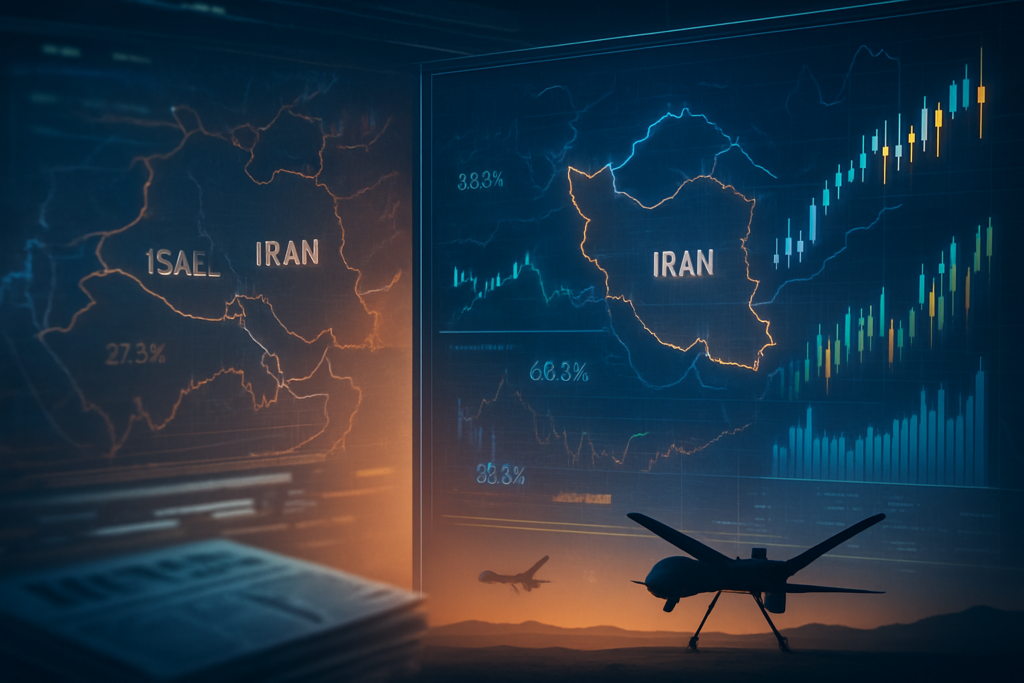
As of January 16, 2026, the global intelligence community is no longer looking solely at satellite imagery or diplomatic cables to gauge the risk of war in the Middle East. Instead, they are watching the order books. The concept of "Operation Iron Strike"—a rumored Israeli military operation against Iranian strategic sites—has moved from classified briefings to the most liquid trading pits on the internet. With a critical January 31 deadline looming for high-stakes strike contracts, prediction markets have officially transitioned from speculative hobbies to "Truth Engines" for global risk.
Currently, the probability of an Israeli strike on Iran before the end of the month is fluctuating wildly between 34% and 52% on Polymarket. This volatility isn't just noise; it represents the collective intelligence of thousands of traders processing real-time data from the ground in Tehran and Tel Aviv. The surge in interest is driven by a unique combination of "Information Finance" (InfoFi) and a breakdown in traditional news speed, where prediction platforms are now consistently outperforming major terminals by as much as 15 minutes.
The Market: What's Being Predicted
The focal point of the current geopolitical trading frenzy is the "Operation Iron Strike" contract series. These markets, primarily hosted on the decentralized platform Polymarket and the regulated U.S. exchange Kalshi, task traders with a binary outcome: Will Israel conduct a military strike against Iran by January 31, 2026?
As we cross the mid-month mark, the liquidity in these specific contracts has reached unprecedented levels. The "Israel Strike" contract on Polymarket has seen over $8 million in monthly volume, while related markets regarding Iranian regime stability and the potential ouster of Supreme Leader Ayatollah Ali Khamenei have attracted upwards of $32 million.
The resolution criteria for these markets are stringent. For the "strike" contract to resolve "Yes," there must be verified reports of kinetic military action—airstrikes, drone swarms, or special operations—conducted by the Israel Defense Forces (IDF) against Iranian soil. The January 31 deadline is particularly significant, as it marks the end of a period of intense military exercises and follows the "Bazaar Revolts" that have destabilized the Iranian domestic front throughout late 2025.
Why Traders Are Betting
The primary driver of the current odds is a divergence between "official" expert analysis and "on-the-ground" data signals. While traditional media outlets like Thomson Reuters (NYSE: TRI) and Bloomberg have cited analysts suggesting a strike is more likely in March 2026, the markets have shifted focus to January. This shift was triggered by a five-hour Israeli security cabinet meeting on January 5, which traders interpreted as a definitive "go" signal.
Furthermore, markets are being influenced by the hyper-devaluation of the Iranian Rial, which recently hit 1.4 million to the USD. Traders use "Information Finance" to hedge against this instability. Large positions—colloquially known as "whale" moves—have been spotted moving into "Yes" positions shortly after localized unrest in Tehran, often before Western media can verify the reports.
The most striking evidence of this "Truth Engine" effect occurred on January 3, 2026, during the capture of Nicolás Maduro in Venezuela. A single Polymarket wallet correctly front-ran the U.S. military announcement by nearly six hours, turning a $32,500 bet into a $400,000 payout. This ability to synthesize "hidden" information into a public probability has made these platforms essential for those looking to avoid being blindsided by "black swan" events.
Broader Context and Implications
The evolution of prediction markets into institutional-grade tools is no longer a fringe theory. Intercontinental Exchange (NYSE: ICE), the parent company of the New York Stock Exchange, recently made a strategic $2 billion investment in prediction market infrastructure, signaling that "InfoFi" is the next frontier of the financial sector. Even mainstream fintech is leaning in; Robinhood (NASDAQ: HOOD) recently launched a dedicated "Prediction Markets Hub," allowing retail users to trade geopolitical outcomes alongside traditional stocks.
This shift has profound implications for how the public consumes news. If a market moves 15 minutes before a Comcast (NASDAQ: CMCSA)-owned CNBC broadcast can confirm a headline, the market becomes the headline. This has led to the introduction of the "Public Integrity in Financial Prediction Markets Act of 2026" by U.S. lawmakers, aimed at preventing government officials with "inside" geopolitical knowledge from profiting on these platforms.
Historically, prediction markets have proven more accurate than individual pundits because they force participants to "put their money where their mouth is." In 2026, this is becoming the primary mechanism for filtering out "diplomatic spin" from the hard reality of impending conflict.
What to Watch Next
As we approach the January 31 deadline, several key milestones will dictate the movement of the "Iron Strike" markets. First, any movement of U.S. carrier strike groups in the Persian Gulf will likely cause immediate spikes in "Yes" probabilities. Second, the internal stability of the Iranian regime during the "Winter Uprising" remains a wildcard; if the regime appears to be losing control of the IRGC, the probability of a foreign intervention may increase as a means of securing nuclear sites.
Market participants should also monitor the News Corp (NASDAQ: NWSA)-owned Wall Street Journal’s live integration of prediction data, which has begun to feature "market-implied probabilities" in its geopolitical coverage. These feeds will likely be the first to reflect any 11th-hour diplomatic breakthroughs or sudden escalations.
Bottom Line
Prediction markets have moved beyond the realm of "betting" and into the realm of "sensing." They have become a decentralized intelligence agency for the common investor and the institutional desk alike. The January 31 contract represents more than just a military deadline; it is a test of the market’s ability to price the most complex and secretive risks in the world.
Whether the outcome is peace or "Operation Iron Strike," the real winner in 2026 is the democratization of information. By transforming speculation into a structured, liquid, and transparent probability, prediction markets are proving to be the most reliable "Truth Engines" in an era of unprecedented geopolitical uncertainty.
This article is for informational purposes only and does not constitute financial or betting advice. Prediction market participation may be subject to legal restrictions in your jurisdiction.
PredictStreet focuses on covering the latest developments in prediction markets.
Visit the PredictStreet website at https://www.predictstreet.ai/.