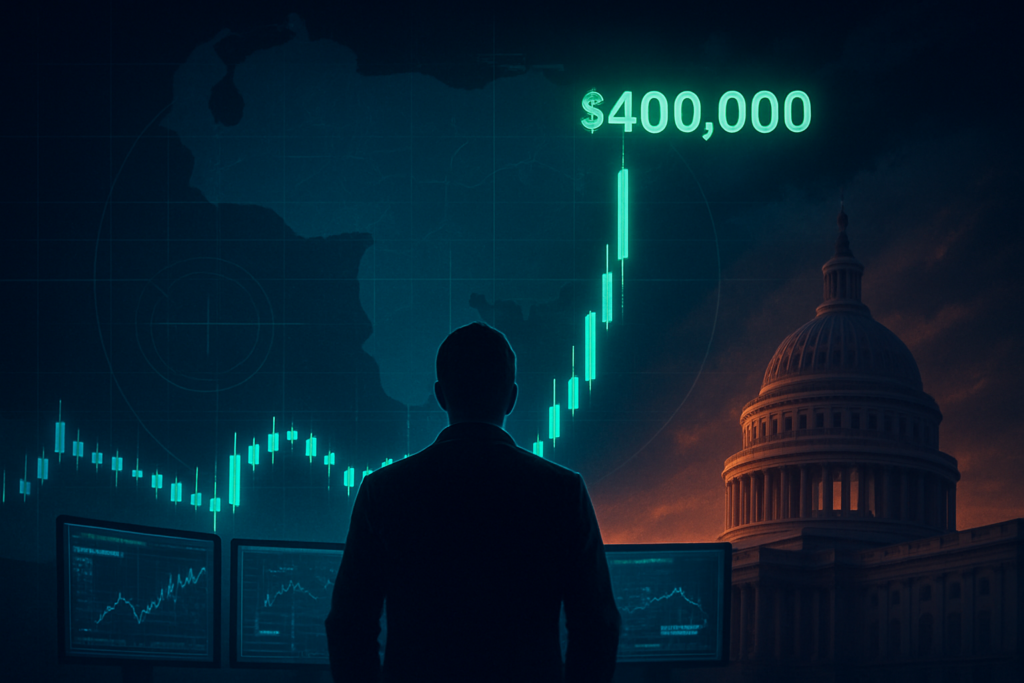
In a stunning display of prediction markets outperforming traditional media—and potentially uncovering federal corruption—an anonymous trader on the decentralized platform Polymarket turned a $32,000 bet into more than $400,000 by correctly predicting the capture of Venezuelan President Nicolás Maduro. The trades were executed on January 2, 2026, just hours before U.S. special operations forces conducted "Operation Absolute Resolve," a high-stakes raid that resulted in Maduro’s detention.
The "Yes" shares for Maduro’s removal, which had been languishing at a mere 7% probability for weeks, surged to nearly 100% within seconds of President Trump’s 4:21 AM ET announcement on Truth Social the following morning. While proponents of prediction markets point to this as proof of their efficiency, the "perfect" timing of the wager has sparked a firestorm of "insider trading" allegations, leading to a major legislative push in Washington to regulate how government officials interact with event-contract platforms.
The Market: What's Being Predicted
The contract at the center of the storm, "Maduro out by January 31, 2026?", was one of the most liquid geopolitical markets on Polymarket. For much of the fourth quarter of 2025, the market reflected a consensus of skepticism; Maduro had survived numerous coup attempts and international pressure campaigns over the years, leading traders to price the "Yes" outcome at approximately $0.07 to $0.08 per share.
The anonymous trader, operating under the handle "Burdensome-Mix," began aggressively accumulating these "Yes" shares in the late evening hours of January 2. By the time the position was fully built, the trader had committed approximately $32,537. Because the odds were so heavily stacked against the outcome, the payout upon the market's resolution exceeded $436,000.
While Polymarket is a decentralized platform, the sheer size and timing of the move caused immediate friction. Unlike traditional financial markets governed by the SEC or the CFTC, Polymarket operates primarily on-chain, allowing for pseudonymized participation that makes identifying the source of "insider" information notoriously difficult.
Why Traders Are Betting
The "Maduro Trade" highlights a growing trend of "whale" activity in prediction markets, where high-net-worth individuals or entities use massive liquidity to signal information that has not yet hit the newswires. In this case, there were no public indicators—no leaked troop movements, no diplomatic warnings—that an operation of this magnitude was imminent.
Analysts suggest three possible drivers for the "Burdensome-Mix" position:
- Material Non-Public Information: The most likely scenario, currently being investigated, is that the trader had access to classified military schedules or executive branch briefings.
- Advanced Sentiment Analysis: Some argue that sophisticated AI tools monitoring localized social media traffic in Caracas or private aviation patterns could have signaled unusual activity, though the precision of the bet suggests a higher level of certainty.
- High-Risk Speculation: A smaller camp believes this could have been a "black swan" bet by a trader with high risk-tolerance, though the timing—occurring less than six hours before the raid—makes this theory less plausible.
The event has cast a shadow over the "wisdom of the crowd," as the market didn't reflect a collective intelligence so much as it reacted to a single, potentially compromised actor.
Broader Context and Implications
The controversy has moved rapidly from the crypto-twitter sphere to the halls of Congress. On January 9, 2026, Representative Ritchie Torres introduced the 'Public Integrity in Financial Prediction Markets Act of 2026'. The bill aims to establish a federal framework that explicitly prohibits government employees, military personnel, and their immediate families from trading on markets where they may have an informational advantage due to their official duties.
This incident has also heightened the contrast between the two titans of the industry: Polymarket and Kalshi. While Polymarket has remained largely silent on the specific identity of "Burdensome-Mix," citing its decentralized nature, Kalshi has moved to capitalize on the moment. Kalshi, which is a U.S.-regulated exchange, already enforces an explicit ban on insider trading by government employees and requires full Know Your Customer (KYC) documentation for all participants.
The fallout has also impacted public companies in the crypto and fintech sectors. Coinbase Global, Inc. (NASDAQ: COIN), which serves as a primary gateway for many Polymarket users to bridge assets to the Polygon network, has seen increased scrutiny regarding its role in facilitating potentially illicit trades. Similarly, the broader tech sector, including companies like Alphabet Inc. (NASDAQ: GOOGL) that have explored integration of prediction data into search and AI, may face new hurdles if the industry is branded as a "haven for corruption."
What to Watch Next
The immediate focus is on the Commodity Futures Trading Commission (CFTC), which has reportedly opened a formal inquiry into the "Maduro Trade." Investigators are likely looking for links between the "Burdensome-Mix" wallet and U.S.-based exchange accounts to unmask the trader. If the trader is revealed to be a government or military official, it could lead to the first major criminal prosecution for insider trading in the prediction market era.
Legislatively, the Torres bill is expected to see a floor vote by late February. Its passage would mark the most significant regulatory change for the industry since the CFTC began its crackdown on offshore platforms years ago. Prediction market advocates are currently lobbying for amendments that would protect "legitimate" hedging and information discovery while still penalizing bad actors.
Furthermore, the resolution of Maduro's legal status in the U.S. will likely trigger a new wave of contracts. Markets are already forming around his potential trial date, the identity of his legal counsel, and the future of Venezuelan oil production—an area closely watched by energy giants like Chevron Corporation (NYSE: CVX).
Bottom Line
The Maduro controversy is a "coming of age" moment for prediction markets, albeit a painful one. It has demonstrated that these platforms can indeed "predict" the future with terrifying accuracy when someone in the room knows the outcome. However, it has also exposed a critical vulnerability: if these markets are seen as rigs for insiders rather than tools for public insight, they risk losing the trust of the retail traders who provide the necessary liquidity.
As the industry moves toward 2026, the "Maduro Trade" will likely be remembered as the catalyst that forced prediction markets to choose between their decentralized, "Wild West" roots and a future as a respected, regulated pillar of the global financial system. For now, all eyes remain on the blockchain, waiting to see where "Burdensome-Mix" moves their $400,000 next.
This article is for informational purposes only and does not constitute financial or betting advice. Prediction market participation may be subject to legal restrictions in your jurisdiction.
PredictStreet focuses on covering the latest developments in prediction markets.
Visit the PredictStreet website at https://www.predictstreet.ai/.