As the 2026 legislative session kicks off in Albany, a high-stakes battle is brewing that could decide the future of information finance in the United States. New York lawmakers are currently weighing Assembly Bill A9251, more ominously known as the "ORACLE Act." The proposed legislation seeks to categorize event contracts on platforms like Kalshi and Polymarket as "unlicensed gambling," threatening the industry with existential fines that could reach as high as $1 million per day for non-compliance.
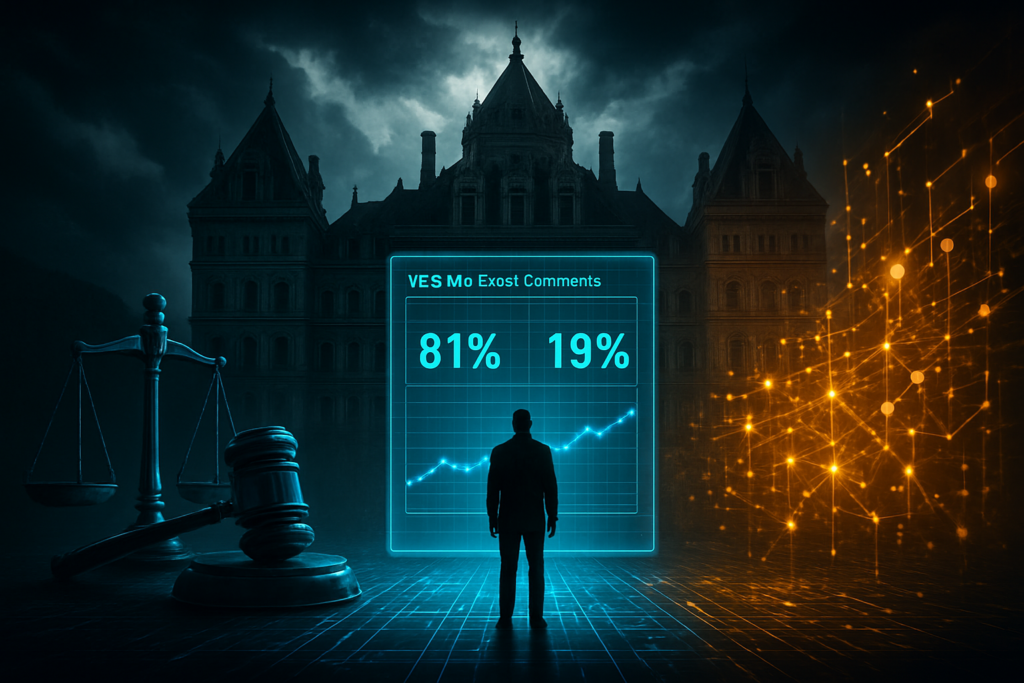
Despite the aggressive rhetoric from state regulators, prediction market traders remain surprisingly resilient. While the ORACLE Act represents the most severe state-level crackdown to date, decentralized "shadow markets" currently assign an 81% probability to the theory that federal law will ultimately override New York’s efforts. For the burgeoning prediction market industry, this is more than just a regulatory hurdle; it is a fight for the right to exist as a legitimate financial tool rather than a digital casino.
The Market: What's Being Predicted
At the center of the storm is Assembly Bill A9251, the Oversight and Regulation of Activity for Contracts Linked to Events (ORACLE) Act. Introduced by Assemblymember Clyde Vanel, the bill aims to close what proponents call a "legal gray area" that has allowed prediction markets to flourish among New York residents. The bill specifically targets five "sensitive" categories for immediate banning: political outcomes, athletic events, catastrophic occurrences, death-related contracts, and securities price movements.
While Kalshi—a federally regulated exchange—avoids hosting markets on its own legal standing to prevent conflicts of interest, the broader ecosystem is betting heavily on the outcome. On the decentralized platform Manifold, the "NY Legal Survival" market has seen significant volume as the bill moved to the Assembly Committee on Consumer Affairs and Protection on January 7, 2026. Current odds suggest that while the bill may pass the Assembly, it faces a steep climb in the Senate, where a competing, more moderate bill (S8889) seeks to regulate these markets under the Department of Financial Services (DFS) rather than banning them outright.
The resolution of this legislative tug-of-war is expected by the end of the current session in June 2026. If A9251 passes in its current form, any platform continuing to serve New Yorkers after a court-ordered injunction would face a scorched-earth penalty: civil fines of $10,000 per violation, escalating to a mandatory $1 million per day for persistent operations.
Why Traders Are Betting
The sudden urgency in Albany is largely attributed to a series of high-profile events that have galvanized both critics and supporters. Chief among them is the controversial "Maduro Trade" on Polymarket earlier this month. Reports that a trader turned a $32,000 position into over $400,000 just hours before a U.S. military-led raid in Venezuela have fueled insider-trading concerns among NY lawmakers.
In a bold counter-move that has stunned the regulatory community, Polymarket recently signed a landmark sponsorship deal to become the Official Prediction Market Partner of the New York Rangers, owned by Madison Square Garden Sports (NYSE: MSGS). By displaying live odds on the LED screens of Madison Square Garden, the industry is effectively daring the state to shut down a product that is becoming woven into the city’s sports and cultural fabric.
Traders are also closely monitoring the internal politics of the New York Statehouse. While the ORACLE Act has the backing of the New York State Gaming Commission, it faces opposition from financial heavyweights like Interactive Brokers Group (NASDAQ: IBKR). Interactive Brokers' Chairman Thomas Peterffy has been vocal about the need for a financial-first approach, arguing that the Senate’s regulatory path is the only way to keep New York at the forefront of financial innovation.
Broader Context and Implications
The New York battle is the frontline of a much larger war over "Federal Preemption." Under the Commodity Exchange Act (CEA), the Commodity Futures Trading Commission (CFTC) has primary jurisdiction over derivatives and event contracts. Kalshi has consistently argued in federal court that its status as a Designated Contract Market (DCM) preempts state gambling laws. If New York succeeds in enforcing the ORACLE Act, it could create a fragmented "patchwork" of state laws that would make it nearly impossible for prediction markets to operate nationwide.
Industry advocates argue that these platforms are not gambling hubs but "Truth Discovery Engines." Peterffy and other industry leaders contend that prediction markets provide a public service by aggregating disparate information into a single, capital-backed consensus estimate. They argue that in an era of rampant misinformation, these markets offer more accurate forecasting than traditional polls or pundits.
Furthermore, the industry emphasizes the "Risk Management" utility of these contracts. For example, a New York small business owner might use a Kalshi contract to hedge against the financial impact of a proposed local tax hike—a form of "event insurance" that traditional providers often refuse to cover.
What to Watch Next
The next six months will be critical for the industry. Traders should watch for the following key milestones:
- Senate Committee Hearings (February/March 2026): Keep a close eye on the progress of Senate Bill S8889. If the Senate favors regulation over Vanel’s ban, the ORACLE Act may be significantly watered down or stalled.
- SDNY Court Rulings: Kalshi is currently operating in New York under a litigation stay. Any movement in the Southern District of New York regarding the state's previous cease-and-desist orders will serve as a bellwether for the ORACLE Act's enforceability.
- Legislative Session Close (June 2026): This is the ultimate deadline for the ORACLE Act. If the bill fails to reach the Governor’s desk by then, the "survival" probability on shadow markets is likely to skyrocket toward 100%.
Bottom Line
The battle over the ORACLE Act is a fundamental clash between 20th-century gambling regulations and 21st-century information finance. New York’s attempt to impose $1 million-a-day fines underscores the perceived threat these markets pose to traditional regulatory structures. However, the industry's pivot toward mainstream partnerships—such as the New York Rangers deal—suggests they are prepared for a long and public fight.
Ultimately, the market sentiment remains cautiously optimistic. Traders are betting that the financial utility of these platforms—their ability to hedge risk and discover truth—will prove too valuable for New York to discard. Whether the state chooses to ban, regulate, or ignore these "engines of insight," the outcome in Albany will set the precedent for the rest of the nation.
This article is for informational purposes only and does not constitute financial or betting advice. Prediction market participation may be subject to legal restrictions in your jurisdiction.
PredictStreet focuses on covering the latest developments in prediction markets.
Visit the PredictStreet website at https://www.predictstreet.ai/.