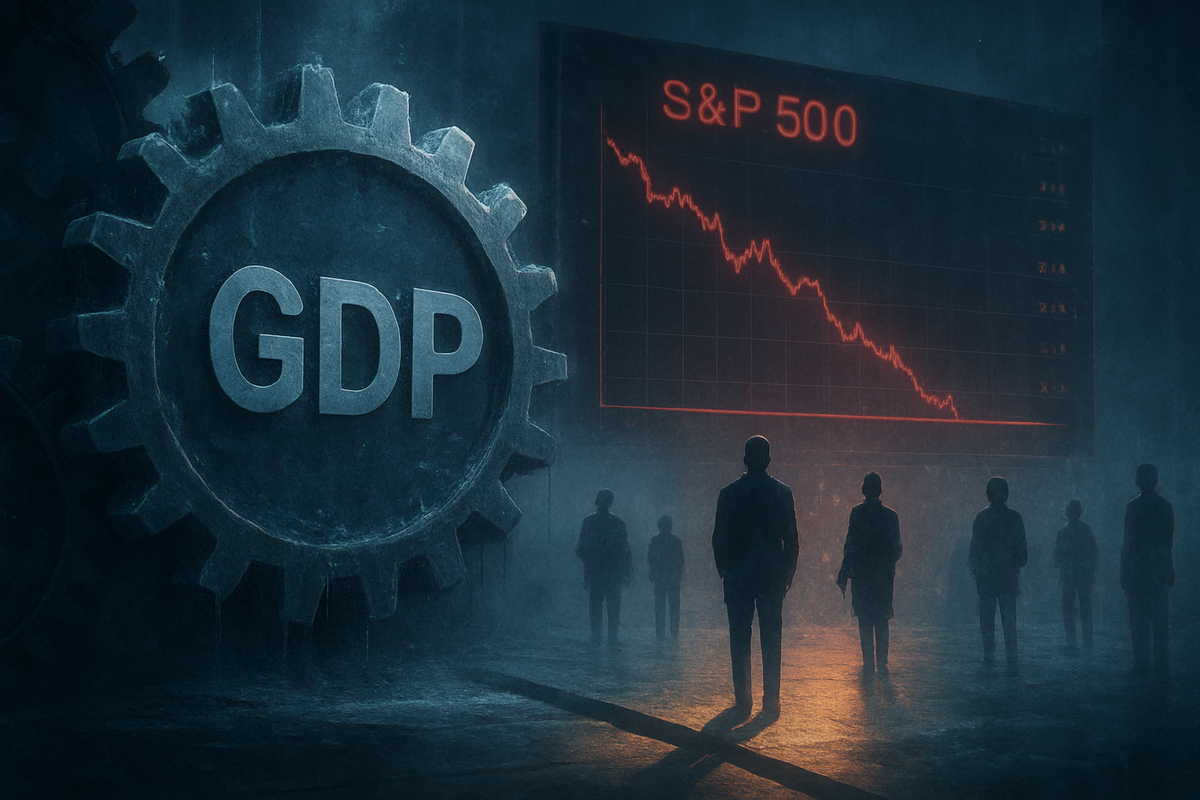
NEW YORK — The American economic engine, which appeared resilient throughout much of 2025, is grinding toward a near-halt in the opening months of 2026. Market analysts and federal agencies are sounding the alarm as the U.S. Gross Domestic Product (GDP) is projected to expand by a meager 0.2% in the first quarter of 2026, a staggering drop from the 2.4% growth rate recorded in the final quarter of 2025. This abrupt deceleration is forcing a massive recalibration on Wall Street, where S&P 500 valuations—already stretched thin by a year of aggressive speculation—are now facing the harsh reality of a "technical recession" threat.
The immediate implications of this "Great Stall" are visible across the financial landscape. Bond yields are fluctuating as investors bet on a potential Federal Reserve pivot, while the equity market has entered a period of heightened volatility. With consumer spending—the traditional backbone of the U.S. economy—showing signs of fatigue and corporate guidance turning cautious, the narrative of a "soft landing" is being replaced by fears of a prolonged period of stagnation.
The Path to 0.2%: A Perfect Storm of Economic Headwinds
The journey to this current economic bottleneck began in the autumn of 2025. While the third quarter of 2025 saw a robust 4.4% expansion, the momentum was severely disrupted by a historic 43-day federal government shutdown that paralyzed Washington from October through November. Although the economy managed to post a 2.4% growth rate in Q4 2025, largely due to a surge in holiday spending and a "front-loading" of imports ahead of 2025 tariff implementations, that temporary boost has evaporated.
By January 2026, the "demand cliff" became undeniable. Retail sales fell 0.2% in the first month of the year, marking the first contraction in nearly six months. This was compounded by what economists are calling the "Great February Freeze," a month where the U.S. economy unexpectedly shed 92,000 jobs. Key players, including the Bureau of Economic Analysis (BEA) and major investment banks like Goldman Sachs (NYSE: GS), have spent the last few weeks slashing their Q1 2026 forecasts from an initial 1.5% down to the currently projected 0.2%.
The reaction from the Federal Open Market Committee (FOMC) has been one of cautious observation. Federal Reserve Chair Jerome Powell, whose term is set to expire in May 2026, has maintained a "hawkish hold," keeping the federal funds rate in the 3.50%–3.75% range. However, as the March 17–18 meeting approaches, the pressure to intervene has reached a fever pitch. Market participants are now intensely focused on whether the Fed will prioritize fighting lingering inflation or stimulating a stalling economy.
Winners and Losers: Equity Markets Under Pressure
As GDP growth slows to a crawl, the S&P 500 has seen its forward price-to-earnings (P/E) ratios—currently hovering between 22x and 25x—come under intense scrutiny. The technology sector, which carried the market in 2025, is showing signs of fragmentation. NVIDIA (NASDAQ: NVDA), the standard-bearer for the AI revolution, recently reported strong Q4 revenue of $68.1 billion, yet its stock price dipped significantly as guidance for Q1 2026 suggested a slowdown in quarterly growth momentum. Investors are no longer rewarding "beats"; they are punishing anything less than exponential acceleration.
On the losing side of this slowdown are the consumer-facing giants. Apple (NASDAQ: AAPL) has faced downward pressure as rising unemployment in early 2026 began to dampen demand for high-end consumer electronics. Similarly, McDonald’s (NYSE: MCD) has reported a decline in foot traffic from low-income demographics, forcing the fast-food leader to pivot back toward aggressive value menus to sustain sales. PayPal (NASDAQ: PYPL) also signaled the cooling environment, issuing Q1 2026 earnings guidance well below Wall Street estimates, citing broader consumer caution and "execution challenges" in a low-growth world.
Conversely, defensive sectors are beginning to shine. Health care and infrastructure-focused technology companies are being viewed as "safe havens." Additionally, gold and other precious metals have seen a resurgence as investors seek protection against potential "stagflation"—a rare and painful combination of stagnant growth and sticky prices. JPMorgan Chase (NYSE: JPM) has noted a shift in institutional flows toward these defensive assets as the "growth-at-any-price" strategy of 2025 loses its luster.
Broad Significance: The Looming "Technical Recession"
This GDP slowdown is not happening in a vacuum; it fits into a broader global trend of exhaustion following the post-pandemic boom years. The shift from 2.4% to 0.2% growth is remarkably similar to the "pre-recession jitters" seen in early 2008 and 2001, where a sudden loss of consumer confidence preceded a wider downturn. The current situation is unique, however, due to the looming leadership change at the Federal Reserve. With Powell’s departure imminent, the market is bracing for a "regime change" that could see a more aggressive or more conservative approach to monetary policy just as the economy hits its most vulnerable point.
The ripple effects are also being felt by U.S. trading partners. As American consumption slows, exporters in Europe and Asia are seeing a cooling of demand for their goods. Furthermore, the regulatory environment is in flux; if the 0.2% expansion turns into a negative print in Q2, the U.S. would officially enter a technical recession, likely triggering automatic stabilizers and renewed calls for fiscal stimulus from a polarized Congress.
What Lies Ahead: A Pivot or a Plunge?
The coming months will be a defining period for the 2026 economic narrative. In the short term, all eyes are on the March FOMC meeting and the subsequent employment reports. If the job losses seen in February continue into March, the Fed may be forced into an emergency rate cut before Powell’s term concludes. A strategic pivot toward "easing" could provide the liquidity needed to jumpstart the economy, but it risks reigniting inflation if the supply side remains constrained by 2025's trade policies.
For corporations, the "playbook" for the remainder of 2026 involves aggressive cost-cutting and a focus on core profitability over expansion. We should expect to see more companies following the lead of McDonald’s and PayPal in lowering expectations and focusing on "value" and "efficiency." Market opportunities may emerge in distressed real estate or oversold consumer discretionary stocks, but these will require a high tolerance for risk and a long-term horizon.
Final Wrap-up: Navigating the 0.2% Economy
The transition from a 2.4% growth rate in late 2025 to a projected 0.2% in Q1 2026 represents a critical "reality check" for the American economy and the S&P 500. The combination of a government shutdown hangover, tariff-driven consumption shifts, and a cooling labor market has created a precarious environment for investors. While the "AI tailwind" still provides some support for the tech sector, it is no longer enough to carry the entire market on its back.
Moving forward, the market will likely be characterized by a "K-shaped" recovery within sectors—separating the companies with strong balance sheets and essential services from those reliant on discretionary spending. Investors should remain vigilant, watching for the "June Pivot" at the Fed and paying close attention to the personal saving rate, which has dipped to a concerning 3.6%. As we navigate this period of near-zero growth, the focus must shift from chasing gains to preserving capital and identifying the few areas of the economy that can still thrive in a low-growth world.
This content is intended for informational purposes only and is not financial advice.