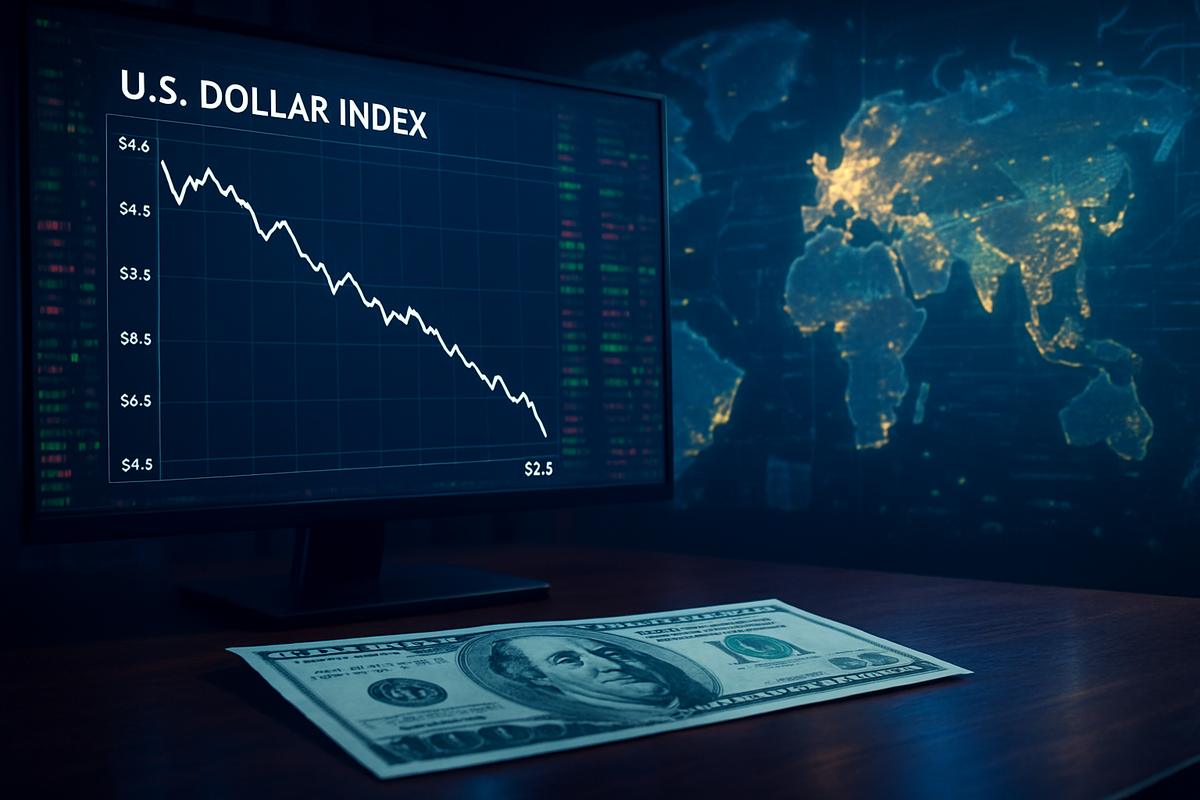
The U.S. Dollar Index (DXY) has plummeted to its lowest levels since early 2022, breaching the critical 95.5 support level in late January and early February before settling into a volatile range of 98.50 to 99.13 as of March 3, 2026. This downward trajectory marks a significant regime shift for global markets, ending years of "dollar exceptionalism" and forcing investors to re-evaluate the structural integrity of the American economy. While a recent safe-haven bounce—triggered by escalating military tensions in the Middle East and strikes involving the U.S. and Iran—has provided temporary relief, the broader trend remains decidedly bearish for the world's primary reserve currency.
The implications of a sustained dollar retreat are sweeping, touching everything from the balance sheets of Silicon Valley tech giants to the price of consumer goods in the Heartland. As the U.S. national debt surges past the $38 trillion mark, a growing "Sell America" trade has emerged, characterized by a massive rotation of capital out of U.S. Treasuries and into European and emerging market equities. However, this pessimistic outlook is being challenged by a "Resilient Growth" counter-narrative, which suggests that an AI-driven productivity miracle is laying the groundwork for a soft landing, potentially positioning the dollar for a mid-year recovery as the Federal Reserve navigates a high-stakes leadership transition.
The Path to 95.5: A Timeline of the Dollar’s Decline
The journey to four-year lows began in earnest throughout 2025, as the Federal Reserve executed a series of three decisive interest rate cuts. By the start of 2026, the target range for the federal funds rate sat at 3.50% to 3.75%, a sharp departure from the "higher for longer" era of 2023. This policy pivot was driven by a cooling labor market and a shift in the central bank’s dual mandate from aggressive inflation-fighting to recession-prevention. The dollar’s weakness accelerated in January 2026 when fiscal data revealed that interest payments on the national debt had begun to eclipse defense spending, sparking fears of long-term currency debasement and a loss of "risk-free" status for U.S. sovereign bonds.
Key stakeholders, including global hedge funds and sovereign wealth funds, responded by cutting their "long dollar" positions to the lowest levels in five years. The market reaction was further complicated by the announcement in February 2026 that Kevin Warsh had been nominated to succeed Jerome Powell as Federal Reserve Chair when the latter's term expires in May. Initially, the nomination was seen as a potential "repudiation" of the Sell America trade, as Warsh is widely expected to prioritize growth-focused policies and maintain central bank independence. However, the relief was short-lived, as an energy shock on March 3—driven by the closure of the Strait of Hormuz—pushed oil prices to eight-month highs, muddling the inflation outlook and forcing the DXY into its current defensive bounce.
Industry reactions have been polarized. While currency traders are grappling with the highest volatility in years, commodity markets have surged, with gold and copper hitting record highs as they are priced in a cheaper currency. The "alligator economy," a term coined by analysts to describe a K-shaped recovery where the bottom is finally trending upward, is currently being tested. While lower energy prices throughout late 2025 helped boost domestic consumption, the sudden spike in crude on March 3 threatens to reignite the very inflation the Fed spent years trying to extinguish.
Multinationals Rejoice While Importers Face the Squeeze
For U.S.-based multi-national corporations, the weaker dollar has become a potent tailwind, effectively boosting international sales when translated back into the domestic currency. Microsoft (NASDAQ: MSFT) recently highlighted this dynamic in its February 2026 earnings report; despite heavy capital expenditures on AI infrastructure, the tech giant saw its Azure cloud revenue grow by 38%, bolstered significantly by favorable foreign exchange movements. Similarly, McDonald’s (NYSE: MCD) emerged as a standout performer, reporting a 9.5% increase in systemwide revenue, with its international developmental licensed markets benefiting directly from the dollar’s slide against the Euro and Yen.
Other major winners include consumer staples giants like Coca-Cola (NYSE: KO) and PepsiCo (NASDAQ: PEP). PepsiCo specifically cited the weaker dollar as a primary factor in mitigating what was expected to be a much larger annual profit drop. For these companies, which derive more than half of their revenue from outside the United States, every percentage point of dollar weakness adds millions to the bottom line. Netflix (NASDAQ: NFLX) and industrial conglomerate 3M (NYSE: MMM) have also seen "windfall" gains, allowing them to remain competitive in global markets despite rising domestic labor costs.
Conversely, the "Sell America" trade has created significant hurdles for domestic-focused retailers and industrial players that rely heavily on imported materials. Dollar General (NYSE: DG) has struggled as the cost of imported goods rose, squeezing margins that were already thin. In the industrial sector, Nucor (NYSE: NUE) and Union Pacific (NYSE: UNP) have faced headwinds; while they do not suffer from foreign exchange translation in their revenues, the rising cost of imported equipment and fuel, combined with a lack of international sales to offset the currency's decline, has dampened their earnings outlook. This divergence is creating a widening gap between the "global winners" and "domestic losers" on Wall Street.
A Macro Battle: Structural Rot vs. The AI Miracle
The current market environment draws striking parallels to early 2021, when a global "reopening" trade saw international growth catch up to the United States, naturally weighing on the dollar. However, many analysts at Bank of America suggest the more accurate historical analogue is 1995. In that era, tech-driven productivity allowed for a soft landing and Federal Reserve rate cuts even as inflation remained "sticky" near 3%. Proponents of the "Resilient Growth" view argue that the current AI boom is a 1995-style event, where increased efficiency will eventually allow the U.S. to grow its way out of its debt burden, eventually stabilizing the dollar.
On the other side of the debate, the "Sell America" camp points to the 2018 divergence as a warning. In 2018, the dollar rose because the Fed was hiking rates during a global trade war; today, the situation is reversed, with the Fed easing while global markets outperform. The structural concern regarding the $38 trillion debt is no longer a fringe talking point but a primary driver of institutional portfolio allocation. This has led to a significant rotation into the Eurozone and emerging markets, as investors bet that the era of U.S. outperformance is finally drawing to a close.
Regulatory and policy implications are also looming large. The transition from Jerome Powell to Kevin Warsh in May 2026 introduces a "policy risk premium" that has kept the dollar under pressure. Investors are watching closely to see if the new Fed leadership will tolerate slightly higher inflation (the core PCE remains "sticky" at 2.8%) in exchange for ensuring a smooth transition for the labor market. This shift from an "inflation-fighting" stance to one of "recession-prevention" is perhaps the most significant structural change in U.S. monetary policy in over a decade.
The Road Ahead: Scenarios for the Second Half of 2026
In the short term, the dollar’s fate is inextricably linked to the geopolitical situation in the Middle East. If the current conflict escalates further, the DXY could see a sustained "safe-haven" rally back toward the 102 level, despite the underlying economic weaknesses. However, if tensions de-escalate, the path of least resistance remains lower. Markets are currently pricing in a 50 to 100 basis point reduction in interest rates by the end of 2026, with the next cut potentially coming in September if the March energy shock proves to be transitory.
The transition at the Federal Reserve in May will be the most critical pivot point for the year. A "dovish but credible" stance from Kevin Warsh could provide the best-case scenario: a controlled decline in the dollar that supports exports without triggering a full-scale currency crisis. For corporations, the strategic adaptation will involve more aggressive hedging of foreign exchange risks and potentially a renewed focus on international expansion to capture the currency tailwinds. Market opportunities may emerge in "late-cycle" sectors like industrials and materials, which tend to benefit from both a weaker currency and continued global infrastructure spending.
Potential scenarios range from a "Goldilocks" soft landing, where the dollar stabilizes at current levels, to a "Hard Landing" where the Sell America trade turns into a rout. Investors should watch for the 95.0 level on the DXY; a break below that could signal a technical breakdown that hasn't been seen in nearly a decade. Conversely, if U.S. AI-related earnings continue to beat expectations, the "Resilient Growth" view may finally win out, prompting a massive short-squeeze that sends the greenback surging back toward par.
Final Assessment: Navigating a New Currency Regime
As of March 2026, the era of the seemingly invincible U.S. dollar has ended. The fall to four-year lows is a clear signal that the world is no longer willing to ignore the U.S. fiscal deficit, especially as other global economies offer competitive growth prospects. For investors, the takeaway is clear: the benefits of geographic diversification have rarely been higher. The massive currency tailwinds enjoyed by companies like Microsoft and Coca-Cola are likely to persist, providing a cushion for earnings even if the domestic U.S. economy experiences a slowdown.
Looking forward, the market will be driven by three pillars: the path of Fed rate cuts, the success of the AI-driven productivity transition, and the stabilization of the national debt. While the "Sell America" trade has dominated the headlines, the underlying strength of the U.S. private sector remains a formidable counter-force. The coming months will determine whether the dollar's retreat is a healthy correction or the start of a long-term decline in American economic hegemony.
Investors should maintain a close eye on core PCE data and the rhetoric coming from the Fed during the leadership transition in May. Additionally, the impact of the March energy shock on inflation expectations will be the primary catalyst for short-term dollar movements. In this high-stakes environment, flexibility and a keen eye on foreign exchange translation will be the hallmarks of a successful investment strategy in 2026.
This content is intended for informational purposes only and is not financial advice.