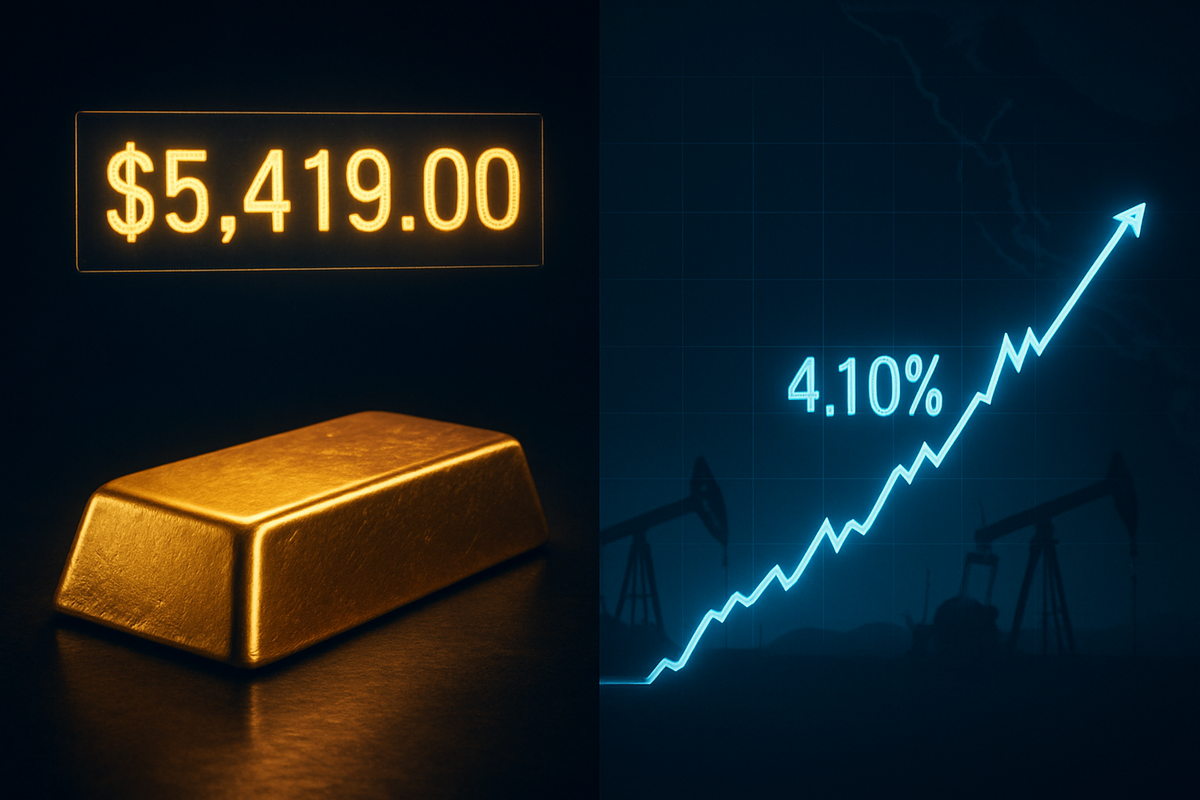
As of March 3, 2026, the global financial landscape is grappling with a paradox that has shattered decade-old correlations. Gold prices have surged to unprecedented heights, touching an intraday record of $5,419 per ounce, even as the benchmark 10-year U.S. Treasury yield reclaimed the 4.10% level. Traditionally, these two assets move in opposite directions; higher yields typically increase the opportunity cost of holding non-yielding bullion. However, a "stagflationary" shock triggered by extreme geopolitical instability has forced both safe-havens to rise in tandem, signaling a fundamental shift in how markets price risk and inflation.
This decoupling comes at a time of high anxiety for global investors. The primary driver is a dramatic escalation in Middle Eastern tensions following military strikes on February 28, which has reignited fears of a permanent energy-driven inflation spike. While gold serves as the ultimate hedge against geopolitical chaos and currency erosion, Treasury yields are rising not because of economic strength, but because bondholders are demanding a higher "inflation premium" to compensate for the soaring cost of oil, which has breached the $80-per-barrel mark for Brent crude.
A Geopolitical Spark and the Death of Correlation
The catalyst for this market upheaval was the February 28, 2026, military strike involving U.S. and Israeli forces against Iranian infrastructure. The resulting instability, including threats to the Strait of Hormuz—a vital artery for 20% of the world's oil supply—sent immediate shockwaves through the commodities complex. By the morning of March 2, the SPDR Gold Shares (NYSEARCA: GLD) and physical spot gold markets saw a "flight to safety" of historic proportions. Investors, fearing a protracted regional conflict and the potential for a global supply chain freeze, liquidated equity positions in favor of the yellow metal.
Simultaneously, the bond market began to hemorrhage. The 10-year U.S. Treasury yield, which had ended February at a relatively stable 3.96%, spiked to 4.107% by March 3. This move was driven by a realization that the "inflation monster" was far from tamed. As Brent crude oil prices jumped 14% in a single session, traders abandoned the hope of imminent Federal Reserve rate cuts. According to the CME FedWatch Tool, the probability of a summer rate cut has evaporated, with markets now bracing for a "higher-for-longer" stance that could persist until September 2026 or beyond.
This rare alignment—rising yields and rising gold—indicates that investors no longer view Treasuries as a refuge from inflation, but rather as a victim of it. In this environment, gold has transitioned from being a mere rival to the dollar to becoming a standalone proxy for global systemic trust.
Winners and Losers in a High-Yield, High-Gold Era
The primary beneficiaries of this divergence have been the major precious metal miners and energy giants. Newmont Corporation (NYSE: NEM) and Barrick Gold (NYSE: GOLD) saw their shares jump significantly as the widening margins between production costs and record-high selling prices bolstered their balance sheets. Similarly, energy titans like Exxon Mobil (NYSE: XOM) and Chevron (NYSE: CVX) have outperformed the broader S&P 500, as the oil price surge directly translates to windfall profits, despite the broader economic cooling.
Conversely, the losers in this scenario are widespread. Fixed-income investors holding long-duration assets, such as those in the iShares 20+ Year Treasury Bond ETF (NASDAQ: TLT), have seen significant capital erosion as yields climbed. The rising yield environment has also placed immense pressure on high-growth technology sectors. Companies that rely on low-cost borrowing and future-dated cash flows are seeing their valuations compressed by the twin pressures of high rates and rising input costs. Furthermore, the retail sector is beginning to buckle as the "energy tax" of $80+ oil starts to squeeze consumer discretionary spending.
Redefining the 'Safe-Haven' Trade
The significance of this event extends far beyond a simple price spike; it represents a potential "regime change" in global finance. Historically, the "60/40" portfolio relied on bonds to offset equity losses. However, in the current March 2026 climate, bonds are falling alongside stocks, leaving gold as one of the few functional diversifiers left. This mirrors the stagflationary periods of the 1970s, where traditional relationships between asset classes broke down under the weight of supply-side shocks.
The ripple effects are also being felt in central bank corridors. The Federal Reserve now faces a policy nightmare: an economic slowdown coupled with accelerating energy inflation. Unlike the 2023-2024 period where inflation was driven by post-pandemic liquidity, the 2026 spike is driven by geopolitical scarcity. This limits the effectiveness of interest rate hikes, as monetary policy can do little to reopen shipping lanes or lower the price of crude oil. Consequently, the "inflation hedge" status of gold has reached a new level of institutional credibility, with central banks themselves reportedly increasing their bullion reserves.
What Lies Ahead: The Path to September 2026
In the short term, markets are likely to remain volatile as they digest the next moves from Tehran and Washington. If the Strait of Hormuz remains contested, the "oil-gold" correlation will likely strengthen, potentially pushing the 10-year yield toward the 4.25% or 4.50% mark as inflation expectations become unanchored. Investors should anticipate a period of "liquidity-driven" volatility, where the U.S. Dollar Index (DXY) remains strong due to its status as a global reserve currency, potentially creating a temporary ceiling for gold's stratospheric rise.
Longer-term, the strategic pivot for investors will involve moving away from traditional fixed income and toward "real assets." The current divergence suggests that the market is preparing for a multi-year period where inflation remains structurally higher than the previous decade’s average. Companies that possess "pricing power" and low debt-to-equity ratios will be the survivors in this high-yield, high-cost environment.
Summary and Market Outlook
The events of early March 2026 have fundamentally altered the investment playbook. The rare tandem rise of gold and Treasury yields serves as a stark warning that the threat of re-ignited inflation—fueled by energy and geopolitics—is now the dominant market narrative. While the $5,419 peak for gold may see some consolidation as the dollar strengthens, the underlying demand for hard assets remains robust.
Moving forward, investors must keep a close watch on two critical metrics: the 10-year Treasury's ability to hold the 4.10% level and the weekly inventory reports for crude oil. These will serve as the "canaries in the coal mine" for the next phase of this stagflationary cycle. As we look toward the second half of 2026, the resilience of the gold market suggests that even if yields remain elevated, the hunt for safety has moved beyond the sovereign debt market and into the vaults of the world's oldest currency.
This content is intended for informational purposes only and is not financial advice.