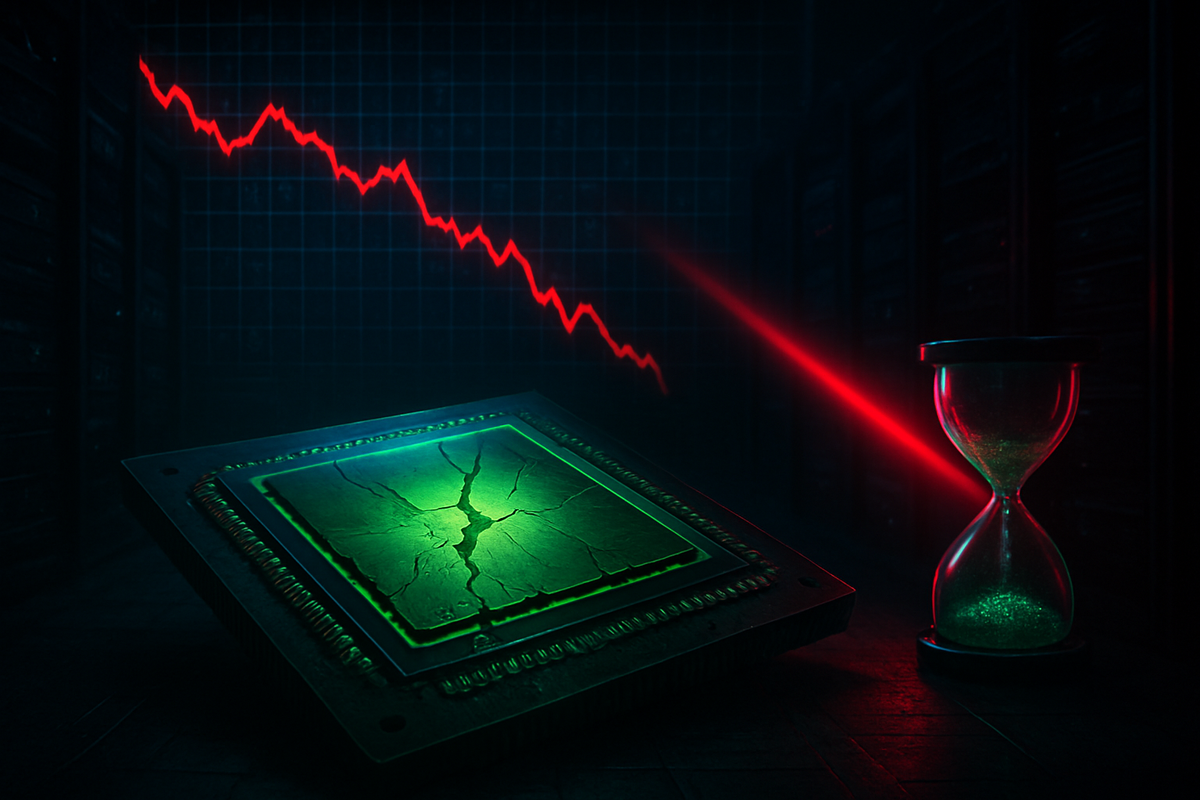
On February 26, 2026, the artificial intelligence trade, which has fueled the most significant bull market of the decade, hit a sobering wall. Shares of Nvidia (Nasdaq: NVDA) plummeted 5.5% in a single trading session, erasing roughly $260 billion in market capitalization despite the company reporting financial results that once would have been hailed as historic. This sharp correction suggests that the "hyper-growth" phase of the AI cycle is transitioning into a much more scrutinized period of "growth durability," where the focus is no longer on how many chips can be sold, but on whether the customers buying them can actually turn a profit.
The sell-off followed Nvidia's Q4 fiscal 2026 earnings report released late the previous evening. While the company beat analyst expectations on both the top and bottom lines—reporting record revenue of $68.1 billion—the market’s reaction was decidedly cold. For the first time in years, a "double-beat and raise" was met with a massive exit, as investors began to fear that the massive infrastructure build-out by hyperscalers is nearing its peak and that competition is finally starting to bite into Nvidia's once-impenetrable moat.
A "Priced for Perfection" Stall
The catalyst for the February 26 decline was a classic "sell-the-news" event, but the underlying anxiety had been building for weeks. Leading up to the earnings report, a leaked internal research note from analysts at Goldman Sachs (NYSE: GS) suggested that the nearly $400 billion spent on AI infrastructure globally in 2025 had yet to show a meaningful impact on U.S. GDP growth. This sparked a "de-risking" trend across the tech sector, making investors hypersensitive to any sign of a slowdown. When Nvidia’s guidance for the upcoming quarter came in at $78 billion—technically a beat—many in the market viewed it as a sign of deceleration compared to the triple-digit percentage gains of 2024 and 2025.
Timeline-wise, the pressure intensified on February 24, when Meta Platforms (Nasdaq: META) announced a multi-year deal to diversify its hardware stack, moving away from an exclusive reliance on Nvidia. By the time CEO Jensen Huang took the stage for the earnings call on the 25th, the narrative had already shifted. Huang emphasized the upcoming transition to the Vera Rubin architecture, promising a 10x reduction in inference costs, but his words struggled to counteract the growing "Peak AI 2026" theory circulating on Wall Street. Initial market reactions saw a broad-based sell-off in semiconductor stocks, as the "Nvidia fatigue" that analysts had been warning about finally broke the stock's momentum.
Key stakeholders, including institutional asset managers who have ridden Nvidia’s meteoric rise, are now wrestling with "customer concentration" risk. With a handful of companies like Microsoft (Nasdaq: MSFT), Amazon (Nasdaq: AMZN), and Alphabet (Nasdaq: GOOGL) accounting for a massive percentage of Nvidia’s revenue, any sign that these "hyperscalers" are tightening their belts or building their own custom silicon sends shockwaves through the supply chain.
Winners and Losers in a Diversifying Market
The biggest winner in this recent shift appears to be Advanced Micro Devices (Nasdaq: AMD). While Nvidia’s stock was reeling, AMD shares remained resilient, buoyed by the Meta partnership. Meta’s commitment to deploying AMD’s Instinct MI450-based GPUs and 6th Gen "Venice" EPYC CPUs serves as a massive validation of AMD as a viable second source for high-performance AI compute. Investors are increasingly viewing AMD as a "catch-up" play, offering a 15% market share potential in a segment where Nvidia’s 90% dominance is seen as unsustainable.
Conversely, the "losers" extend beyond just Nvidia. The broader Software-as-a-Service (SaaS) sector, including companies like Salesforce (NYSE: CRM) and Adobe (Nasdaq: ADBE), has been caught in the crossfire. There is a growing fear that if the AI infrastructure boom doesn't quickly translate into software revenue, these companies will be the first to suffer from reduced enterprise spending. Server manufacturers like Super Micro Computer (Nasdaq: SMCI) also saw sympathetic declines, as their fortunes are inextricably linked to the volume of Nvidia’s rack-scale deployments.
Furthermore, the cloud providers themselves are under the microscope. If the ROI on the hundreds of billions spent on AI remains elusive, the market may begin to penalize Microsoft and Google for their aggressive capital expenditure (CapEx) budgets. For these tech giants, the Feb 26 drop was a warning: the market will no longer give a "free pass" to massive spending without clear evidence of monetization.
The Shift from Training to Inference
This event fits into a broader industry trend toward the "inference" phase of artificial intelligence. For the past three years, the market has been obsessed with "training"—the massive, power-hungry process of building models. However, as we move into 2026, the focus is shifting to how these models are used. This "inference" market is more price-sensitive and potentially more competitive, allowing challengers like AMD and even specialized startups to gain a foothold where Nvidia’s CUDA software ecosystem is less of an insurmountable barrier.
Historical precedents, such as the build-out of fiber optic networks in the late 1990s, are being frequently cited by skeptics. Just as the massive infrastructure of the dot-com era eventually led to a "telecom winter" before the true utility of the internet was realized, some fear the AI market is entering a similar consolidation phase. Regulatory implications are also looming, as governments in the U.S. and EU begin to scrutinize the power consumption of AI data centers, potentially slowing the pace of new construction and, by extension, chip orders.
The ripple effect is also being felt in the energy sector. The "AI-Energy Nexus" has become a central theme, with the massive power requirements of next-generation chips like Nvidia's Blackwell and Rubin platforms forcing a conversation about grid stability. If power becomes the ultimate bottleneck for AI scaling, the valuation of hardware providers may continue to face downward pressure, regardless of how fast their engineering teams can innovate.
What Lies Ahead: A Strategic Pivot Required
In the short term, Nvidia will likely need to convince the market that its transition to the Vera Rubin platform will be seamless and that yield issues often associated with cutting-edge 2nm processes are under control. The upcoming GTC Conference will be a critical venue for the company to reclaim the narrative. To regain its "hyper-growth" premium, Nvidia must show that it is more than just a hardware vendor—it must prove that its software and networking stack (Infiniband and Spectrum-X) creates a "sticky" ecosystem that competitors cannot easily disrupt.
Longer-term, the market is waiting for the emergence of the "Killer AI App" for the consumer space. Until there is a software breakthrough that justifies the trillions of dollars in collective enterprise valuation, the hardware trade will remain volatile. Potential strategic pivots for Nvidia might include more aggressive moves into custom silicon design services for their largest customers, effectively competing with their own partners to ensure they remain the architects of the AI future.
Scenario planning for investors now involves a world where Nvidia is a "normal" high-performing company rather than a miracle stock. Challenges such as geopolitical tensions in the Taiwan Strait and the maturation of the Chinese domestic chip industry remain "gray swan" events that could further complicate the recovery. The era of blind faith in AI growth has ended; the era of disciplined execution and proven ROI has begun.
Final Thoughts: The Maturation of the AI Trade
The events of late February 2026 mark a definitive turning point in market history. The 5.5% drop in Nvidia shares was not merely a correction; it was a signal that the market's "hallucination phase"—where potential was valued over proof—is over. Key takeaways include the growing legitimacy of AMD as a primary challenger and the fact that "stellar results" are no longer enough to satisfy a market that has already priced in several years of perfect execution.
Moving forward, the market is likely to remain bifurcated. Companies that can demonstrate real-world efficiency gains and monetization from AI will lead the next leg of the cycle, while those purely riding the "AI-adjacent" hype may continue to see their valuations compressed. The durability of growth is now the only metric that truly matters.
For investors, the coming months will require a shift in strategy. Watching the capital expenditure reports of the "Magnificent Seven" hyperscalers will be more important than watching Nvidia’s own quarterly beats. As the dust settles on this $260 billion wipeout, the question remains: was this a healthy pause in a long-term bull market, or the first crack in the AI foundation?
This content is intended for informational purposes only and is not financial advice