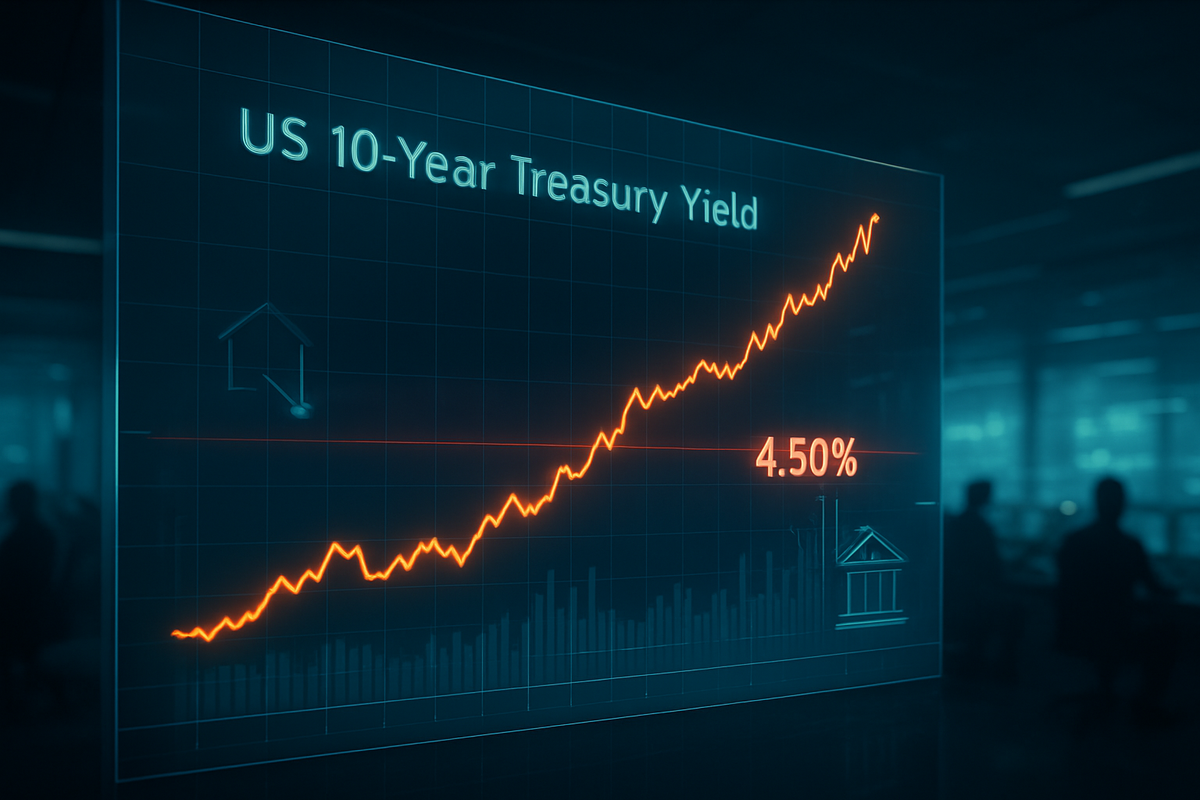
As of March 3, 2026, the financial world is fixated on a singular number: 4.50%. The US 10-year Treasury yield, a global benchmark for borrowing costs, is currently oscillating between 4.04% and 4.10%, but technical analysts and institutional traders are sounding the alarm as it approaches the critical 4.50% breakout target. This level, often described as a "line in the sand," represents a multi-decade resistance zone not breached decisively since 2007. A move above this threshold would signal a definitive shift into a "higher-for-longer" economic regime, fundamentally altering the valuation models for everything from suburban homes to Silicon Valley startups.
The immediate implications are already being felt across the fixed-income landscape. While a surge in safe-haven demand—fueled by escalating geopolitical tensions in the Middle East—has provided a temporary ceiling for yields, the underlying pressure from sticky 3% inflation and a massive federal deficit remains relentless. For the broader market, the 4.50% mark is more than just a psychological barrier; it is a technical trigger that could accelerate "bear steepening," pushing long-term rates toward 5.0% and beyond, potentially destabilizing a fragile post-AI-hype recovery.
The Technical Ascent: A Timeline of Tapering Hopes
The journey to the current 4.50% standoff began in late 2023, following a series of aggressive Federal Reserve hikes that took the Fed Funds Rate to its current 3.50%–3.75% range. Throughout 2024 and 2025, markets repeatedly bet on a "dovish pivot" that never fully materialized, as the core Personal Consumption Expenditures (PCE) price index remained anchored near 2.8%. By early 2026, the technical narrative shifted from "when will rates fall?" to "how high can the ceiling go?" Technical charts now reveal a massive symmetrical triangle pattern that has been narrowing for over two years, with the 4.50% level acting as the upper resistance bound.
Key stakeholders, including the outgoing Federal Reserve Chair Jerome Powell—whose term concludes in May 2026—have maintained a cautious stance, refusing to commit to further cuts until labor market productivity offsets persistent service-sector inflation. Initial market reactions to the recent yield climb have been defensive. In January 2026, when yields briefly touched 4.26%, the S&P 500 saw a 4% correction in a single week, underscoring the equity market’s extreme sensitivity to the "risk-free" rate. Bond vigilantes are now watching the term premium closely, wary that a lack of fiscal discipline in Washington could be the final catalyst to push yields through the 4.50% barrier.
Corporate Winners and Losers in a High-Yield Era
The approach toward 4.50% is creating a sharp divide between capital-intensive industries and those with "fortress" balance sheets. Homebuilders like D.R. Horton (NYSE: DHI), Lennar (NYSE: LEN), and PulteGroup (NYSE: PHM) are on the front lines of this volatility. D.R. Horton recently reported a significant dip in net income as it was forced to allocate billions toward mortgage rate buydowns to keep monthly payments affordable for buyers facing 7% mortgage rates. Conversely, PulteGroup has found a niche in the "active adult" segment, where buyers are less rate-sensitive, allowing the company to maintain higher margins than its entry-level competitors.
In the banking sector, the impact is nuanced. JPMorgan Chase & Co. (NYSE: JPM) has leveraged its scale to raise its 2026 Net Interest Income (NII) outlook to over $104 billion, benefiting from a "fortress balance sheet" that allows it to lock in high yields on long-term Treasuries. However, Bank of America (NYSE: BAC) faces steeper challenges with "deposit beta," as it must pay higher rates to retain depositors who are increasingly tempted by 4.5% Treasury bills. Meanwhile, the tech sector is seeing a "Great Anchoring" of valuations. NVIDIA (NASDAQ: NVDA) and Apple (NASDAQ: AAPL) are no longer trading solely on hype; at a 4.5% yield, their future earnings are discounted more heavily, forcing a focus on "earnings execution" and massive share buybacks to protect stock floors.
Wider Significance: The End of Easy Money
The potential 4.50% breakout is not an isolated event; it fits into a broader global trend of "regime uncertainty." For the past two decades, the global economy operated under a disinflationary tailwind driven by globalization and technological efficiency. In 2026, that tailwind has turned into a crosswind of protectionism and "fiscal dominance." The US government’s need to refinance trillions in debt at these higher rates is creating a "crowding out" effect, where public borrowing competes directly with private investment, keeping upward pressure on the 10-year yield regardless of Fed policy.
This mirrors historical precedents such as the late 1970s, where inflation proved difficult to eradicate, leading to a decade of high structural rates. The ripple effects extend to the "lock-in effect" in the housing market, where homeowners with 3% mortgages are effectively "trapped" in their homes, unable to move without doubling their interest expense. This has frozen the existing home market, fundamentally shifting the business models of real estate platforms and providing a paradoxical tailwind to new-home construction, which now provides the only available inventory for a growing population.
The Path Forward: Scenarios for the Rest of 2026
Looking ahead, two primary scenarios dominate the outlook. In the "Breakout Scenario," a hotter-than-expected inflation print or a failure in a major Treasury auction could propel the 10-year yield past 4.50%, triggering a wave of algorithmic selling that targets 5.0%. This would likely necessitate a strategic pivot from the Federal Reserve, potentially forcing them to pause any planned rate cuts or even reconsider "Yield Curve Control" if market functioning becomes impaired. For corporations, this would mean a rush to the "maturity wall," as companies with debt expiring in 2026/2027 scramble to refinance at significantly higher costs.
Alternatively, a "Growth Scare" could see yields retreat toward 3.75%. If AI-driven labor disruptions begin to significantly increase unemployment, the narrative could shift from inflation to recession. In this environment, long-dated Treasuries would become the ultimate "flight-to-safety" asset, potentially providing a windfall for asset managers like BlackRock (NYSE: BLK), which has seen record inflows into fixed-income ETFs. Investors should prepare for increased volatility as the market tests these extremes, with a focus on "yield-plus" strategies found in specialty REITs like Equinix (NASDAQ: EQIX) or VICI Properties (NYSE: VICI), which offer income plus protection from underlying secular trends.
Final Assessment: Navigating the 4.5% Threshold
The approach of the 10-year Treasury yield toward the 4.50% breakout target is the defining macro event of early 2026. It serves as a stark reminder that the era of ultra-cheap capital is firmly in the rearview mirror. The key takeaway for investors is that "valuation matters again." In a world where the risk-free rate is 4.5%, the hurdle for any investment—be it a tech startup or a commercial real estate project—is significantly higher than it was just a few years ago.
Moving forward, the market will likely remain in a state of high-tension equilibrium until a clear catalyst emerges. Investors should watch the upcoming FOMC meetings and the transition to the new Fed Chair in May for clues on the long-term policy trajectory. Success in this environment will require a focus on quality, liquidity, and sectors with structural tailwinds, such as AI infrastructure and defensive financials. While the 4.50% level is a daunting technical hurdle, it also provides the highest yields for savers and bondholders in a generation, marking a return to a more traditional, if more volatile, financial landscape.
This content is intended for informational purposes only and is not financial advice.