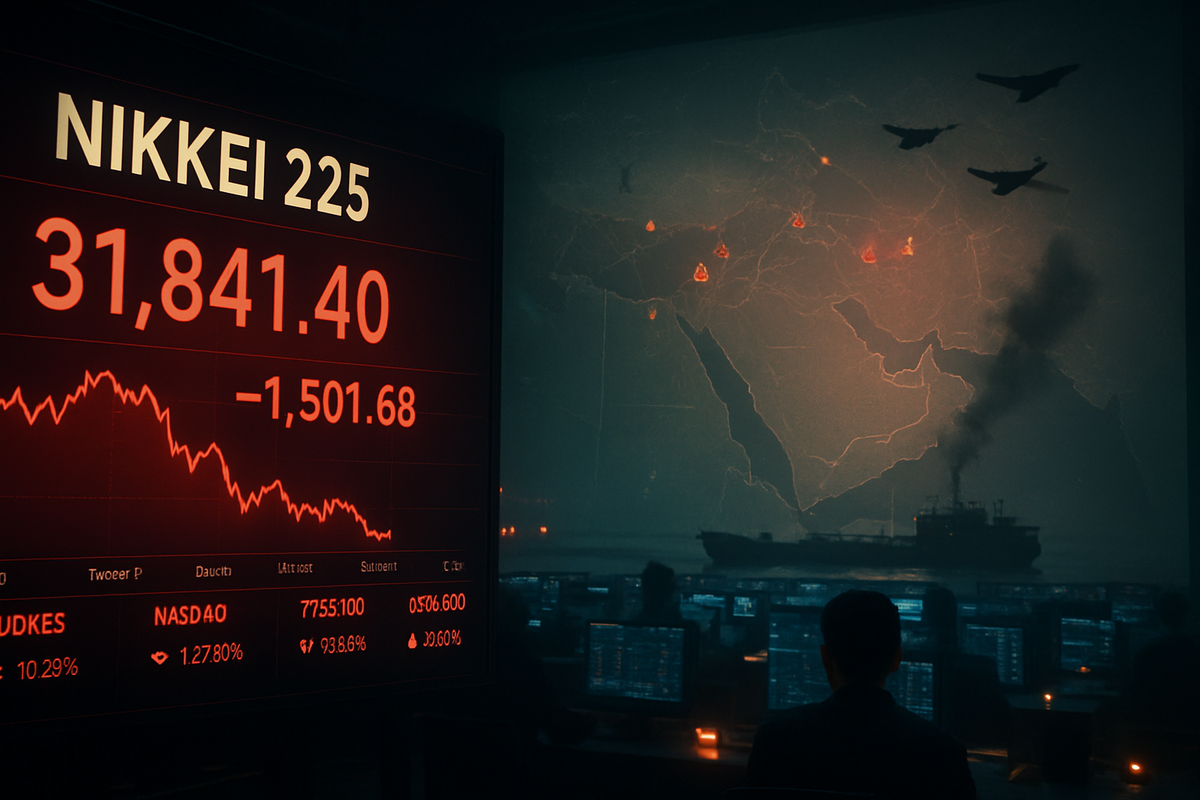
TOKYO — Global financial markets entered a state of high alert on Tuesday, March 3, 2026, as the conflict between a U.S.-led coalition and Iran escalated into a full-scale regional crisis. The Nikkei 225 index in Tokyo plummeted 3.06%, closing at 56,279.05, marking its sharpest single-day decline in months. The sell-off, which began in Asia, has rapidly transmitted through global financial centers, casting a long shadow over U.S. pre-market trading and igniting fears of a prolonged disruption to the world’s energy and technology supply chains.
The volatility follows a weekend of unprecedented military action dubbed "Operation Epic Fury." As investors digest reports of precision strikes on Iranian nuclear facilities and the subsequent closure of the Strait of Hormuz, a massive "risk-off" sentiment has gripped the markets. Beyond the equity losses, safe-haven assets like gold and the U.S. dollar have surged, while Brent crude oil prices breached the $84-per-barrel mark, threatening to unleash a "second wave" of global inflation that could force central banks to rethink their interest rate trajectories.
The Escalation of "Operation Epic Fury"
The current market turmoil is the direct result of a rapid military escalation that began on February 28, 2026. The U.S. and Israeli coalition launched a series of high-intensity air strikes across Iran, targeting critical military command structures and nuclear enrichment sites. Intelligence reports suggesting the death of senior Iranian leadership, including Supreme Leader Ayatollah Khamenei, have sent shockwaves through the Middle East. Iran’s "bitter retaliation" was swift and multi-pronged, involving drone and missile strikes on the U.S. Embassy in Riyadh and targets near the U.S. diplomatic compound in Kuwait.
Perhaps the most significant blow to the global corporate sector occurred on March 1 and 2, when Iranian drones targeted critical infrastructure in the United Arab Emirates and Bahrain. Physical damage to major cloud computing hubs caused a localized but severe collapse of digital services. In the UAE, two availability zones were knocked offline, leading to a massive failure of over 60 Amazon Web Services (AWS) protocols. This physical destruction of "the cloud" in a conflict zone has forced multinational corporations to scramble for data backups and migration strategies, a scenario previously considered a low-probability "tail risk."
The timeline moved into a critical phase late Monday night when Iranian state media announced the total closure of the Strait of Hormuz. By claiming the ability to "burn" any passing vessel, Tehran has effectively held 20% of the world’s daily oil supply—and 90% of the oil destined for Asian markets—hostage. This bottleneck is the primary driver behind the 3% crash in the Nikkei, as Japan’s energy-dependent economy remains uniquely vulnerable to maritime disruptions in the Persian Gulf.
Market Casualties and Conflict Beneficiaries
The carnage in the Asia-Pacific markets was most pronounced among industries sensitive to fuel costs and supply chain stability. In Japan, Japan Airlines (TYO: 9201) saw its shares dive 6.4%, while its rival ANA Holdings (TYO: 9202) dropped 3.3%. In South Korea, the KOSPI index suffered an even more dramatic 7.2% collapse as semiconductor titans Samsung Electronics (KRX: 005930) and SK Hynix (KRX: 000660) both shed over 6% of their value amid fears that a broader war would disrupt the delicate logistics of high-tech manufacturing.
Conversely, the defense and energy sectors have emerged as the only bright spots in a sea of red. In the U.S. pre-market, defense contractors like Lockheed Martin (NYSE: LMT) and Raytheon (NYSE: RTX) trended higher as investors bet on sustained military spending. Energy producers with significant domestic or non-Middle Eastern footprints, such as Diamondback Energy (NASDAQ: FANG) and Devon Energy (NYSE: DVN), saw gains of approximately 3% as oil prices spiked.
However, the tech sector faces a dual threat. Beyond the general market downturn, the direct strikes on Amazon (NASDAQ: AMZN) data centers have highlighted a new era of physical vulnerability for tech giants. Companies like Apple (NASDAQ: AAPL) were forced to temporarily shutter retail operations in the UAE, while cloud-reliant firms like Snowflake (NYSE: SNOW) reported regional service disruptions. The burgeoning AI industry, which had recently established the UAE as a high-performance computing hub utilizing Nvidia (NASDAQ: NVDA) hardware, is now facing a difficult re-evaluation of its geographical risk profile.
Wider Significance and Historical Precedents
The current crisis represents a fundamental shift in how geopolitical conflict transmits through the modern economy. Unlike the oil shocks of the 1970s, which primarily affected the cost of fuel, the "Epic Fury" conflict is disrupting the physical infrastructure of the digital economy. The targeting of data centers suggests that "cloud sovereignty" and physical security for server farms will become paramount for investors and regulators alike. This event may trigger a massive wave of capital flight from Middle Eastern tech hubs back toward more secure, albeit more expensive, Western jurisdictions.
Furthermore, the closure of the Strait of Hormuz draws comparisons to the 2021 Suez Canal blockage, but with far more dire implications. While the Suez incident was a logistical hurdle, the current blockade is a strategic military move intended to weaponize the global energy supply. This comes at a precarious time for the Federal Reserve and other central banks, which were just beginning to declare victory over the post-pandemic inflationary spike. A sustained period of oil above $85 could reignite cost-push inflation, potentially leading to a "higher for longer" interest rate environment that would punish growth-oriented tech stocks for months to come.
The regulatory fallout is also likely to be significant. In the coming weeks, we can expect the U.S. Treasury and SEC to scrutinize the "single-point-of-failure" risks inherent in regional cloud hubs. There is already growing pressure for new mandates requiring critical financial institutions, such as Emirates NBD (DFM: EMIRATESNBD) or First Abu Dhabi Bank (ADX: FAB), to maintain real-time geographic redundancy outside of conflict-prone zones.
Strategic Pivots and the Path Ahead
In the short term, the market will remain hostage to the news cycle. Any signs of further escalation, particularly if the conflict spreads to other OPEC members or involves cyber-attacks on Western financial systems, could push the VIX—Wall Street's "fear gauge"—well above its current peak of 27.30. Investors should anticipate continued volatility in US pre-market trading, with Nasdaq 100 futures already signaling a opening drop of over 2%.
Longer-term, a strategic pivot is likely among multinational firms. The "just-in-time" supply chain philosophy is being further eroded by "just-in-case" military realities. We may see a massive investment surge into domestic energy production and alternative energy sources as a matter of national security rather than just environmental policy. For the tech sector, the era of building massive data centers in geopolitically sensitive tax havens may be nearing its end, replaced by a "Fortress Data" approach that prioritizes physical security above all else.
Potential scenarios range from a rapid de-escalation via international mediation to a "Forever War" in the Persian Gulf. If the Strait of Hormuz remains closed for more than 14 days, analysts predict Brent crude could test the $100 level, a psychological and economic threshold that could tip several major economies into recession.
Final Assessment: What Investors Should Watch
The events of March 3, 2026, serve as a stark reminder that the global financial system is only as strong as its weakest physical link. The 3% drop in the Nikkei is not just a localized Japanese event; it is the first domino in a chain reaction that connects Iranian silos to Tokyo trading floors and New York server racks. The immediate takeaways for investors are clear: energy and defense are the primary hedges, while the "tech-safe-haven" thesis is being severely tested by the physical vulnerability of cloud infrastructure.
As we move forward, the market’s recovery will depend on three key factors: the duration of the Hormuz blockade, the resilience of the U.S. consumer in the face of rising gas prices, and the Federal Reserve's willingness to look through a temporary "energy shock." For now, the sentiment remains defensive. Investors should closely monitor the performance of semiconductor and logistics stocks in the coming months, as they will serve as the "canary in the coal mine" for broader economic health in a newly fragmented and volatile world.
This content is intended for informational purposes only and is not financial advice.