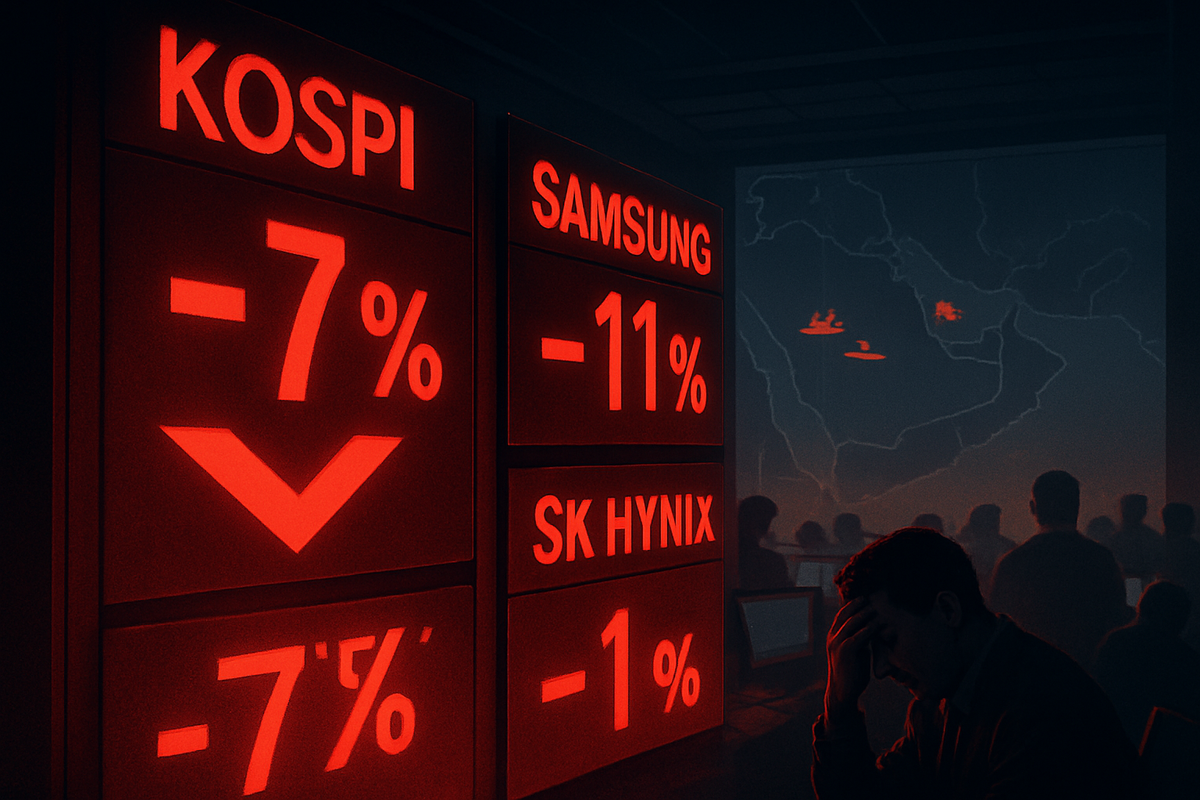
The South Korean financial markets suffered one of their most devastating sessions in history on Tuesday, March 3, 2026, as a "perfect storm" of geopolitical escalation and sector-specific setbacks sent the KOSPI index into a tailspin. The benchmark index plummeted 7.24% to close at 5,791.91, erasing billions in market capitalization and triggering "sidecar" trading curbs and circuit breakers for the first time since the 2024 yen carry-trade crisis. The panic was primarily fueled by a sharp escalation in the U.S.-Israel-Iran conflict over the weekend, which sent crude oil prices surging and raised immediate alarms about energy security for the import-dependent nation.
The carnage was most visible in South Korea’s crown jewel semiconductor sector. Samsung Electronics (KRX: 005930) saw its shares dive 9.88%, falling below the critical 200,000-won psychological support level, while its rival SK Hynix (KRX: 000660) cratered by 11.5%. For global tech investors, the meltdown in Seoul is a flashing red light for the broader AI-driven bull market, signaling that the high-flying semiconductor supply chain—long considered the backbone of 2025’s record gains—may be entering a period of extreme volatility as macroeconomic risks finally catch up to technological optimism.
The Perfect Storm: War, Oil, and a Halted AI Rally
The sell-off began immediately at the opening bell on Tuesday, following a long holiday weekend that saw "Operation Epic Fury"—a joint U.S. and Israeli military strike on Iranian nuclear and leadership infrastructure—escalate into a full-scale regional crisis. By the time Seoul markets opened, Iran had already threatened to block the Strait of Hormuz, a maritime artery responsible for 20% of the world’s oil supply. Brent crude prices responded by surging over 13% in a single session to surpass $85 per barrel. For South Korea, which imports nearly 2.76 million barrels of oil daily through that specific passage, the news was an existential threat to its industrial economy and a major driver for the KOSPI's 452.22-point drop.
Panic intensified as market authorities were forced to activate sell-side circuit breakers when the KOSPI 200 futures index fell more than 5%, temporarily halting program selling to prevent a total market collapse. Foreign investors, who had been the primary drivers of the "AI Gold Rush" in 2025, led the exodus, offloading a record 5.17 trillion won ($3.5 billion) in a single day. The selling pressure was compounded by a sense of exhaustion; after the KOSPI rose an unprecedented 76% in 2025, many institutional players were looking for any excuse to lock in gains and rotate into safer assets.
Adding fuel to the fire was a devastating corporate update from Samsung Electronics. Just as the market was grappling with geopolitical fears, reports surfaced that the mass production schedule at Samsung’s highly anticipated Taylor, Texas semiconductor plant had been pushed back further to 2027. This delay raised urgent questions about Samsung’s ability to compete with rival foundries in the high-stakes 2nm and 3nm chip segments, particularly as global demand for specialized AI hardware remains at its peak.
Winners and Losers: A Great Reallocation of Capital
The primary victims of this "Black Tuesday" were undoubtedly the semiconductor giants that underpin the global technology ecosystem. Samsung Electronics (KRX: 005930), which serves as a bellwether for the South Korean economy, saw its valuation shredded as investors weighed the twin pressures of a slowing foundry rollout and rising energy costs for its massive domestic fabs. SK Hynix (KRX: 000660), a critical supplier of High Bandwidth Memory (HBM) for AI chips, fared even worse, with its 11.5% drop reflecting fears that any disruption in the Middle East could lead to a broader global recession, dampening the demand for high-end server hardware.
In the United States, the ripple effects were felt immediately in the pre-market and previous sessions. Micron Technology (NASDAQ: MU), a direct competitor to the Korean memory duo, fell 7% as analysts warned that the rising cost of energy and potential logistics bottlenecks in Asia would squeeze margins. Even the indomitable Nvidia (NASDAQ: NVDA) felt the heat, trading down roughly 3% as investors questioned whether the AI supply chain could maintain its frenetic pace amidst such geopolitical instability.
However, the day was not a loss for everyone. The defense and energy sectors saw an extraordinary influx of "war-sensitive" capital. Hanwha Aerospace (KRX: 012450) was the day's standout performer in Korea, soaring 19.83% on expectations of increased global military procurement. Similarly, domestic defense firm LIG Nex1 (KRX: 079550) hit its 30% daily upper limit. In the U.S., defense behemoths like Lockheed Martin (NYSE: LMT) and Northrop Grumman (NYSE: NOC) reached all-time highs, gaining 6.5% and 6% respectively. In the energy space, ExxonMobil (NYSE: XOM) gapped up to a record $161 as the prospect of a prolonged Middle East conflict drove investors into the arms of Big Oil.
Broader Significance: The "Korean Discount" and the AI Supply Chain
This event marks a significant turning point in the "AI-driven" market cycle that has dominated the last 24 months. For years, investors have overlooked geopolitical risks in favor of the exponential growth promised by artificial intelligence. The March 3 crash serves as a reminder that the physical infrastructure of the digital age—the massive fabrication plants and the energy required to run them—remains vulnerable to traditional geopolitical shocks. The disruption of the Strait of Hormuz is not just an oil story; it is a supply chain story for every device and data center that relies on Korean memory.
Furthermore, the crash has reignited concerns regarding the "Korean Discount"—the historical tendency for South Korean stocks to trade at lower valuations than global peers due to corporate governance issues and proximity to geopolitical flashpoints. While the 2025 bull run seemed to suggest that South Korea had finally shed this reputation, the speed and scale of today’s sell-off suggest that global capital remains skittish. The market is now pricing in a higher risk premium for any asset located within the reach of regional conflicts or dependent on the fragile stability of the Middle East.
Historically, this event draws comparisons to the August 2024 "Black Monday," where a combination of U.S. recession fears and a yen carry-trade unwinding caused a similar 8.77% plunge. However, the current crisis is fundamentally different because it is driven by supply-side shocks rather than just monetary policy or technical positioning. In 2024, the market recovered quickly as the Federal Reserve stepped in; in 2026, the path to recovery is much murkier, as it depends on military de-escalation and the stabilization of energy prices—factors that are largely out of the hands of central bankers.
What Comes Next: Strategic Pivots and Geopolitical Realignment
In the short term, investors should expect a "risk-off" environment to persist until there is clarity on the extent of the U.S.-Iran conflict. If the Strait of Hormuz remains contested, the inflationary pressure from sustained $90-$100 oil could force global central banks, including the Federal Reserve and the Bank of Korea, to rethink their rate-cut trajectories. This would create a difficult "stagflationary" backdrop for tech stocks, where rising costs and high interest rates eat into the premium valuations of AI leaders.
For Samsung and SK Hynix, the coming months will require a strategic pivot. Samsung, in particular, must address the delays at its Taylor, Texas plant to reassure investors that it can diversify its manufacturing footprint away from East Asia’s geopolitical vulnerabilities. We may see an accelerated push for "friend-shoring" of semiconductor production, with more aggressive incentives from the U.S. and European governments to bring critical chip manufacturing closer to home. This could lead to a long-term capital expenditure boom in the U.S., benefiting domestic construction and fab-equipment providers at the expense of South Korean domestic investment.
Market opportunities may emerge in the fallout, particularly for companies that provide energy efficiency solutions or alternative energy sources. If oil prices remain elevated, the transition to nuclear power and renewables may receive a second wind of political and financial support as a matter of national security. Investors should watch for potential "bottom-fishing" opportunities in high-quality tech stocks once the initial panic subsides, but for now, caution is the prevailing sentiment.
Final Assessment: A Wake-Up Call for the Global Market
The events of March 3, 2026, will be remembered as the day the "AI euphoria" met the cold reality of global geopolitics. The 7% collapse of the KOSPI and the double-digit declines of Samsung and SK Hynix are not merely local incidents; they are symptomatic of a global financial system that is deeply interconnected and highly sensitive to energy shocks. The immediate trigger was a military strike in the Middle East, but the underlying fragility was created by nearly two years of aggressive speculative growth in the tech sector.
Moving forward, the market is likely to undergo a period of painful re-valuation. The "Korean Discount" is back with a vengeance, and the semiconductor sector, once viewed as a safe bet on the future of humanity, is now being scrutinized for its physical and geopolitical vulnerabilities. Investors must now shift their focus from purely growth-oriented metrics to a more holistic view that includes geopolitical risk, energy dependence, and supply chain resilience.
In the coming months, the most important indicators to watch will be the status of the Strait of Hormuz, the trajectory of Brent crude, and any updates regarding Samsung’s competitive positioning in the 2nm race. While the long-term potential of AI remains intact, the "easy money" phase of the cycle has likely come to a violent end. Investors who can navigate this new era of volatility with a diversified and risk-aware strategy will be the ones to emerge intact from this "Black Tuesday."
This content is intended for informational purposes only and is not financial advice.