WASHINGTON, D.C. — In a series of defiant remarks delivered from the White House on March 2, 2026, President Donald Trump signaled a massive shift in U.S. foreign policy, committing the United States military to a sustained and potentially indefinite campaign against the Islamic Republic of Iran. Speaking at a Medal of Honor ceremony just forty-eight hours after the commencement of "Operation Epic Fury," the President echoed the sentiments of his top advisors, stating that the U.S. has the "capability to go far longer" than initial projections to ensure the complete neutralization of Iran’s nuclear and ballistic capabilities. The rhetoric—summarized by Secretary of State Marco Rubio as a commitment to stay "as long as it takes"—has sent shockwaves through global financial markets, as the prospect of a short, surgical strike evaporates in favor of a grueling regional war.
The immediate implications are staggering. With the Strait of Hormuz effectively shuttered by the Islamic Revolutionary Guard Corps (IRGC) and major regional hubs under fire, the global economy is facing its most significant energy supply shock since the 1970s. As the "shadow war" between Washington and Tehran transforms into a direct kinetic conflict, the phrase "as long as it takes" has become a chilling mantra for investors, signaling that the volatility seen in the last 72 hours may only be the beginning of a long-term geopolitical realignment.
Operation Epic Fury and the Path to Escalation
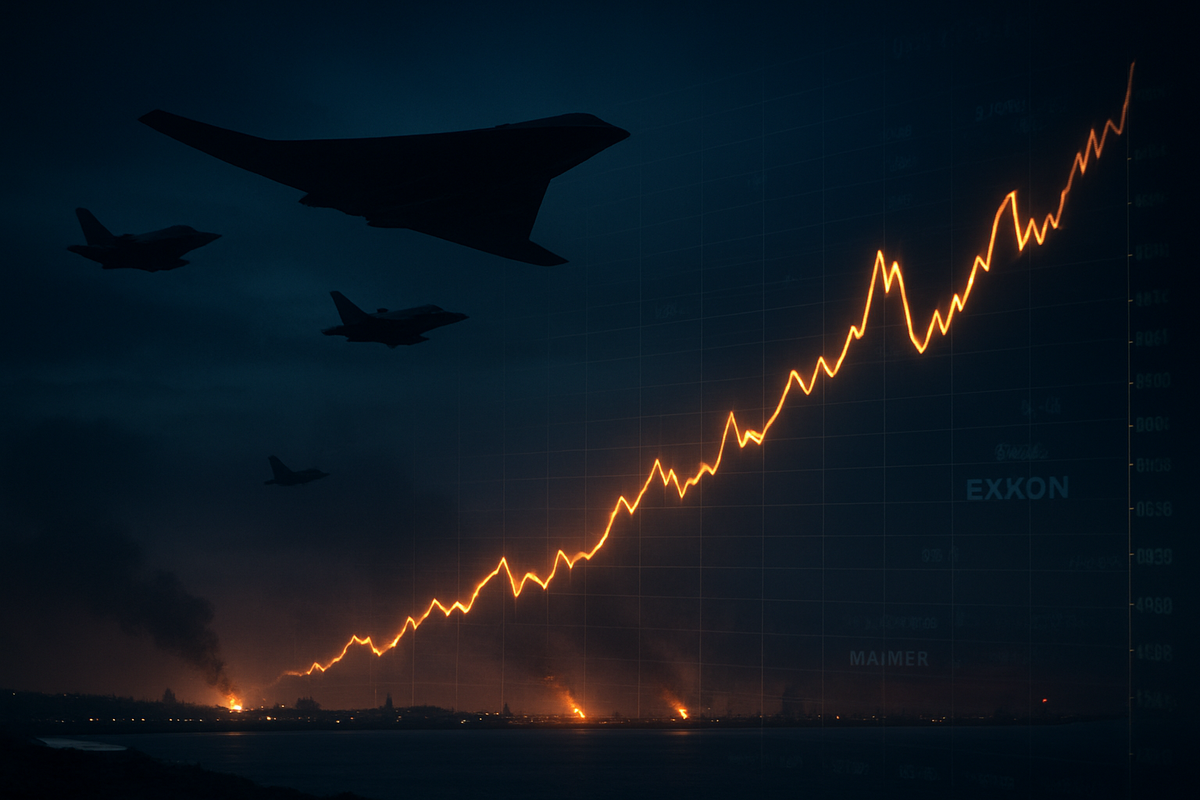
The transition to open warfare began in the pre-dawn hours of February 28, 2026, when a joint U.S.-Israeli task force launched a massive wave of airstrikes targeting over 1,500 sites across Iran. Operation Epic Fury, as it has been dubbed by the Pentagon, utilized Northrop Grumman (NYSE: NOC) B-2 Spirit stealth bombers and advanced F-35 variants to bypass Iranian air defenses. Early reports from intelligence agencies suggest the strikes were devastatingly effective, reportedly resulting in the death of Iran’s Supreme Leader, Ayatollah Ali Khamenei, and several high-ranking IRGC commanders.
However, any hopes for a quick Iranian surrender were dashed on March 1, when Tehran launched "Operation Martyr Soleimani II." This retaliatory phase saw hundreds of ballistic missiles and "suicide" drones targeting U.S. installations in Qatar, Kuwait, and the UAE, while the IRGC officially declared the Strait of Hormuz—the world’s most vital oil artery—closed to all maritime traffic. By the time President Trump took the podium on Monday, March 2, the conflict had already transcended a local skirmish. "We projected four to five weeks," Trump told reporters, "but we have the capability to go far longer than that. We will do whatever it takes." This hardened stance was reinforced by Israeli Ambassador Danny Danon at the United Nations, who confirmed that Israel's military objectives would not be met until Tehran's nuclear "cancer" was fully excised.
Initial market reactions on Monday morning were reflexive and violent. The S&P 500 opened down 1.4%, while gold and the U.S. Dollar surged as investors fled to safe-haven assets. The most dramatic movement, however, occurred in the pits of the energy and defense sectors, where the reality of a prolonged conflict began to be priced into the 2026 fiscal year.
Winners and Losers: A Tale of Two Markets
The prospect of a multi-month or multi-year conflict has created a sharp divide between sectors positioned to benefit from increased defense spending and those crippled by rising input costs. The "War Trade" dominated Monday’s session, with Lockheed Martin (NYSE: LMT) and RTX Corporation (NYSE: RTX) seeing gains of 3.7% and 4.7%, respectively. Analysts point to the heavy reliance on Patriot missile batteries and Raytheon-manufactured interceptors to protect U.S. allies in the Gulf as a primary driver for these valuations. Northrop Grumman (NYSE: NOC) was the standout performer, jumping nearly 6% following the high-profile success of its stealth platforms in the initial strikes. Furthermore, data-analytics firm Palantir Technologies (NYSE: PLTR) saw a 5.8% spike, as its AI-driven battlefield management software became central to the Pentagon's coordination of the theater.
Conversely, the "Losers" column is headed by the aviation and discretionary sectors, which are reeling from the double-blow of skyrocketing fuel prices and closed airspaces. United Airlines (NASDAQ: UAL) and American Airlines (NASDAQ: AAL) plunged 8.7% and 4.2%, as Brent Crude leaped past $82 per barrel. The closure of the Strait of Hormuz has essentially eliminated the "peace dividend" in energy, threatening to push oil toward the $100 mark. Logistics giants were not spared; FedEx (NYSE: FDX) dropped sharply after suspending all operations in 11 Middle Eastern countries, while shipping conglomerates like Maersk reported rerouting vessels around the Cape of Good Hope, a move that adds weeks to transit times and millions to operational costs.
The consumer discretionary sector also faced significant headwinds. Norwegian Cruise Line Holdings (NYSE: NCLH) was the day's biggest decliner, falling 10.6% on fears that a prolonged war would evaporate international tourism. American Express (NYSE: AXP) also saw a nearly 8% drop, as investors braced for a downturn in high-end global travel and a potential spike in defaults if the conflict triggers a broader inflationary recession.
Wider Significance and Geopolitical Shifts
The events of early 2026 represent a definitive end to the post-Cold War era of "contained" regional friction. By stating that the U.S. will stay "as long as it takes," the Trump administration is effectively tearing up the playbook of limited engagement. This shift mirrors historical precedents like the 1990 Gulf War, but with far higher stakes due to Iran's sophisticated proxy network and its proximity to global energy chokepoints.
The wider significance lies in the threat of "stagflation" returning to the global stage. If 20% of the world's oil remains locked behind an IRGC blockade, the resulting inflationary pressure could force the Federal Reserve to reconsider interest rate cuts that were planned for later in 2026. Furthermore, the conflict is accelerating a trend of "de-globalization" in energy markets. European nations, already wary of Russian gas, are now seeing their Middle Eastern alternatives go up in smoke, likely triggering a frantic pivot toward domestic renewables and North American LNG exports, benefiting companies like ExxonMobil (NYSE: XOM) and Chevron (NYSE: CVX).
Policy-wise, the "as long as it takes" doctrine suggests a return to a "Maximum Pressure" campaign on steroids. This has significant implications for global trade partners, particularly China, which relies heavily on Iranian oil. The ripple effects could lead to secondary sanctions against Chinese entities, further straining the fragile U.S.-China trade relationship and potentially sparking a broader trade war that could impact the entire tech sector.
What Comes Next: The Road to $100 Oil
In the short term, the market's eyes will be fixed on the Strait of Hormuz. If the U.S. Navy moves to forcibly reopen the waterway—a move that would involve high-risk minesweeping operations—investors should expect another spike in volatility. In the long term, a "prolonged conflict" suggests that the U.S. may be entering a period of permanent mobilization in the Middle East. Strategic pivots will be required for any company with exposure to global logistics; the era of "just-in-time" delivery may be officially dead, replaced by "just-in-case" stockpiling that will drive up inventory costs across the S&P 500.
Market opportunities may emerge in the cybersecurity and domestic energy infrastructure space. As Iran's conventional forces are degraded, many experts expect Tehran to pivot toward asymmetric warfare, specifically cyberattacks against Western financial institutions and power grids. This makes the cybersecurity sector a critical watchpoint for the coming months. Additionally, any domestic U.S. oil producer with "shale-ready" assets will likely see a premium valuation as the "geopolitical risk premium" becomes a permanent fixture of oil pricing.
A New Reality for Investors
The takeaway from President Trump's March 2 address is clear: the United States has committed to a decisive, and likely lengthy, military resolution to the Iranian problem. The phrase "as long as it takes" serves as a warning to both Tehran and Wall Street that the status quo has been permanently altered. For the market, this means the end of the "low-volatility" regime that characterized much of 2025.
Moving forward, investors must grapple with a bifurcated economy where defense and domestic energy serve as the primary engines of growth, while consumer-facing and global-logistics sectors face an uphill battle against rising costs and geopolitical instability. The coming months will be defined by the U.S. military's ability to maintain the "Epic Fury" momentum while preventing a total collapse of global energy flows. Investors should watch for the $100 oil threshold; should Brent Crude break that level and hold it, the risk of a global recession becomes not just a possibility, but a probability.
This content is intended for informational purposes only and is not financial advice.