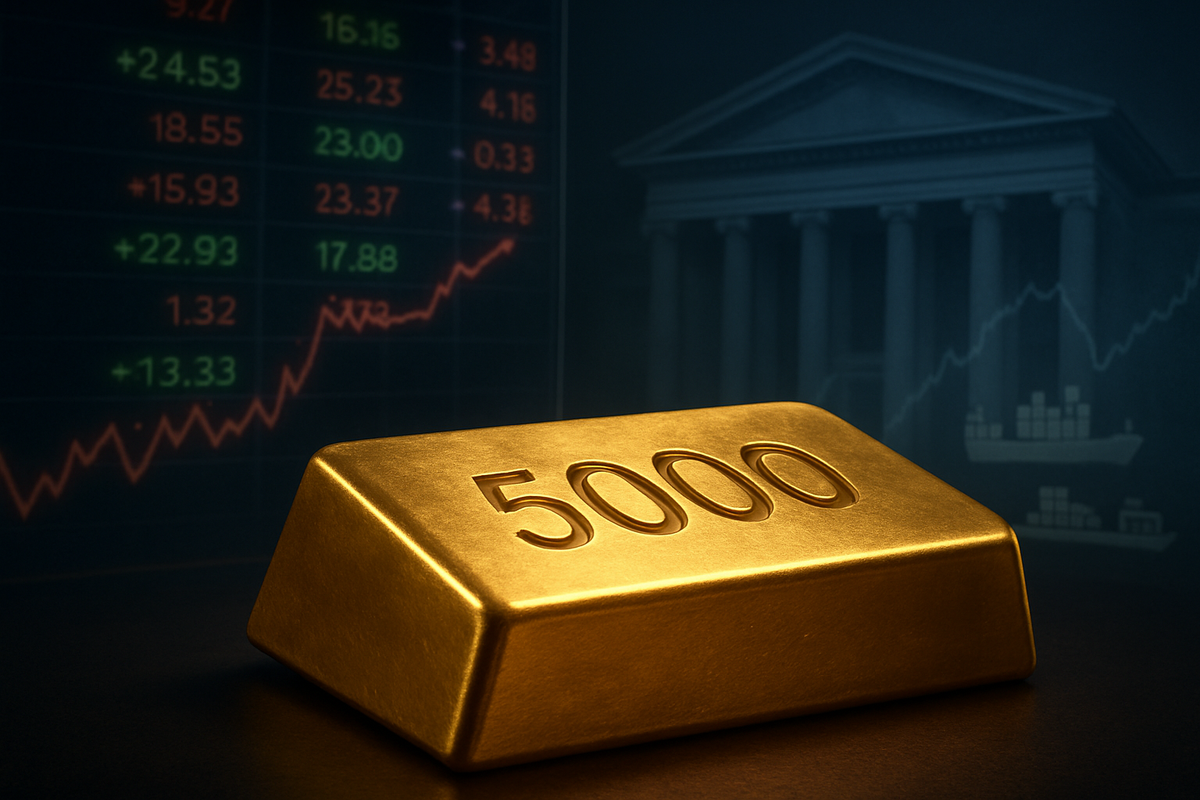
As of March 2, 2026, the global financial landscape is witnessing a historic decoupling of traditional economic correlations. Gold, the ancient hedge against uncertainty, has decisively shattered the $5,000 per ounce barrier, trading near $5,395 despite a Federal Reserve that refuses to budge from its restrictive 3.5%–3.75% interest rate range. This surge marks a paradigm shift in investor behavior, where the "fear trade" and the "inflation trade" have merged to overwhelm the traditional "yield trade."
The immediate implications are profound for both Wall Street and Main Street. While high interest rates typically strengthen the dollar and dampen the appeal of non-yielding assets like bullion, the current environment of persistent "pipeline inflation" and geopolitical instability has rendered traditional models obsolete. Investors are no longer prioritizing the 3.7% yield on cash; they are instead fleeing to the perceived safety of gold as a shield against a darkening stagflationary horizon.
The PPI Catalyst and Fed Paralysis
The catalysts for this historic rally were cemented in late February with the release of the January 2026 Producer Price Index (PPI) data. The report revealed a scorching 0.5% Month-over-Month (MoM) increase, far exceeding the 0.3% consensus and signaling that inflationary pressures are far from extinguished. Even more alarming was the Core PPI, which excludes food and energy, surging by 0.8%—the largest monthly jump in recent memory. This data confirms that the "last mile" of the inflation fight has turned into an uphill battle for the Federal Reserve.
The Federal Open Market Committee (FOMC), led by Chair Jerome Powell, currently maintains the benchmark federal funds rate at 3.5%–3.75%. Despite the aggressive inflation data, the Fed has opted for a "wait-and-see" hold, pausing the easing cycle that began in late 2025. This policy paralysis has created a vacuum of uncertainty; while the Fed remains officially "higher-for-longer" to combat the PPI spike, the market is aggressively pricing in a pivot, with a 92% probability of a rate cut starting in June 2026 to prevent a hard landing as GDP growth stagnates at a mere 1.4%.
The timeline of this ascent began in earnest in late 2025 when the $3,000 and $4,000 levels were breached in rapid succession. The momentum accelerated in February 2026 following coordinated military strikes in the Middle East and the effective closure of major shipping lanes. This geopolitical "risk premium" has added an estimated $800 to the price of an ounce, as central banks—particularly in the Global South—accelerate their de-dollarization efforts, diversifying into gold at a pace not seen since the 1970s.
Winners and Losers in the Golden Age
The primary beneficiaries of this "Golden Age" are the major mining conglomerates, which are currently enjoying the widest profit margins in history. Newmont (NYSE: NEM) recently reported record 2025 net income of $7.2 billion, with its management indicating that every $100 increase in the gold price adds hundreds of millions to their bottom line. Similarly, Barrick Gold (NYSE: GOLD) is operating with All-In Sustaining Costs (AISC) near $1,500 per ounce, resulting in a staggering profit margin of over $3,800 per ounce. These companies are generating more free cash flow than many Silicon Valley tech giants, leading to a surge in dividend announcements and stock buybacks.
Agnico Eagle Mines (NYSE: AEM) has also emerged as a winner, reporting record free cash flow of $4.4 billion. However, even these titans are not immune to the broader economic malaise; rising labor costs and electricity inflation have slightly pushed up production costs, though these are dwarfed by the explosive rise in the spot price. For individual investors, the SPDR Gold Shares (NYSE Arca: GLD) has seen record inflows, becoming one of the most liquid and sought-after assets in the global market.
On the losing side of this equation are import-dependent manufacturers and retail consumers. The "pipeline inflation" seen in the PPI data is largely a result of companies passing through the costs of the new 15% blanket global tariff regime. Industries ranging from automotive to consumer electronics are seeing their margins squeezed, as they cannot raise prices fast enough to keep up with the rising cost of industrial inputs and the broader inflationary wave.
The Stagflationary Dilemma and Trade Risks
The broader significance of gold’s $5,000 milestone lies in the emergence of a "stagflationary" dilemma that is baffling central bankers. The introduction of the 15% tariff regime under Section 122 of the Trade Act of 1974 has created a unique economic pincer movement: it is simultaneously suppressing economic growth by increasing costs for businesses and accelerating inflation by making imports more expensive. This is the classic stagflation trap, where traditional monetary policy tools—raising rates to fight inflation or lowering them to spur growth—actually make the opposing problem worse.
This shift represents a fundamental change in market priority. Historically, gold prices were sensitive to real interest rates (the nominal rate minus inflation). However, in 2026, investors are prioritizing geopolitical trade risks and the potential for a "policy error" by the Fed over traditional interest rate differentials. The market is betting that the Fed will eventually be forced to prioritize growth over inflation, leading to a devaluation of the dollar and another leg up for bullion.
Furthermore, the 15% tariff regime has sparked fears of a global trade war, reminiscent of the protectionist eras of the 1930s. As nations move to protect their domestic industries, the efficiency of global supply chains is being dismantled, ensuring that inflation remains "sticky" regardless of how high the Federal Reserve keeps interest rates. This systemic shift toward protectionism is a primary reason why analysts believe the current gold rally is not a bubble, but a structural re-pricing of risk.
The Road to June: Strategic Pivots and Scenarios
Looking ahead, the next three months will be critical for the trajectory of both the economy and the gold market. All eyes are on the June FOMC meeting. If the Fed refuses to cut rates despite slowing growth, the risk of a deep recession increases, likely driving gold even higher as a defensive play. Conversely, if the Fed begins to cut rates while PPI remains high, it will confirm that the central bank has abandoned its 2% inflation target, potentially sending gold toward the $6,000 mark.
The 15% tariff regime is also subject to a 150-day Congressional review period that concludes in the summer of 2026. Any sign that these tariffs will be made permanent or increased will likely trigger another wave of "stagflation" hedging. Companies will need to adapt by diversifying their supply chains and potentially relocating manufacturing hubs, a process that is both costly and inflationary in the short term.
Strategic pivots are already underway. Wealth managers are increasingly recommending a 10% to 15% allocation to physical gold or mining equities, up from the traditional 5%. We may also see the emergence of gold-backed digital assets or "stablecoins" as international trade participants seek alternatives to a dollar that is increasingly weaponized through tariffs and sanctions.
A New Paradigm for Global Markets
In summary, the permanence of $5,000 gold in the face of a 3.5%–3.75% Fed funds rate is a clear signal that the market's trust in traditional central bank "inflation-targeting" is wavering. The combination of the January PPI shock, the 15% global tariff regime, and the looming threat of stagflation has created a robust foundation for precious metals. Investors have signaled that they are more concerned with the preservation of capital in an unstable world than with chasing a modest yield in a currency that is losing its purchasing power.
Moving forward, the market will likely remain in a state of high volatility as it navigates the conflicting signals of a hawkish Fed and a slowing economy. The lasting impact of this period will likely be a permanent upward shift in the floor for gold prices and a fundamental re-evaluation of what constitutes a "safe" asset.
For the coming months, investors should closely monitor the "pipeline inflation" indicators and any shifts in the Fed's rhetorical stance regarding the June meeting. The era of low inflation and predictable trade is over; the era of $5,000 gold and geopolitical uncertainty has arrived.
This content is intended for informational purposes only and is not financial advice