As of March 16, 2026, the global base metals market has been plunged into an unprecedented supply crisis following the effective closure of the Strait of Hormuz. What began as a series of military exchanges in late February has evolved into a full-scale maritime blockade, severing one of the world’s most vital arteries for industrial commodities. The impact was immediate and staggering: copper prices have surged past $13,000 per tonne on the London Metal Exchange (LME), while aluminum has hit four-year highs, threatening to derail global manufacturing and the renewable energy transition.
The disruption is not merely a regional headache; it is a systemic shock to the global supply chain. With the Port of Jebel Ali effectively cut off from international liner networks, approximately 40,000 tons of copper cathode per month—essential for electrical wiring and high-tech manufacturing—are now trapped within the Persian Gulf. Furthermore, a burgeoning "sulphur famine" triggered by the halt of Middle Eastern oil and gas by-products is threatening to shut down massive copper operations in Africa, putting nearly a quarter of the world’s copper exports at risk of a total standstill.
A Two-Week Escalation: From Military Tensions to Total Blockade
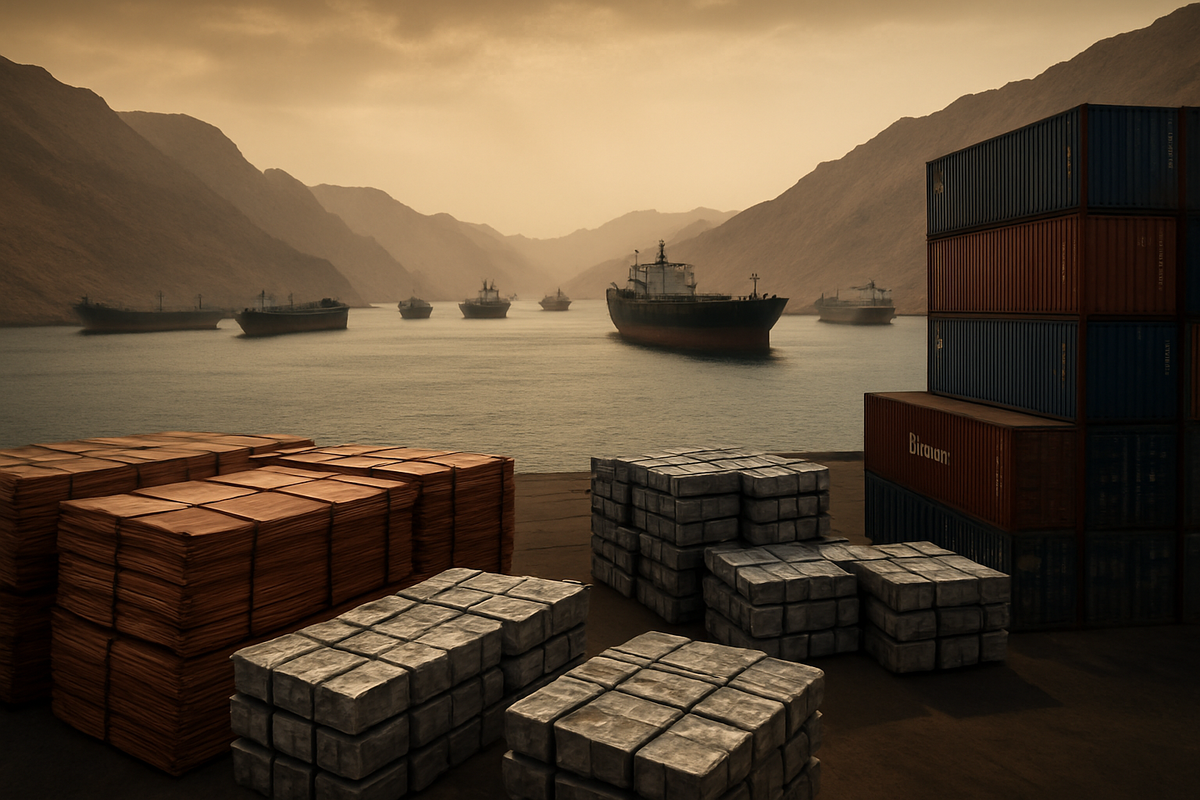
The crisis reached a tipping point on February 28, 2026, when military strikes on critical infrastructure led to an "effective closure" of the Strait. By March 2, major shipping conglomerates including Maersk and Hapag-Lloyd officially suspended all transits through the waterway, citing "unacceptable risks to crew and vessel safety." This left an estimated 200,000 to 470,000 TEUs of cargo trapped inside the Gulf, much of it consisting of base metals destined for European and Asian markets.
Central to this disruption is the loss of 40,000 tons per month of refined copper cathode. This volume, largely transiting through the Port of Jebel Ali in the UAE, serves as the lifeblood for wire rod producers across the Gulf Cooperation Council (GCC) and beyond. The blockade has also halted the bulk of Iranian refined copper exports—roughly 114,000 tons annually—which primarily move through Bandar Abbas. As inventories in regional warehouses dwindle, the global market is pricing in a "geopolitical total war" scenario, with analysts at Goldman Sachs warning that the scarcity of physical metal could lead to widespread industrial rationing.
The aluminum sector has been equally devastated. The Middle East accounts for approximately 9% of global primary aluminum production and a staggering 23% of the supply outside of China. Smelters are now trapped in a "double-jeopardy" scenario: they are unable to export finished metal to global buyers and are simultaneously running out of imported feedstock like alumina and bauxite. By March 5, major regional energy producers had begun halting natural gas flows to conserve domestic power, forcing several high-output smelters into controlled shutdowns to avoid catastrophic equipment damage.
Corporate Fallout: Winners, Losers, and Force Majeure
The corporate impact of the closure has been swift and severe. Aluminium Bahrain (Alba) (Bahrain: ALBH), one of the world’s largest single-site smelters, was among the first to declare force majeure on its export shipments. The company has already initiated a phased shutdown of three production lines—representing roughly 19% of its capacity—to conserve dwindling raw materials. Similarly, Qatalum, a joint venture between QatarEnergy and Norsk Hydro (OSE: NHY), has been forced into a controlled production scale-back as gas supplies were diverted to emergency domestic heating and power needs.
Regional giant Saudi Arabian Mining Company (Ma’aden) (TADAWUL: 1211) is navigating a complex crisis. While the company possesses integrated domestic supplies from bauxite to aluminum, it faces astronomical logistics costs. To bypass the Strait, Ma’aden is attempting to use a "land-bridge" strategy, trucking materials across the Arabian Peninsula to Red Sea ports like Jeddah. However, logistics costs have spiked by over 300% in the last two weeks, eroding margins and slowing the flow of materials to a trickle.
On the other side of the ledger, global miners with production bases outside the conflict zone are seeing their valuations skyrocket as metal prices soar. Freeport-McMoRan (NYSE: FCX) and Rio Tinto (NYSE: RIO) have seen significant share price appreciation as the market bets on their ability to fill the supply vacuum. However, even these giants are not immune to the "sulphur famine." Glencore (LSE: GLEN) and Ivanhoe Mines (TSX: IVN) are facing a critical shortage of elemental sulphur—a by-product of Gulf oil refining—which is essential for producing the sulphuric acid used to leach copper in the Central African Copperbelt. Ivanhoe Mines' founder Robert Friedland has warned that if the blockade persists beyond three weeks, major African mines like Kamoa-Kakula could be forced to halt operations entirely.
The Sulphur Famine and the Fragility of Green Energy
The closure of the Strait of Hormuz fits into a broader, more alarming trend of geopolitical volatility threatening the "Green Transition." The Middle East produces roughly 24% of the world’s elemental sulphur. The Democratic Republic of the Congo (DRC) and Zambia import two million tons of this sulphur annually to facilitate copper production. This secondary ripple effect means that a blockade in the Middle East can effectively shut down the mines of Central Africa, which provide 26% of global copper exports.
This event mirrors historical precedents such as the 1973 oil crisis, but with a 21st-century twist: the commodities at stake are the building blocks of electric vehicles, wind turbines, and power grids. Regulatory bodies in the EU and the US are already holding emergency sessions to discuss the release of strategic metal reserves, but unlike oil, strategic stockpiles for copper and aluminum are far less robust. The crisis highlights a decade of underinvestment in non-Middle Eastern logistics and the dangerous concentration of refined metal processing in volatile regions.
The Path Ahead: Short-Term Pain or Long-Term Realignment?
In the short term, the market is bracing for even higher volatility. If the blockade persists through the end of March 2026, Citi analysts predict copper could test the $15,000 per tonne mark, while aluminum could exceed $4,000. For companies like Emirates Global Aluminium (EGA), which had been targeting a $10–15 billion IPO on the ADX, the timing could not be worse. The uncertainty has effectively frozen regional capital markets, forcing a strategic pivot toward securing alternative supply routes through Oman’s Port of Sohar or the Indian Ocean-facing Port of Fujairah.
Over the long term, this crisis will likely trigger a massive shift in supply chain strategy. Manufacturers in Europe and North America are expected to accelerate "near-shoring" and "friend-shoring" initiatives, seeking to reduce their reliance on any single maritime chokepoint. We may see a surge in investment for domestic sulphur capture technologies in the Americas and Australia to decouple African copper production from Middle Eastern oil refining.
Conclusion: A Market Forever Changed
The March 2026 closure of the Strait of Hormuz is more than a temporary trade disruption; it is a catalyst for a global rethink of resource security. The "cathode squeeze" and the "sulphur famine" have exposed the delicate threads that hold the global economy together. For investors, the coming months will be defined by a flight to safety in diversified miners and a close watch on diplomatic efforts to reopen the waterway.
Key takeaways include the immediate loss of 40,000 tons of monthly copper cathode and the threat to nearly 10% of global aluminum production. As the market moves forward, the focus will shift from "just-in-time" inventory to "just-in-case" stockpiling. Investors should watch for the status of force majeure declarations from companies like Aluminium Bahrain (Alba) and the success of land-bridge workarounds in Saudi Arabia. Until the Strait of Hormuz is reopened, the world’s industrial engine will remain at the mercy of one of the world’s most narrow and volatile passages.
This content is intended for informational purposes only and is not financial advice.