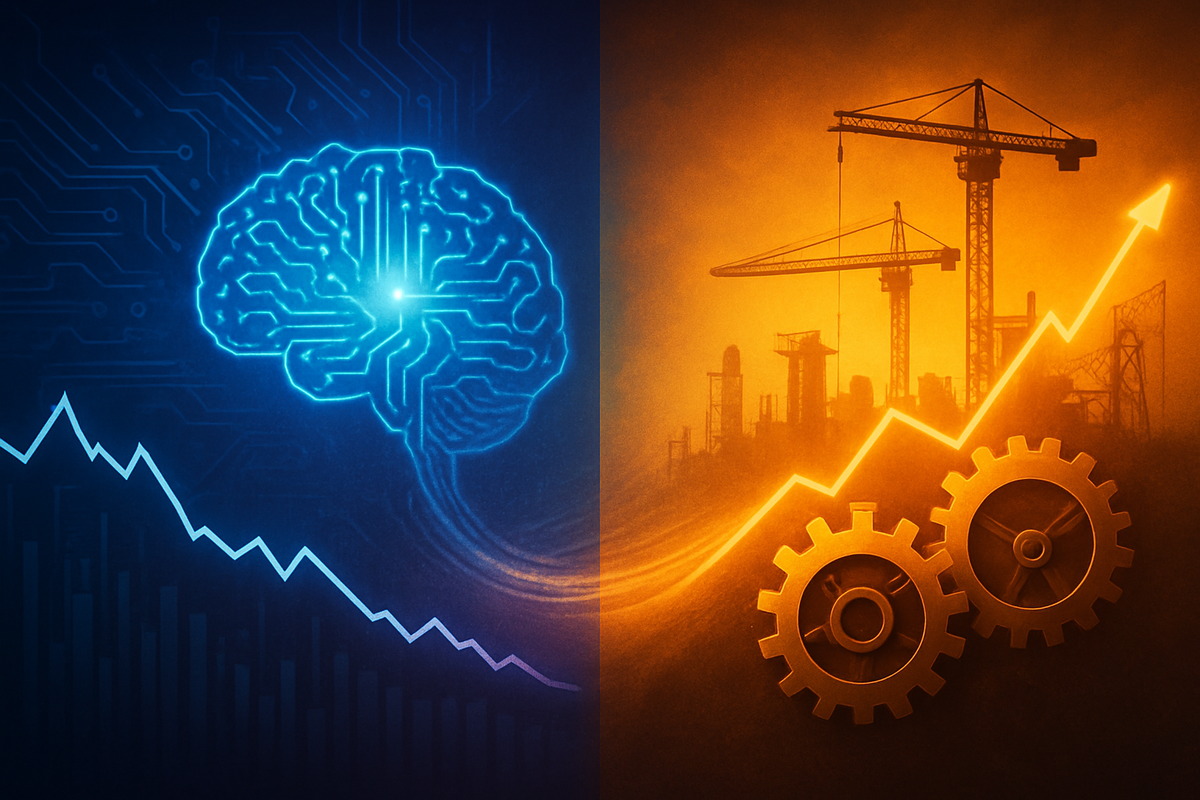
As of late February 2026, a seismic shift in market leadership has fundamentally altered the landscape for Wall Street investors. For the first time in the artificial intelligence era, the "Magnificent Seven" and their high-growth peers are no longer the primary engines of market growth. Instead, a massive "Rotation Trade" has taken hold, characterized by a staggering performance gap: the Invesco S&P 500 Equal Weight ETF (NYSEARCA: RSP) is up 6.7% year-to-date, while the market-cap weighted SPDR S&P 500 ETF Trust (NYSEARCA: SPY) has eked out a meager 0.9% gain.
This divergence marks the end of a multi-year period where a handful of trillion-dollar tech giants dictated the direction of the entire market. The immediate implications are clear: market breadth is the healthiest it has been in years, but the heavyweights that investors relied on for "safe" growth are facing a crisis of confidence. As capital flees the bloated valuations of Silicon Valley, it is finding a new home in the "Heavy Assets, Low Obsolescence" (HALO) sectors—industrials, energy, and financials—that were long ignored during the AI frenzy of 2024 and 2025.
The Dawn of the 'HALO' Trade and the AI Spending Plateau
The timeline of this rotation trace back to the Q3 2025 earnings season, where the narrative of "infinite AI demand" first met the reality of balance sheet constraints. Major hyperscalers, including Microsoft (NASDAQ: MSFT), Alphabet (NASDAQ: GOOGL), and Amazon (NASDAQ: AMZN), signaled that their combined capital expenditures for AI infrastructure would exceed $600 billion in 2026. However, as the calendar turned to the new year, shareholders began demanding tangible returns on these astronomical investments. This "AI infrastructure spending fatigue" was compounded by the "Warsh Shock" in February 2026, following the nomination of Kevin Warsh to lead the Federal Reserve. His pivot toward a "Sound Money" policy sent the 10-year Treasury yield toward 4.5%, effectively devaluing the long-duration cash flows of tech companies.
Simultaneously, the legislative environment shifted in favor of the "real economy." The passage of the "One Big Beautiful Bill Act" (OBBBA) in mid-2025, which provided permanent tax cuts and 100% bonus depreciation for domestic manufacturers, began to bear fruit in early 2026 earnings reports. This created a perfect storm for rotation: tech was cooling due to valuation digestion and interest rate pressure, while industrials and materials were heating up thanks to fiscal tailwinds and a revitalized domestic supply chain. By mid-February, the NYSE Advance-Decline line reached all-time highs, confirming that while the headline index (SPY) remained flat, the majority of stocks were actually in a robust bull market.
Winners and Losers: From Silicon to Steel
The primary beneficiaries of this rotation have been the "Heavy Asset" giants. Caterpillar (NYSE: CAT) and GE Vernova (NYSE: GEV) have emerged as the new market darlings, as the demand for power grid upgrades and industrial machinery outpaces the cooling demand for consumer software. These companies, which trade at significantly lower price-to-earnings multiples than their tech counterparts, are seeing massive institutional inflows as fund managers seek "value with growth." Financial heavyweights like JPMorgan Chase (NYSE: JPM) have also benefited, as higher interest rates and a steepening yield curve have bolstered net interest margins.
Conversely, the "losers" in this environment are the very companies that led the 2023-2025 rally. NVIDIA (NASDAQ: NVDA), despite reporting record-breaking revenue in February, saw its stock price remain stubbornly flat as the market priced in a "valley of disappointment" regarding AI monetization. Investors are no longer rewarding companies for simply buying chips; they are looking for the software and service companies that can actually turn those chips into profit—and so far, that transition has been slower than expected. Similarly, the iShares Russell 2000 ETF (NYSEARCA: IWM) has outperformed the tech-heavy indices for 15 consecutive sessions in early February, signaling that the "other 493" companies in the S&P 500 and smaller-cap firms are finally catching up.
Broader Significance: A Return to Market Sanity?
This event fits into a broader historical trend of "mean reversion." Historically, periods of extreme market concentration—such as the Nifty Fifty era of the early 1970s or the Dot-com bubble of 2000—eventually give way to broad-based rotations where value and smaller-cap stocks outperform. The 2026 rotation is being viewed by many analysts as a "healthy recalibration" rather than a market crash. By spreading gains across 400+ stocks rather than just seven, the market's foundation becomes much more resilient to shocks in any single sector.
The ripple effects are also being felt in the regulatory and policy spheres. With the focus shifting from digital dominance to industrial sovereignty, policy is increasingly favoring "Made in America" initiatives. This has put additional pressure on tech companies that rely on complex global supply chains and high-margin digital exports. The precedent here is the post-2000 period, where the market remained flat for several years at the index level, but "old economy" sectors like energy and materials entered a massive multi-year bull run.
What Comes Next: Navigating the 'New Normal'
In the short term, the market is likely to see continued volatility in the market-cap weighted indices as the mega-cap tech stocks search for a bottom. If the 10-year Treasury yield remains above 4.25%, the pressure on high-multiple growth stocks will persist. Strategic pivots will be required for tech companies; expect a wave of aggressive share buybacks and "efficiency" initiatives as they attempt to lure back investors who have migrated to the industrial and financial sectors.
Long-term, the opportunity lies in identifying the "AI Implementers" rather than the "AI Builders." While the initial infrastructure phase (chips and data centers) is showing signs of fatigue, the second wave—where traditional companies use AI to radically improve margins—is just beginning. If companies like Caterpillar or JPMorgan can successfully integrate AI to reduce costs, their valuations may undergo a permanent re-rating. Investors should watch for a "convergence" where tech valuations come down and industrial valuations go up, eventually meeting at a more sustainable middle ground.
Conclusion: The New Market Hierarchy
The 2026 Rotation Trade is more than just a temporary fluctuation; it is a fundamental reordering of the market hierarchy. The 6.7% vs. 0.9% YTD performance gap between the equal-weighted and market-cap weighted S&P 500 is a clear signal that the era of "passive" index investing dominated by five or six stocks is over. Market breadth is now the primary indicator of health, and for the first time in years, the "average" stock is outperforming the leaders.
Moving forward, the market looks increasingly bifurcated. While the headline indices may struggle to reach new highs due to the weight of Big Tech, the underlying opportunities in the broader market are the best they have been in a decade. Investors should keep a close eye on the 200-day moving averages of the tech giants and the continued strength of the Advance-Decline line. The "Great Equalization" is here, and those who remain over-concentrated in yesterday's winners may find themselves left behind in the industrial and value-driven bull market of 2026.
This content is intended for informational purposes only and is not financial advice.