As the first full trading week of 2026 unfolds, the financial markets have been gripped by a "healthy pullback," with the S&P 500 and Nasdaq Composite retreating from record highs. However, Nvidia (NASDAQ: NVDA) continues to demonstrate remarkable structural resilience. On January 8, 2026, while the broader tech sector grappled with rising Treasury yields and a significant rotation into defense stocks, Nvidia shares remained a beacon of stability, trading firmly in the $185.00 to $186.00 range. Despite a minor intraday dip of 1.7%, the company’s market capitalization held steady near the $4.6 trillion mark, bolstered by groundbreaking announcements at the Consumer Electronics Show (CES) 2026.
The immediate implication of this performance is clear: Nvidia has decoupled from the standard "tech beta." Investors are no longer treating the semiconductor giant as a speculative growth play but as a foundational utility of the modern economy. With its dominant 92% market share in discrete GPUs and a massive $37 billion capital return program executed in the prior quarter, the company’s ability to "buck the trend" suggests that the artificial intelligence (AI) supercycle is entering a more mature, yet equally lucrative, phase.
The Rubin Revolution: A New Era of Compute
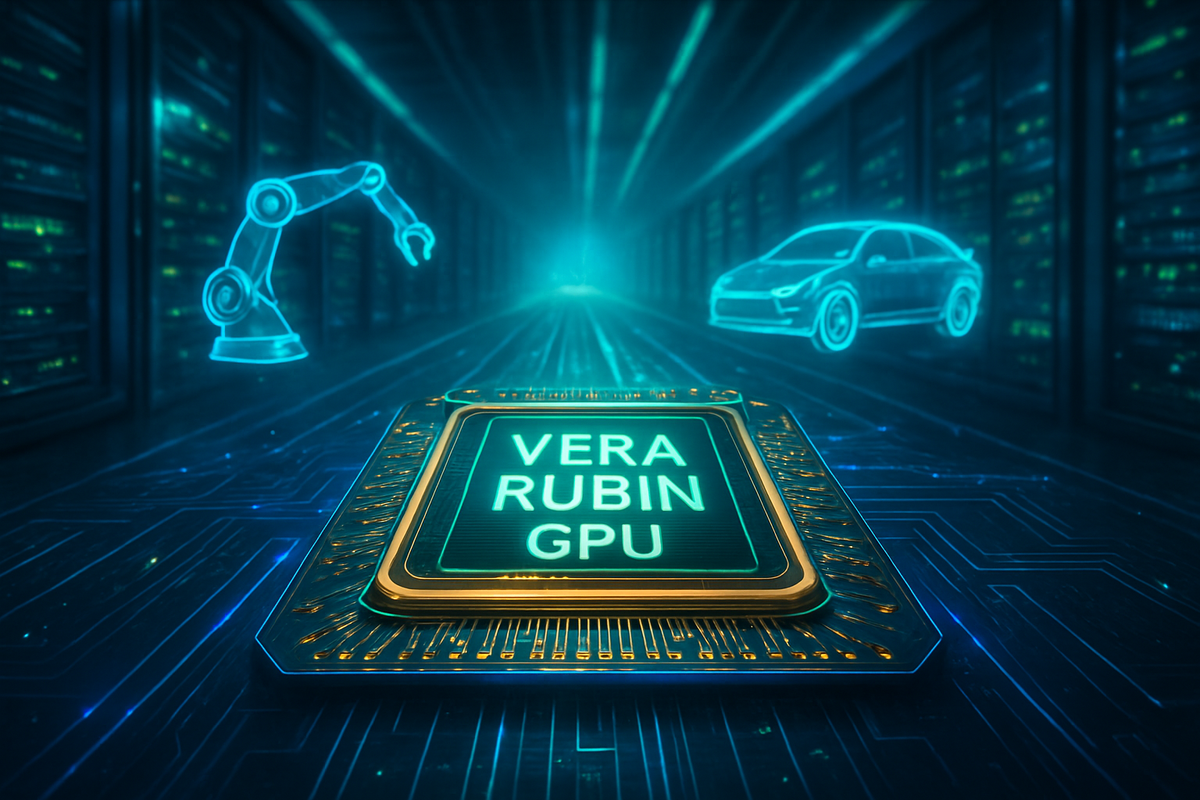
The primary catalyst for Nvidia’s resilience this week was the formal unveiling of the Vera Rubin architecture at CES 2026. Named after the pioneering astronomer, the Rubin platform represents a massive leap beyond the current Blackwell generation. The announcement, delivered during a period of high market volatility, provided the "visibility" that Wall Street craves. Nvidia confirmed that the Rubin GPU is already in full production, with a scheduled launch for the second half of 2026. This new architecture promises a staggering 5x increase in AI compute power and a 10x reduction in cost per token compared to its predecessor, effectively silencing critics who argued that AI scaling laws were hitting a wall.
The timeline leading to this moment has been one of relentless execution. Throughout 2025, Nvidia successfully navigated the "Blackwell ramp," with the GB200 and GB300 systems selling out through mid-2026. The transition to Rubin is not just a hardware refresh but a platform shift; it introduces the Vera CPU, an 88-core Arm-based processor, and utilizes next-generation HBM4 memory with 22 TB/s bandwidth. This technical superiority has maintained a massive moat between Nvidia and its competitors. Initial industry reactions have been overwhelmingly positive, with major hyperscalers like Microsoft (NASDAQ: MSFT) and Alphabet (NASDAQ: GOOGL) reportedly already queuing for the first Rubin-based clusters.
Winners and Losers in the 2026 Rotation
The current market environment has created a stark divide between the "AI-haves" and "AI-have-nots." While Nvidia stands tall, its primary competitors are feeling the heat. Advanced Micro Devices (NASDAQ: AMD), despite launching its Helios architecture, has struggled to erode Nvidia’s software-hardware ecosystem, known as CUDA. Similarly, Intel (NASDAQ: INTC) continues to face uphill battles in its foundry business, failing to capture the high-end training market that Nvidia dominates. These firms are finding it increasingly difficult to compete with Nvidia’s pace of innovation, which has now accelerated to a one-year product cycle.
On the winning side of the current market shift are defense contractors, which have benefited from a massive $1.5 trillion military budget signal for 2027. Companies like Lockheed Martin (NYSE: LMT) and Northrop Grumman (NYSE: NOC) saw significant inflows as investors rotated out of high-valuation tech. However, the "Nvidia exception" remains; the company’s pivot into "Physical AI"—integrating compute into robotics and autonomous systems—has made it a dual-play on both technology and industrial automation. This strategic diversification has allowed Nvidia to capture "safe haven" status that other tech stocks lack.
The Shift to Physical AI and Global Trends
Nvidia’s current dominance fits into a broader industry trend known as the "Physical AI" era. While 2024 and 2025 were defined by Large Language Models (LLMs) and chatbots, 2026 is the year of the robot. At CES, Nvidia showcased its Alpamayo platform, which leverages the Rubin architecture to power fully autonomous vehicles and humanoid robots. This shift is significant because it moves AI from the data center into the physical world, creating a ripple effect for partners like Tesla (NASDAQ: TSLA) and various industrial automation firms.
Historically, market pullbacks of this nature often signal the end of a bubble. However, analysts point to Nvidia’s forward P/E ratio of 40x–46x—high, but not irrational given its triple-digit growth rates—as evidence that this is a "re-rating" rather than a collapse. Furthermore, geopolitical shifts are playing into Nvidia’s hands. Signs that the U.S. Department of Commerce may ease restrictions on the export of advanced H200 chips to China suggest a potential multi-billion dollar revenue recovery, providing a cushion against any slowdown in domestic demand.
Looking Ahead: The Road to $275
In the short term, investors should prepare for continued volatility as the 10-year Treasury yield hovers near 4.19%. The market is currently pricing in a "higher-for-longer" interest rate environment, which typically pressures tech valuations. However, Nvidia’s long-term outlook remains tethered to its product roadmap. The successful integration of HBM4 memory and the rollout of the Vera CPU will be the key milestones to watch in the second half of 2026. If Nvidia can maintain its production schedule, the projected revenue visibility of "half a trillion dollars" through the end of the year could push the stock toward the $270–$275 price targets set by major Wall Street firms.
Strategic pivots will be required for Nvidia's partners. As the company moves deeper into the "Physical AI" space, it will increasingly compete with traditional industrial players. The challenge for Nvidia will be navigating the regulatory hurdles associated with autonomous systems and robotics, which are far more complex than the regulations governing cloud-based AI.
Conclusion: A Market in Transition
The resilience of Nvidia shares on January 8, 2026, serves as a powerful testament to the company’s unique position in the global economy. While a broader market pullback has dampened sentiment across the tech sector, Nvidia’s relentless innovation—exemplified by the Vera Rubin architecture—has provided a floor for its valuation. The company is no longer just a chipmaker; it is the architect of the infrastructure for the next industrial revolution.
Moving forward, investors should keep a close eye on three factors: the production ramp of the Rubin GPU, the stability of the 10-year Treasury yield, and any shifts in U.S. export policies regarding China. While the "AI bubble" talk will undoubtedly persist, Nvidia’s tangible revenue growth and sold-out order books tell a different story. In a market characterized by uncertainty, Nvidia remains the clearest bet on the future of compute.
This content is intended for informational purposes only and is not financial advice.