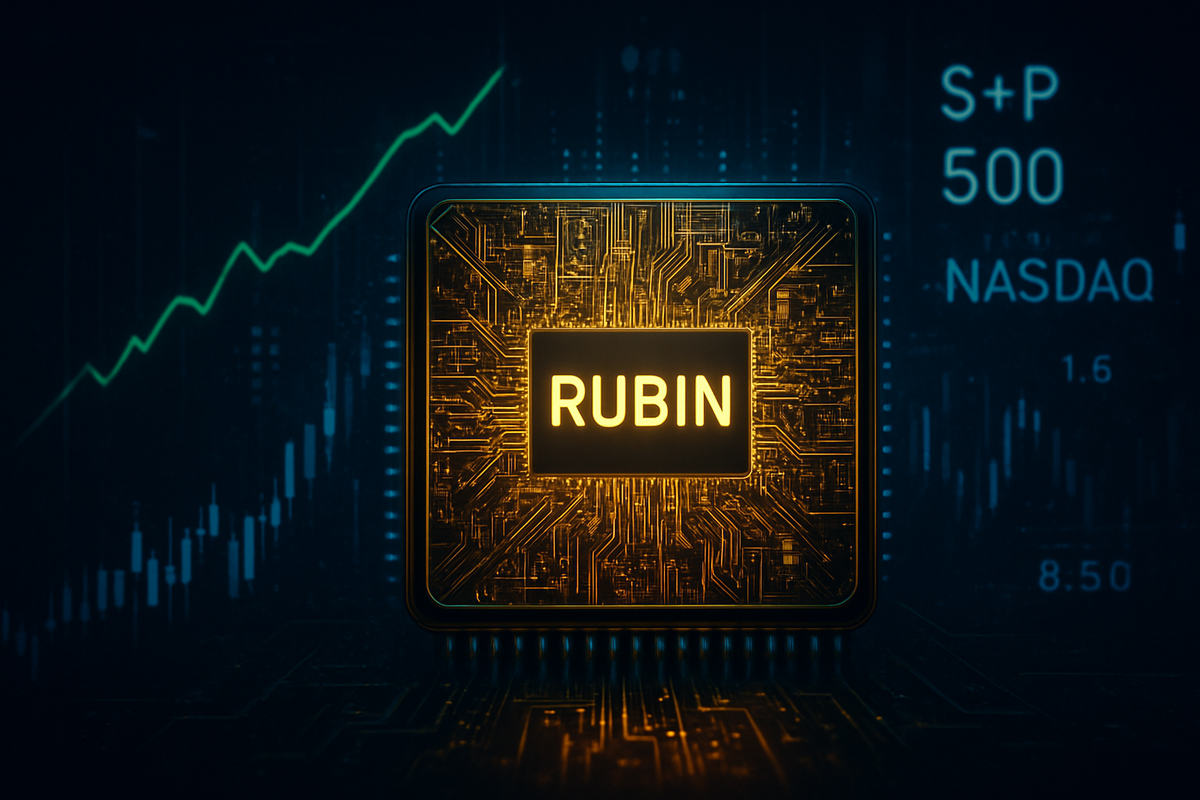
As the opening bells of 2026 ring across Wall Street, the financial landscape remains firmly under the gravitational pull of a single entity: NVIDIA (NASDAQ: NVDA). Following a historic 2025 that saw the chipmaker become the first company in history to eclipse a $5 trillion market capitalization, Nvidia has once again seized the narrative at the start of the new year. With the formal unveiling of its next-generation "Rubin" architecture at CES 2026 on January 5, the company has signaled that its relentless one-year product cycle remains the primary engine of the ongoing bull market, dictating the momentum of both the Nasdaq-100 and the S&P 500.
The immediate implications of Nvidia’s current trajectory are profound. As of January 6, 2026, the stock accounts for an unprecedented 8% of the S&P 500 (INDEXSP: .INX) and over 10% of the Nasdaq-100 (INDEXNASDAQ: NDX), meaning its daily fluctuations now carry more weight than entire industrial sectors. This "Nvidia-centric" market environment has forced institutional investors to recalibrate their risk models, as the company’s quarterly earnings have effectively replaced traditional economic indicators as the most critical "macro events" on the calendar.
The Dawn of Rubin and the Blackwell Backlog
The current market fervor centers on the transition from the highly successful Blackwell architecture to the newly announced Rubin platform. Throughout 2025, Nvidia struggled to keep pace with insatiable demand for its Blackwell GB200 systems, which remain sold out through mid-2026. However, the announcement of the Rubin GPU and the "Vera" CPU yesterday has shifted the goalposts again. The Rubin architecture, which utilizes advanced HBM4 memory and promises a five-fold increase in inference performance over its predecessor, represents a strategic pivot toward "Physical AI"—the integration of high-level compute into robotics and autonomous systems.
This moment is the culmination of a three-year sprint that began with the generative AI explosion in late 2022. Key stakeholders, including CEO Jensen Huang and major cloud providers, have spent the last 24 months moving from experimental AI clusters to industrial-scale "AI factories." The initial market reaction to the Rubin announcement has been overwhelmingly bullish, with Nvidia shares gaining 2% in the first trading sessions of 2026, even as analysts debate whether the "law of large numbers" will eventually catch up to the company's staggering growth rates.
Winners and Losers in the $600 Billion Capex Race
The primary beneficiaries of Nvidia’s continued dominance are the "Hyperscalers" and the specialized supply chain. Companies like Microsoft (NASDAQ: MSFT), Amazon (NASDAQ: AMZN), and Alphabet (NASDAQ: GOOGL) have collectively projected nearly $600 billion in capital expenditures for 2026, much of which is earmarked for Nvidia-powered data centers. Additionally, key partners such as Taiwan Semiconductor Manufacturing Co. (NYSE: TSM), which produces Nvidia’s leading-edge chips, and SK Hynix, the primary supplier of HBM4 memory, are seeing their valuations swell alongside the AI titan. Oracle (NYSE: ORCL) has also emerged as a significant winner, recently securing a massive 50,000-chip Blackwell cluster to bolster its specialized AI cloud services.
Conversely, the "losers" in this environment are those failing to pivot away from legacy architectures or those hamstrung by infrastructure bottlenecks. Intel (NASDAQ: INTC), while making strides with its 18A foundry process, continues to fight an uphill battle to regain market share in the high-end AI accelerator space. Similarly, traditional enterprise software firms that have failed to demonstrate clear ROI from their AI integrations are seeing their multiples compressed as investors rotate capital toward the hardware "picks and shovels" that offer more tangible growth. Furthermore, utilities and power-grid equipment providers are under immense pressure; companies that cannot secure the massive electrical capacity required to run these new AI factories are finding themselves unable to deploy the very hardware they have spent billions to acquire.
Index Concentration and the Shift to Physical AI
Nvidia’s role as a market mover has reached a level of historical significance that draws comparisons to the influence of the "Nifty Fifty" in the 1960s or the dominance of General Motors in the mid-20th century. However, the sheer speed of Nvidia’s ascent is unprecedented. The company’s influence has created a "concentration risk" that keeps regulators and index providers on high alert. With the top five stocks now commanding nearly 30% of the S&P 500's total value, any hiccup in Nvidia’s execution could trigger a systemic deleveraging event across the broader market.
Beyond the financial metrics, Nvidia is driving a fundamental shift in industry trends. The focus in early 2026 has moved from digital chatbots to "Physical AI." This is evidenced by the integration of Nvidia’s DRIVE Thor platform into mass-produced vehicles from manufacturers like Mercedes-Benz (OTC: MBGYY). This expansion into edge computing and autonomous mobility suggests that Nvidia is successfully diversifying its revenue streams beyond the data center, potentially insulating itself from any future cooling in pure-play AI software spending. This trend also carries regulatory implications, as governments worldwide begin to scrutinize the safety and sovereignty of AI-driven physical infrastructure.
Looking Ahead: The Challenges of Scale
In the short term, the market will be laser-focused on Nvidia’s ability to navigate the transition to Rubin while fulfilling the massive backlog of Blackwell orders. The primary challenge for 2026 is not demand, but the "physical limits" of deployment. Electrical grid constraints and the cooling requirements of high-density Blackwell racks are becoming the new bottlenecks. Strategic pivots toward liquid cooling and modular data center designs will be required for the industry to maintain its current pace of growth.
Longer-term, the emergence of "Sovereign AI"—where nations build their own domestic compute capacity—presents both a massive market opportunity and a geopolitical challenge. As countries like Saudi Arabia, Japan, and members of the EU seek to reduce their reliance on US-based cloud providers, Nvidia’s ability to sell directly to sovereign entities will be a key driver of its next trillion dollars in market value. However, this also places the company at the heart of ongoing trade tensions and export controls, which remain the most significant "black swan" risk for the stock in the latter half of the decade.
The 2026 Outlook: A Market Tethered to One Ticker
As we look toward the remainder of 2026, the key takeaway is that Nvidia is no longer just a semiconductor company; it is the fundamental infrastructure upon which the modern economy is being rebuilt. Its technical performance is the primary barometer for global risk appetite. For the S&P 500 and the Nasdaq to continue their upward trajectory, Nvidia must not only meet its lofty earnings targets but also successfully usher in the Rubin era without significant supply chain disruptions.
Investors should watch for three critical factors in the coming months: the pace of power-grid upgrades in major tech hubs, the adoption rates of "Physical AI" in the automotive and industrial sectors, and any signs of "AI fatigue" among the Big Tech hyperscalers. While the "Nvidia rally" has proven remarkably resilient, the market’s extreme concentration means that the margin for error has never been thinner. For now, the silicon sovereign remains on its throne, and the rest of the market is simply living in its world.
This content is intended for informational purposes only and is not financial advice.