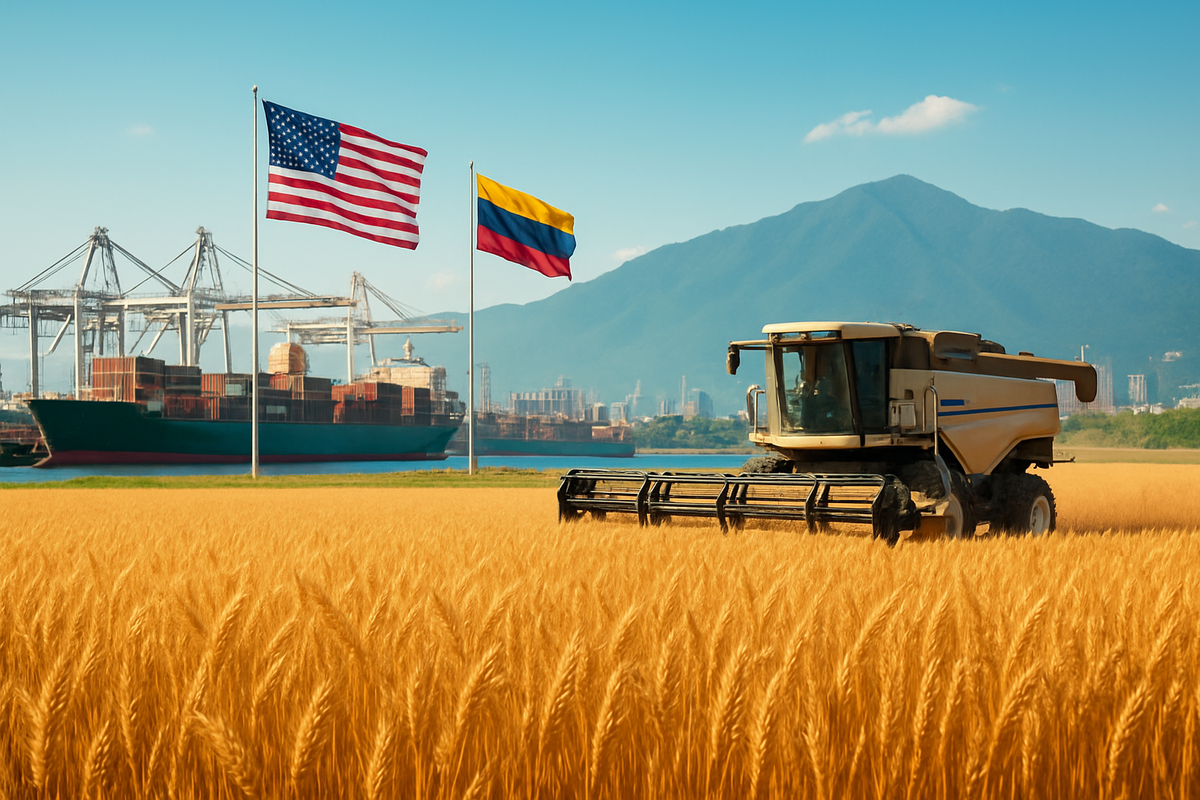
The geopolitical landscape of South America has been fundamentally reshaped in the opening days of 2026. Following a dramatic U.S.-led intervention on January 3, 2026, which resulted in the capture of Nicolás Maduro, Venezuela has entered a period of managed political transition. While the immediate focus remains on security and the establishment of an interim governing council, the economic implications are already reverberating through the global commodities markets. For U.S. agricultural producers, this transition represents the potential reopening of one of the most significant export markets in the Western Hemisphere, particularly for corn and wheat.
The sudden shift in governance is expected to dismantle the systemic corruption and financial bottlenecks that have throttled trade for over a decade. As the U.S. administration moves to stabilize the Venezuelan economy and address a looming humanitarian crisis, the "unfettered flow" of food has become a primary policy objective. This pivot is not merely a diplomatic gesture but a massive commercial opportunity for American farmers and agribusinesses to reclaim market share from competitors like Russia and Turkey, who had filled the vacuum left by years of sanctions and political instability.
A New Era in Caracas: The Fall of the Maduro Regime
The events of early January 2026 have moved with a speed that has caught global markets off guard. On January 3, U.S. forces conducted a high-stakes operation in Caracas, detaining Nicolás Maduro and several key members of his inner circle. By January 6, 2026, a U.S.-led transitional oversight body, coordinated by high-ranking officials including Secretary of State Marco Rubio, has begun the arduous task of stabilizing the nation's "broken infrastructure." While domestic figures like Edmundo González Urrutia and María Corina Machado are positioning for a sovereign transition, the immediate reality is a U.S.-managed environment designed to prevent a total collapse of the state.
The timeline leading to this moment was marked by years of economic decay and a contested 2024 election that left the country in a state of suspended animation. The U.S. has now signaled that while an oil embargo remains in place to prevent remnants of the old regime from accessing funds, agricultural trade is being fast-tracked. The Office of Foreign Assets Control (OFAC) is expected to issue sweeping new licenses that go beyond the existing General License 4C, moving from mere "humanitarian exemptions" to a fully functional commercial framework supported by U.S.-backed banking channels.
Industry reactions have been swift. Agricultural futures for corn and wheat saw increased volatility as traders began pricing in a surge in demand from the Caribbean basin. Stakeholders in the U.S. grain belt are already looking toward the Gulf Coast ports, anticipating a logistical pivot as Venezuela seeks to import an estimated 1.45 million metric tons (MMT) of wheat and 1.5 MMT of corn for the 2025/2026 marketing year. The primary goal for the transitional government is to alleviate food insecurity, which has seen nearly 80% of the Venezuelan population struggle with basic nutrition.
The Corporate Vanguard: Agribusiness Giants Set to Reclaim Ground
The primary beneficiaries of this political sea change are the "ABCD" grain majors, who possess the global logistics networks and historical presence to scale operations rapidly. Archer-Daniels-Midland Company (ADM:NYSE) and Bunge Global SA (BG:NYSE) are at the forefront of this opportunity. Both firms had significantly scaled back direct sales to the Venezuelan government in 2016 due to extreme credit risks and military interference. With the transition toward a transparent, U.S.-supervised payment system, these companies can now safely resume bulk shipments of Hard Red Winter (HRW) and Soft Red Winter (SRW) wheat to Venezuelan millers.
Beyond the grain traders, the infrastructure and input sectors are poised for a windfall. Corteva, Inc. (CTVA:NYSE) stands to benefit from a desperate need for high-quality seeds and crop protection products. Venezuela’s domestic corn production has stagnated at roughly 1.2 MMT due to a chronic lack of inputs; Corteva’s advanced genetics could be instrumental in rebuilding the nation’s internal supply chain. Similarly, Deere & Company (DE:NYSE) may see a surge in demand for agricultural machinery as the transitional government and private landholders seek to modernize a farming fleet that has been cannibalized for parts over the last decade.
The energy sector also plays a critical role in the agricultural recovery. Chevron Corporation (CVX:NYSE) and Exxon Mobil Corporation (XOM:NYSE) are viewed as the "economic engines" that will provide the hard currency necessary for the Venezuelan private sector to purchase U.S. exports. As these energy titans ramp up production under new security guarantees, the resulting oil revenue will likely be funneled into a "Food for Energy" style stabilization fund, ensuring that U.S. agricultural exporters are paid in a timely and reliable manner.
Wider Significance: Reshaping Global Grain Flows
The reopening of Venezuela to U.S. agriculture is more than a bilateral success; it is a strategic blow to the influence of Russia and Turkey in the region. Over the past five years, Moscow had successfully leveraged Venezuela’s isolation to become its primary wheat supplier. By re-establishing the U.S. as the dominant trade partner, the transition aligns with broader American interests in reducing the geopolitical footprint of adversarial nations in the South American continent. This shift mirrors historical precedents, such as the reopening of Eastern European markets in the 1990s, where agricultural trade served as the "soft power" vanguard of democratic transition.
Furthermore, this event fits into a broader trend of "near-shoring" and regionalizing supply chains. The proximity of U.S. Gulf ports to Venezuelan terminals like Puerto Cabello gives American producers a massive logistical advantage over South American competitors like Brazil or distant exporters in the Black Sea. The reduction in shipping times and costs could make U.S. yellow corn the undisputed choice for Venezuela’s recovering poultry and pork sectors, which are expected to lead the country’s nutritional recovery.
However, the transition also brings regulatory challenges. The U.S. Department of Agriculture (USDA) will likely need to reactivate and expand the GSM-102 Export Credit Guarantee Program for Venezuela to mitigate the initial risks of the new government’s creditworthiness. This would represent a significant policy shift, moving from "sanctions management" to "market development," and could serve as a blueprint for future interventions in failed states.
The Road Ahead: Short-Term Relief and Long-Term Rebuilding
In the short term, the market should expect a flurry of "emergency" tenders for white corn and wheat to stabilize bread and arepa prices. These initial shipments will likely be facilitated by the World Food Programme (WFP) and U.S. government subsidies. Investors should watch for the formal establishment of a new Venezuelan central bank authority, which will be the gatekeeper for foreign exchange and trade finance. The immediate challenge will be the state of Venezuelan ports and silos, many of which have fallen into disrepair and will require rapid capital injection to handle large-scale bulk carriers.
Long-term, the opportunity lies in the total rehabilitation of the Venezuelan agribusiness ecosystem. This includes not just commodity exports, but also the export of technology, logistics expertise, and livestock genetics. If the transition holds, Venezuela could move from a state of chronic deficit to a regional agricultural player once again. Strategic pivots for U.S. companies will involve moving from simple transactional exports to joint ventures with local processors who have survived the Maduro era.
The primary risk remains political stability. While the U.S. military presence provides a security floor, the potential for a "shadow government" led by remnants of the old regime could lead to localized disruptions or sabotage of infrastructure. The market will be closely monitoring the transition's ability to integrate the Venezuelan opposition into a functional cabinet that can command the respect of both the international community and the local populace.
Conclusion: A Pivot Point for the Americas
The capture of Nicolás Maduro and the subsequent U.S.-led transition in Venezuela mark a historic turning point for Western Hemisphere trade. For the U.S. agricultural sector, the event clears a path to reclaim a vital market that has been largely inaccessible for a generation. The demand for corn and wheat is immediate and massive, providing a timely boost for U.S. exporters facing global price pressures.
Moving forward, the market will transition from watching military developments to monitoring "trade mechanics"—the issuance of licenses, the reopening of credit lines, and the repair of logistical bottlenecks. Investors should keep a close eye on the quarterly reports of ADM:NYSE and Bunge Global SA (BG:NYSE) for mentions of "Latin American volume recovery," as well as any announcements from the USDA regarding new export credit guarantees.
Ultimately, the success of this transition will be measured not just by political stability, but by the return of food security to the Venezuelan people. "Breadbasket diplomacy" is back at the center of U.S. foreign policy, and the American farmer is set to be its most effective ambassador.
This content is intended for informational purposes only and is not financial advice