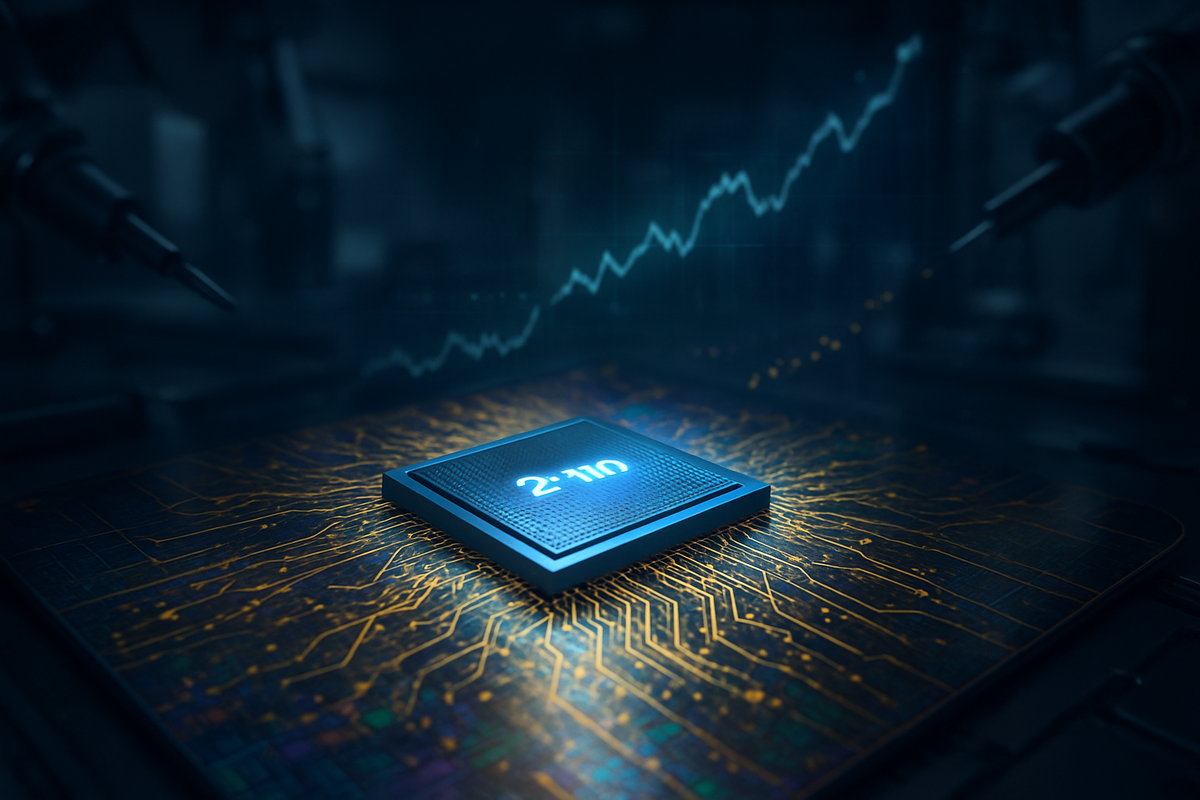
The global semiconductor landscape reached a historic milestone today, January 5, 2026, as shares of Taiwan Semiconductor Manufacturing Co. (NYSE: TSM; TWSE: 2330) surged to a record high, propelled by a bullish research report from Goldman Sachs. The investment bank significantly raised its price target for the foundry giant, citing an unprecedented "AI-driven supercycle" that is expected to redefine the industry’s revenue trajectory over the next 24 months.
The surge has pushed TSMC’s market capitalization firmly above the $1.2 trillion mark, solidifying its position as the indispensable backbone of the modern digital economy. With the mass production of its next-generation 2-nanometer (2nm) chips now in full swing, the market is signaling high confidence that TSMC’s technological lead and pricing power will yield record-breaking margins despite rising geopolitical and operational costs.
Goldman Sachs Sets a Bold New Ceiling
The catalyst for the current rally was a comprehensive report released by Goldman Sachs analyst Bruce Lu, who characterized 2026 as the year when "artificial intelligence moves from infrastructure build-out to ubiquitous token consumption." Goldman raised its price target for TSMC’s Taipei-listed shares to NT$2,330, a staggering 35% increase from previous estimates. For the US-listed American Depositary Receipts (ADRs), this implies a target price in the range of $370 to $375.
This valuation hike is supported by a revised revenue growth forecast of 30% for 2026, up from an earlier projection of 22%. The report highlights that TSMC’s transition to the 2nm node—which utilizes the revolutionary Gate-All-Around (GAA) nanosheet transistor architecture—is scaling faster than any previous node in the company's history. Mass production officially commenced in late 2025 at Fab 20 in Hsinchu and Fab 22 in Kaohsiung, and Goldman expects monthly output to reach 140,000 wafers by the end of this year.
The Winners: Nvidia, Apple, and the "Leading-Edge" Elite
The primary beneficiaries of TSMC’s record-breaking run are its "Big Tech" partners who have effectively monopolized the company's advanced capacity. Nvidia (NASDAQ: NVDA) remains the most prominent winner, as its demand for high-performance AI accelerators continues to outstrip supply. By securing a massive portion of TSMC’s CoWoS (Chip-on-Wafer-on-Substrate) packaging capacity, Nvidia has ensured its dominance in the data center market, even as TSMC implements price hikes of up to 10% for its most advanced processes.
Apple (NASDAQ: AAPL) has also emerged as a strategic victor, reportedly securing more than 50% of the initial 2nm capacity for its upcoming A20 and M6 chips. While these chips are significantly more expensive to produce than their 3nm predecessors, Apple’s ability to absorb these costs while maintaining premium hardware margins gives it a distinct advantage over competitors. Furthermore, equipment providers like ASML Holding N.V. (NASDAQ: ASML) are seeing a direct boost from TSMC’s updated capital expenditure plan, which is now projected to exceed $150 billion between 2026 and 2028.
However, the "losers" in this scenario may include smaller fabless semiconductor firms and competitors like Intel Corporation (NASDAQ: INTC) and Samsung Electronics (KRX: 005930). As TSMC raises prices to maintain its 60%+ gross margins, smaller players may find themselves priced out of the leading-edge market. Meanwhile, Intel and Samsung continue to face an uphill battle in proving their foundry yields can match TSMC’s reliability, potentially leading to further market share erosion.
A Monopoly in the Age of AI Tokens
The wider significance of TSMC’s record high lies in its role as a "single point of success" for the global AI industry. Goldman Sachs’ report emphasizes that the shift from training large language models to high-volume inference is driving an exponential increase in "token consumption." This transition requires a continuous supply of highly efficient silicon, which currently only TSMC can provide at scale. This has created a unique market dynamic where TSMC possesses nearly absolute pricing power over the sub-3nm market.
This event also highlights a broader industry trend: the decoupling of semiconductor cycles from traditional consumer electronics. While smartphone and PC markets have stabilized, the structural demand for AI infrastructure is creating a "decoupled" growth path for foundries. However, this dominance also brings increased regulatory and geopolitical scrutiny. Governments in the U.S., Europe, and Japan are closely monitoring TSMC’s expansion, as any disruption in Taiwan would now have even more catastrophic consequences for a $1.2 trillion entity that underpins the world's most valuable companies.
The Road to 1.6nm and Beyond
Looking ahead, the market is already focusing on what follows the 2nm ramp-up. In the second half of 2026, TSMC is expected to introduce the N2P variant, featuring backside power delivery—a technology that significantly improves energy efficiency for mobile devices. Furthermore, the company is already hitting development milestones for its "A16" (1.6nm) node, which is slated for 2027. This relentless pace of innovation suggests that TSMC’s capital intensity will remain high, but so will its barrier to entry.
The short-term challenge for TSMC will be managing its global footprint. As fabs in Arizona and Japan come online, the company must prove it can maintain its legendary "Taiwan-level" yields in foreign environments. For investors, the risk lies in potential "AI fatigue" if the ROI on AI software doesn't materialize as quickly as the hardware build-out suggests. However, for now, the momentum is undeniably on TSMC’s side.
Wrap-Up: A New Era for the Silicon King
TSMC’s record-breaking performance in early 2026 marks a definitive shift in the semiconductor industry. The Goldman Sachs price target hike is not just a vote of confidence in one company, but a validation of the entire AI ecosystem’s longevity. By successfully transitioning to 2nm and securing the loyalty (and capital) of giants like Nvidia and Apple, TSMC has effectively de-risked its medium-term growth profile.
As the market moves forward, investors should keep a close eye on quarterly yield reports from the new 2nm fabs and any shifts in the pricing strategies of Nvidia and Apple. While the geopolitical risks surrounding Taiwan remain a permanent "X-factor," the financial reality is that the world’s most advanced technologies currently have no other home. TSMC is no longer just a chipmaker; it is the gatekeeper of the AI future.
This content is intended for informational purposes only and is not financial advice.