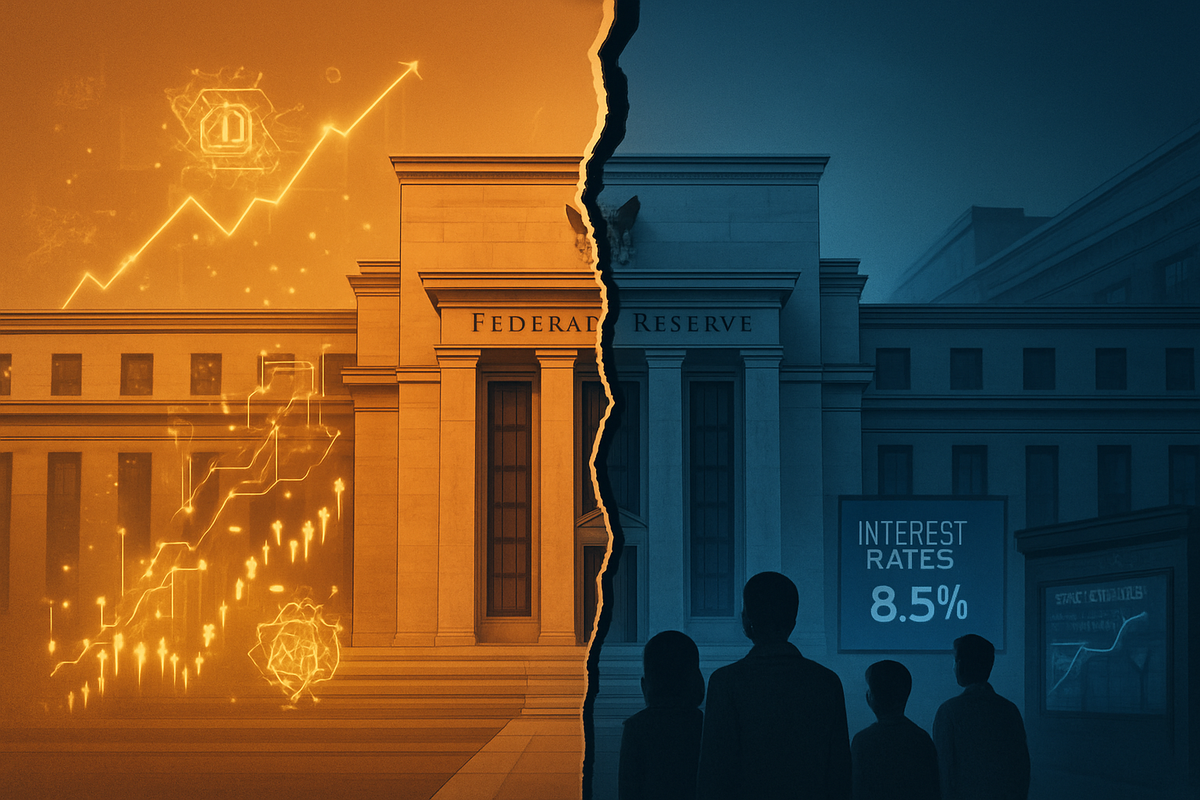
As the calendar turns to 2026, the global financial community is grappling with a stark admission from the world’s most powerful central bank. In a series of year-end communications, most notably a candid address by Governor Christopher Waller on December 16, 2025, the Federal Reserve has effectively conceded that its primary tools are incapable of narrowing the massive economic divide in the United States—a divide that many critics argue was exacerbated by the Fed’s own long-standing policies.
This "Great Admission" marks a fundamental shift in central banking philosophy. After years of attempting to foster "broad-based and inclusive" growth, the Fed is now pivoting toward a posture of "economic humility." This acknowledgment signals that while the Fed can manage the aggregate temperature of the economy, it lacks the surgical precision to repair a "K-shaped" recovery where asset owners thrive while wage earners struggle under the weight of persistent structural costs.
The Pivot to Economic Humility: A Timeline of Concessions
The road to this admission began in earnest on August 22, 2025, when the Federal Open Market Committee (FOMC) released its revised "Statement on Longer-Run Goals and Monetary Policy Strategy." In a move that surprised many progressive economists, the Fed removed the word "shortfalls" from its description of maximum employment. This semantic shift was the first formal signal that the central bank could no longer prioritize low-income employment gains if they risked broad-based inflation. The updated statement explicitly noted that maximum employment is determined by "nonmonetary factors"—such as demographics and technology—effectively placing the burden of solving inequality back onto Congress.
The narrative reached a boiling point on December 16, 2025, at the Yale CEO Summit. Governor Christopher Waller spoke of a "dichotomy" in the American experience. He admitted that while corporate America and high-net-worth individuals were benefiting from a "booming stock market" driven by advancements in artificial intelligence, the lower half of the population was facing a "stall in hiring" and credit card rates exceeding 20%. "We cannot easily correct the widening economic gap," Waller stated, acknowledging that the Fed's tools are "blunt instruments" that often benefit the wealthy first through asset inflation.
Chair Jerome Powell echoed these sentiments in his final press conference of 2025, noting that aggregate statistics like GDP often "mask important disparities." Powell’s recent rhetoric has focused on the "sting of inflation," admitting that the very families the 2020 "inclusive" framework sought to protect are the ones currently most damaged by the cost-of-living crisis and the high interest rates required to fight it.
Market Bifurcation: Winners and Losers of the New Reality
The Fed’s admission has created a clear divide in the equity markets, as investors recalibrate their portfolios for an economy where the "wealth gap" is treated as a permanent feature rather than a policy target.
The Winners: Asset management giants like BlackRock (NYSE: BLK) and Goldman Sachs (NYSE: GS) stand to benefit as the Fed shifts its focus toward stabilizing the financial cycle rather than social engineering. With the Fed acknowledging that asset inflation is a byproduct of its stability mandates, wealth managers are seeing record inflows into private credit and alternative assets. Furthermore, the AI-driven surge that has bolstered the "K-shape" continues to favor technology leaders like Nvidia (NASDAQ: NVDA), which remains a cornerstone for the portfolios of the asset-rich class. Luxury conglomerates like LVMH (OTC: LVMUY) also continue to see resilience, as their core demographic remains largely insulated from the "stall speed" of the broader labor market.
The Losers: On the other side of the "K," companies sensitive to the "Main Street" consumer are feeling the pressure. Nike (NYSE: NKE) saw its shares stumble in late December after signaling that the "stall in hiring" mentioned by Waller was impacting discretionary spending. Similarly, Ford (NYSE: F) and other credit-dependent manufacturers are struggling as the Fed admits it cannot easily lower rates for the poor without reigniting inflation for everyone. Discount retailers like Dollar General (NYSE: DG), which typically thrive during downturns, are facing a unique challenge: their customer base is so stretched by the "housing caste system" and high debt costs that even basic consumption is slowing.
Wider Significance: The End of the "Inclusive" Era
The significance of this shift cannot be overstated. For the better part of a decade, central banks globally followed the Fed’s lead in believing that "lower for longer" interest rates would eventually "trickle down" to the most vulnerable workers by tightening the labor market. The events of 2024 and 2025 have proven the opposite: ultra-low rates created a "locked-in" effect for homeowners and asset holders, while the subsequent rate hikes to fight inflation have disproportionately punished those without assets.
This event fits into a broader trend of "fiscal dominance," where the public and markets are beginning to realize that monetary policy has reached its limits. The Fed's retreat is a direct challenge to the legislative branch, effectively saying that if the U.S. wants to solve the wealth gap, it must do so through tax policy and social spending, not the printing press. This mirrors the historical precedent of the late 1970s, where the Fed eventually had to abandon social goals to regain its primary mandate of price stability.
Furthermore, the admission of a "housing caste system"—where those with sub-3% mortgages are "locked in" while new buyers are priced out—suggests that the Fed’s previous policies have created structural rigidities that will take decades to unwind.
What Comes Next: The Road to 2027
In the short term, the market expects the Fed to continue a cautious cycle of rate cuts, but with a different justification. Instead of cutting to "boost the economy," the Fed will likely cut to "prevent a collapse" in the lower-tier labor market. Investors should prepare for a "lower-for-longer" growth environment where inflation remains stickier than in the pre-pandemic era.
Strategic pivots are already underway. Corporations are increasingly looking toward AI and automation to maintain margins as the labor market "stalls." For investors, the "Great Admission" suggests that the "Fed Put" (the idea that the Fed will always step in to save the market) may now only apply to systemic financial stability, rather than the broader health of the American consumer. This creates a market where "quality" and "balance sheet strength" become the only metrics that matter, as the central bank steps back from its role as a social stabilizer.
Final Assessment: A New Mandate of Realism
The Federal Reserve’s admission is a watershed moment for modern economics. By acknowledging that it cannot fix inequality, the Fed is attempting to protect its remaining credibility. The key takeaway for the market is that the "inclusive" experiment of 2020 is officially over, replaced by a mandate of cold, hard realism.
Moving forward, the market will likely remain bifurcated. Investors should watch for the February 2026 semiannual testimony to Congress, where Chair Powell is expected to face intense questioning regarding this pivot. The lasting impact will be a permanent shift in how we view the "neutral rate" of interest and a realization that the wealth gap is now a fiscal problem that the Fed will no longer attempt to mask.
For the months ahead, the watchword is "disparity." Watch the performance of high-end luxury versus discount retail, and keep a close eye on the spread between mortgage rates and Treasury yields. The Fed has stepped out of the social arena; the market must now learn to walk on its own.
This content is intended for informational purposes only and is not financial advice.