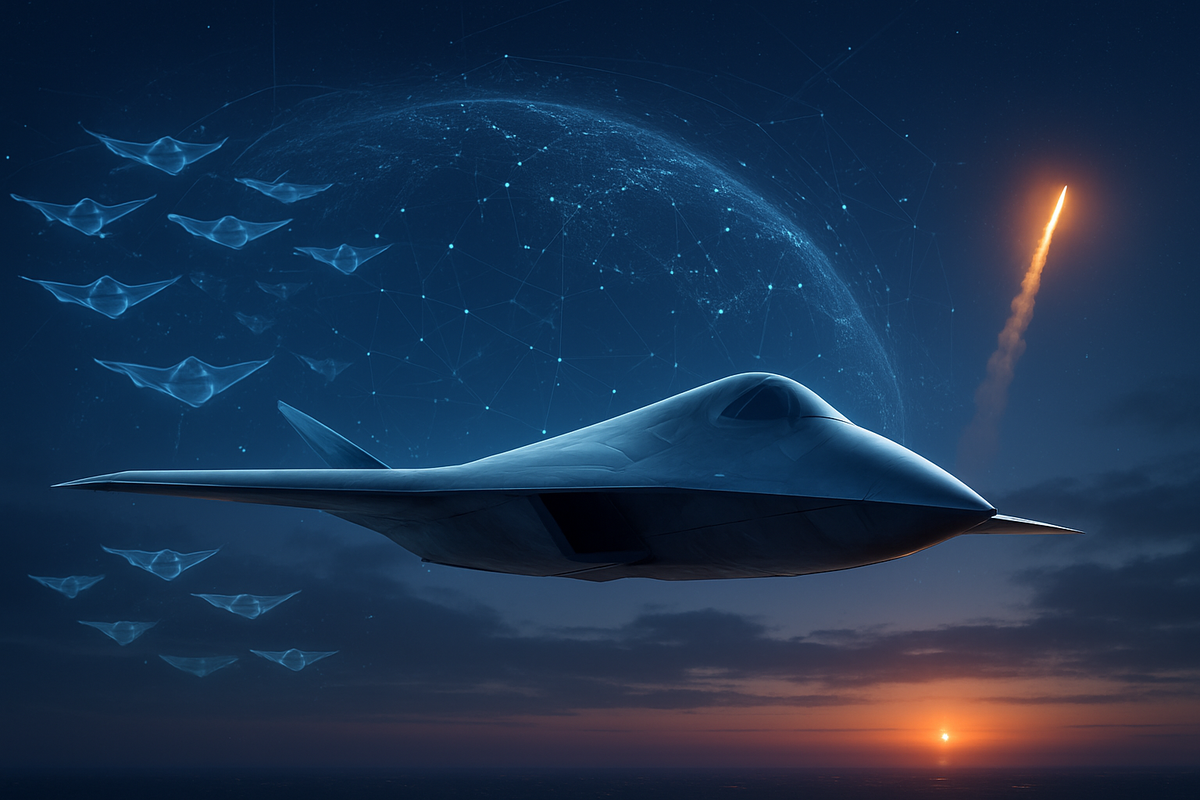
As the sun rises on 2026, the aerospace and defense sector stands at the center of a global industrial renaissance. Driven by a historic $1.01 trillion U.S. defense budget and a radical shift in NATO spending priorities, the industry has transitioned from a period of supply chain recovery to one of high-volume, high-margin execution. Investors who once viewed defense stocks as slow-growth "bond proxies" are now treating them as the bedrock of growth portfolios, as the "New Cold War" reality cements a permanent demand for advanced kinetic and autonomous systems.
The immediate implications are profound: the era of the "peace dividend" has officially been replaced by a "security supercycle." With major backlogs reaching record highs across the board, the focus for 2026 has shifted from securing contracts to the rapid industrialization of new technologies. This pivot is not merely a reaction to localized conflicts but a systemic overhaul of global security architecture, where "sovereign capability" and "software-defined defense" have become the new watchwords for institutional investors and government planners alike.
The Road to the Trillion-Dollar Budget
The path to the current 2026 landscape was paved by a series of seismic shifts throughout 2024 and 2025. Following the 2024 U.S. election, the return of an "America First" posture in early 2025 accelerated a pivot toward domestic industrial revitalization and intensified focus on the Indo-Pacific. This policy shift was punctuated by the "Golden Dome" initiative—a $25 billion national missile defense program designed to shield North America from the rising threat of hypersonic and cruise missiles. This massive investment served as a catalyst for the sector, signaling a long-term commitment to high-tech deterrence.
Simultaneously, the NATO Hague Summit in June 2025 marked a turning point for European defense. Member states moved beyond the traditional 2% GDP spending target, agreeing to a "quantum leap" toward a 5% target by 2035. This agreement was born out of the realization that European stockpiles were dangerously depleted after years of supporting regional conflicts. By early 2026, 22 of the 32 NATO members have already exceeded the previous 2% benchmark, leading to a surge in cross-border procurement and a "re-arming" of the continent that has disproportionately benefited large-cap U.S. defense firms capable of rapid delivery.
The timeline of the last 18 months also saw a strategic transition in the Middle East. While 2024 was defined by high-intensity kinetic warfare, 2025 saw a shift toward "strategic containment" and the protection of "invisible infrastructure," such as undersea cables and energy pipelines. This shift has not reduced spending; rather, it has redirected it toward sophisticated surveillance, electronic warfare, and layered air defense systems. The result is a market that is no longer reactive to "hot" wars but is instead sustained by a global, multi-theater preparation for long-term competition.
The Titans of 2026: Winners and Losers in a High-Stakes Market
Lockheed Martin (NYSE: LMT) enters 2026 as a primary beneficiary of the renewed focus on missile defense and multi-domain operations. With a record backlog of approximately $179 billion, the company has finally stabilized its F-35 delivery pipeline after years of software delays. The late-2025 award of a $9.8 billion contract for PAC-3 MSE interceptors has positioned Lockheed as the "value play" of the sector, trading at roughly 17x earnings while maintaining a dominant position in the "Golden Dome" initiative.
RTX Corporation (NYSE: RTX) has emerged as the sector's standout performer, with its shares gaining nearly 60% over the past 52 weeks. The company successfully navigated the Pratt & Whitney engine crisis of 2024, and by early 2026, the financial impact has been fully contained. RTX is now reaping the rewards of its "Iron Dome" joint venture and a massive $1.7 billion Patriot system deal with Spain. For investors, RTX represents the "normalization" of the industry—a firm that has cleared its legacy hurdles and is now generating over $7 billion in annual free cash flow.
In contrast, Northrop Grumman (NYSE: NOC) faces a more complex 2026. While the company remains a leader in space-based defense and nuclear modernization, its flagship Sentinel ICBM program is currently navigating a "critical" cost breach, with total program estimates ballooning to $141 billion. Although the Pentagon has certified the program as essential, the restructuring required in 2026 may weigh on Northrop's margins. However, their success in the B-21 Raider program and a $1.4 billion missile defense modernization win in Poland continue to provide a solid floor for the stock.
General Dynamics (NYSE: GD) continues to be the "steady hand" of the sector, bolstered by its Marine Systems division. As the U.S. and its AUKUS partners prioritize naval sovereignty in the Indo-Pacific, General Dynamics has secured multi-billion dollar contracts for Columbia-class and Virginia-class submarines. Meanwhile, Boeing (NYSE: BA) is in the midst of a fragile recovery. Under new leadership, Boeing has seen a 30% reduction in production defects, but the 777X program’s delay to 2027 remains a significant headwind. While Boeing’s defense wing secured an $8.6 billion F-15IA deal with Israel in late 2025, the company’s massive debt load continues to make it the most volatile play among the large-caps.
A Shift in the Warfare Paradigm: Attrition and Autonomy
The wider significance of the 2026 outlook lies in the fundamental change in how wars are fought and deterred. The conflicts of 2024-2025 proved that "drones are the new bullets," shifting the industry's focus toward mass-producible, low-cost autonomous systems. This "drone gold rush" has forced traditional defense giants to adopt "expeditionary manufacturing" techniques, such as 3D printing at the front lines, to keep pace with the staggering attrition rates seen in modern combat.
This trend fits into a broader industry move toward "Software-Defined Defense." In 2026, the value of a platform is increasingly found in its AI-driven "agentic" capabilities rather than its physical hull or airframe. This has led to a flurry of partnerships between traditional defense firms and Silicon Valley tech companies, as the Pentagon prioritizes "Collaborative Combat Aircraft" (CCA)—autonomous wingmen that fly alongside manned jets. This shift is blurring the lines between the aerospace and technology sectors, creating a new regulatory environment focused on AI ethics and data sovereignty.
Furthermore, space has officially been codified as a "contested warfighting domain." With over 47 countries now maintaining active military space programs, the 2026 budget includes significant allocations for "nuclear-hardened" satellite constellations. This represents a historical precedent similar to the naval arms races of the early 20th century, where control of the "high ground" is seen as the prerequisite for terrestrial security. The ripple effect is a massive expansion in the private space launch and satellite servicing market, benefiting both established players and "New Space" startups.
The 2027 Horizon: Strategic Pivots and Emerging Challenges
Looking ahead, the short-term focus for the A&D sector will be the "reindustrialization" of the supply chain. Companies are aggressively "friend-shoring" their critical mineral requirements to reduce reliance on adversarial nations. This strategic pivot is not optional; it is a requirement for securing future government contracts. We expect to see more vertical integration in 2026, as defense primes acquire smaller specialized firms in the semiconductor and rare-earth processing spaces to ensure production resilience.
The long-term challenge—and opportunity—lies in hypersonics and directed-energy weapons. As the U.S. prepares for its first nuclear tests in over 30 years following the collapse of the New START treaty in February 2026, the pressure to field functional hypersonic interceptors will reach a fever pitch. This will likely lead to a "winner-take-all" scenario for the first company to successfully demonstrate a reliable, Mach 5+ defense shield, potentially shifting billions in market cap between the major players.
Market opportunities will also emerge from the "dual-use" nature of these technologies. The autonomous flight systems developed for the military are already beginning to find applications in commercial logistics and urban air mobility. However, the industry must remain wary of potential "budget fatigue." While the $1 trillion milestone has been reached, the sustainability of such spending levels will depend on continued geopolitical tension and the ability of these companies to prove they can deliver high-tech solutions without the massive cost overruns that plagued the previous decade.
Conclusion: Investing in the "Fortress" Era
The aerospace and defense sector enters 2026 not as a cyclical industry, but as a structural necessity of the modern geopolitical order. The key takeaways for the year are clear: the "security supercycle" is real, driven by a trillion-dollar U.S. budget and a re-armed Europe; the industry has successfully pivoted toward autonomous and software-defined systems; and the financial health of the "Big Five" has largely stabilized following the supply chain shocks of the early 2020s.
Moving forward, the market will likely favor companies that can demonstrate "industrial agility"—the ability to scale production of low-cost drones while simultaneously managing the complex engineering of nuclear and space-based assets. Investors should keep a close eye on the FY2027 budget requests, which will be released in the coming months, as they will provide the first clues as to whether the "Golden Dome" and "CCA" programs will receive the sustained funding needed to reach full-rate production.
In this "Fortress" era of investing, the aerospace and defense sector offers a unique combination of government-backed revenue certainty and high-tech growth potential. While risks remain—particularly in the form of regulatory scrutiny over AI and the ongoing challenges of nuclear modernization—the fundamental drivers of the industry have never been stronger. For the foreseeable future, the defense of the realm is also the defense of the portfolio.
This content is intended for informational purposes only and is not financial advice.