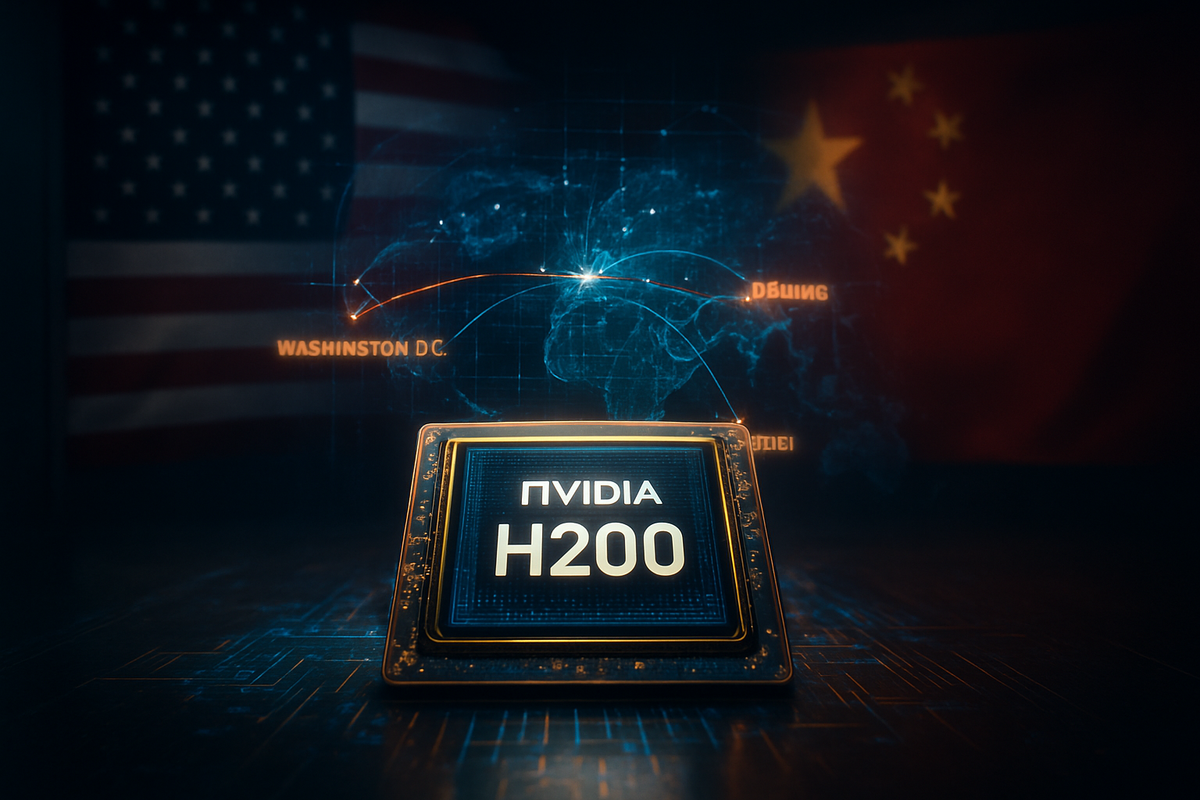
WASHINGTON D.C. — In a landmark shift for global technology trade, the Trump administration has officially authorized the export of Nvidia Corporation (NASDAQ: NVDA)'s high-performance H200 AI chips to the Chinese market. The move, finalized between January 13 and 14, 2026, replaces the previous administration's "presumption of denial" with a new "managed access" framework. While the approval opens a massive revenue stream for the American chip giant, it comes with stringent security requirements, including a mandatory "U.S. Routing" verification process and a 25% "Trump Surcharge" on every unit sold to China.
The immediate market reaction was characterized by caution rather than celebration. Nvidia’s share price dipped 1.4% following the announcement, closing at $183.14. Investors expressed concern over the logistical hurdles and the potential for a retaliatory response from Beijing, which has already signaled that it may label the H200 chips "unsafe" due to the new American oversight protocols. Despite the dip, the policy marks a definitive turning point in the U.S.-China tech cold war, moving from total decoupling toward a model of "taxable dependency."
A New Framework for Silicon Diplomacy
The approval of the H200 follows months of intense lobbying and direct negotiations between Nvidia CEO Jensen Huang and the Trump administration throughout late 2025. The new licensing framework issued by the Bureau of Industry and Security (BIS) is built on several rigorous conditions. First is the "50% Rule," which caps Nvidia’s total shipment volume to China at 50% of its domestic U.S. sales volume, ensuring that American firms maintain priority access to the most advanced hardware. Furthermore, the chips must meet specific performance thresholds; the H200, with its Total Processing Performance (TPP) score of 15,832, falls safely under the government’s new 21,000 cap.
The most controversial element of the deal is the mandatory U.S. Routing and Verification. For the first time, chips manufactured by Taiwan Semiconductor Manufacturing Company (NYSE: TSM) must be shipped to the United States for testing by an independent, U.S.-headquartered laboratory before they can be forwarded to China. This requirement is designed to ensure that the hardware has not been "overclocked" or modified to exceed performance limits. Additionally, President Trump signed a Section 232 proclamation imposing a 25% surcharge on these exports. The administration intends to use the estimated $4 billion to $6 billion in annual revenue from this "cut" to fund domestic semiconductor manufacturing and infrastructure.
Winners, Losers, and the Margin Squeeze
Nvidia (NASDAQ: NVDA) stands as the primary beneficiary of the policy in terms of raw market access, yet the 1.4% stock slide reflects the complex trade-offs. The company now faces a logistical nightmare: the U.S. routing requirement adds weeks to delivery times and significantly increases freight and insurance costs. Moreover, there is lingering uncertainty about whether Nvidia can pass the 25% surcharge onto Chinese buyers or if it will have to absorb the cost to remain competitive against domestic Chinese rivals like Huawei and its Ascend 910C series.
On the other side of the Pacific, Chinese tech giants such as Alibaba (NYSE: BABA) and Tencent (OTC:TCEHY) may see this as a mixed blessing. While they finally gain access to the H200’s massive 141 GB of HBM3e memory—crucial for training frontier-scale AI models—they do so under the watchful eye of the U.S. government. Meanwhile, Taiwan Semiconductor Manufacturing Company (NYSE: TSM) faces increased complexity in its supply chain, having to navigate the detour to U.S. ports for verification. Domestically, U.S. chipmakers like Intel Corporation (NASDAQ: INTC) and Advanced Micro Devices (NASDAQ: AMD) may benefit from the "Trump Surcharge" fund, which is slated to subsidize American-made silicon, potentially narrowing the cost gap between domestic and foreign-made hardware.
Compute as a Sovereign Asset
This policy shift fits into a broader global trend of treating AI compute as a strategic sovereign resource, akin to oil or rare earth minerals. By moving away from a total ban, the U.S. is attempting to establish a "taxable dependency." The strategy is clear: allow China to purchase American technology that is intentionally kept one generation behind—keeping the latest Blackwell and Rubin architectures restricted—while extracting a significant financial toll that strengthens the U.S. industrial base. This "managed access" model asserts that if China wants to participate in the AI revolution, it must do so on American terms and at an American-set price.
Historically, this resembles the "CoCom" regulations of the Cold War, but with a modern, mercantilist twist. The mandatory routing through the U.S. is a bold assertion of "Foundry Chokepoint" diplomacy. It essentially tells the world that even if a chip is designed in California and made in Taiwan, it remains under U.S. jurisdiction until the final point of sale. This sets a precedent that could soon extend to other critical technologies, such as quantum computing components or advanced biotech equipment, further integrating national security directly into the corporate balance sheet.
The Road Ahead: Retaliation and Innovation
In the short term, the market will be watching Beijing’s response with bated breath. Early reports from Chinese customs suggest a potential "tit-for-tat" move, with officials threatening to block the H200 imports on the grounds that the U.S. routing process introduces "security vulnerabilities" or "backdoors." If China refuses to accept the chips under these terms, Nvidia’s projected revenue gains could evaporate, leading to further volatility in the semiconductor sector.
Looking further ahead, this policy may accelerate China’s "self-reliance" drive. Deprived of the very latest U.S. architectures and taxed heavily on the previous generation, Chinese firms will likely double down on domestic GPU development. For Nvidia and its peers, the strategic pivot will involve balancing this new regulatory maze with the need to innovate faster than the "managed access" limits can be adjusted. Investors should expect a period of "logistical discovery" as the first H200 shipments make their way through the new U.S. verification hubs in the coming months.
Summary and Market Outlook
The Trump administration’s approval of H200 exports to China is a sophisticated, albeit risky, evolution of U.S. trade policy. By replacing bans with a system of surcharges and mandatory routing, the U.S. is attempting to monetize its lead in the AI race while simultaneously funding its own industrial resurgence. The key takeaways for investors are the 25% surcharge and the "U.S. Routing" requirement, both of which introduce significant friction into what was once a seamless global supply chain.
Moving forward, the market will likely remain sensitive to any signs of Chinese retaliation or logistical bottlenecks in the verification process. While the H200 approval provides a "floor" for Nvidia’s China revenues, the "ceiling" is now firmly controlled by Washington. Investors should watch for the first quarterly earnings reports of 2026 to see how these surcharges and delays impact Nvidia’s gross margins and whether the "managed access" model becomes the new standard for the entire high-tech sector.
This content is intended for informational purposes only and is not financial advice.