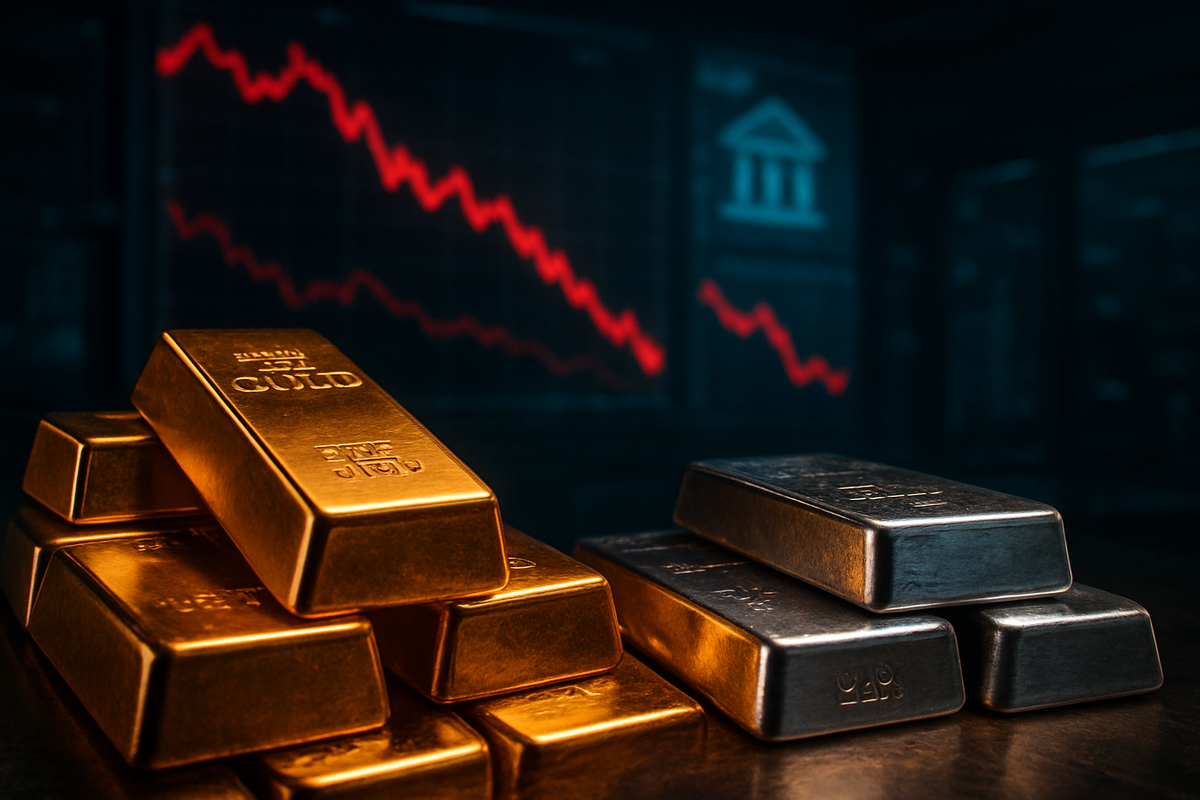
In a historic session that has sent shockwaves through global financial centers, precious metals have ascended to heights once deemed unthinkable by mainstream analysts. As of January 16, 2026, spot gold has surged to a fresh record high of $4,635 per ounce, while silver has catapulted past the psychological $90 barrier to trade at $93 per ounce. This vertical ascent represents a fundamental repricing of hard assets as investors flee traditional paper markets in response to a deepening systemic tremor within the global banking sector and persistent macroeconomic instability.
The immediate implications are profound: the U.S. dollar is facing a "crisis of confidence" as real yields remain deeply negative, and capital is hemorrhaging from regional banking equities into "safe-haven" vaults. For the average consumer, this surge signals a transition into a high-inflationary regime where the purchasing power of fiat currency is being tested against the enduring value of bullion. Market participants are no longer asking if a recession is coming, but rather how much of the existing financial architecture will survive the current "CRE debt cliff."
A Perfect Storm: The Path to the Record Highs
The rally that culminated in today’s record prices was not an overnight phenomenon but the result of a compounding "perfect storm" that began in late 2025. The primary catalyst has been the realization of the long-feared Commercial Real Estate (CRE) crisis. With approximately $1.5 trillion in CRE debt maturing between 2025 and 2026, delinquency rates for office properties spiked to 10.4% this month. This has forced mid-sized lenders to drastically increase loan-loss provisions, sparking fears of a contagion similar to the 2023 regional banking crisis, but on a significantly larger scale.
The timeline of this surge accelerated following the Federal Reserve’s pivot in December 2025. Facing a liquidity crunch in money markets, the Fed moved from Quantitative Tightening to what it termed "active reserve management"—effectively a return to Quantitative Easing. This influx of liquidity, intended to stabilize banks, instead acted as rocket fuel for precious metals. The situation reached a boiling point on January 12, 2026, when reports surfaced of a federal investigation into regulatory lapses, causing the KBW Regional Banking Index to plunge 7.2% in a single day and triggering the massive "flight to quality" seen over the last 96 hours.
Mining Giants and Fragile Lenders: The Market’s Winners and Losers
The surge in metal prices has created a bifurcated market of spectacular winners and distressed losers. Leading the charge are the senior gold producers, who are currently enjoying the widest profit margins in the history of the industry. Newmont (NYSE: NEM) has seen its stock price nearly triple over the last twelve months, as its All-In Sustaining Costs (AISC) have remained relatively stable near $1,000, allowing for unprecedented free cash flow. Similarly, Barrick Gold (NYSE: GOLD) has emerged as a cash-flow engine, with its Tier-One assets in Nevada providing massive leverage to the $4,600+ gold price.
In the silver space, the gains have been even more parabolic. Hecla Mining (NYSE: HL) has outperformed the broader market by over 200% as silver's industrial and monetary demand converged. Streaming companies like Wheaton Precious Metals (NYSE: WPM) are also reaping the rewards; their business model allows them to purchase metal at fixed, low costs, shielding them from inflationary pressures while they sell into a record-high market. Conversely, the losers are concentrated in the financial sector. Regional banks such as Zions Bancorporation (NASDAQ: ZION) and Western Alliance Bancorporation (NYSE: WAL) are under intense pressure, with their balance sheets weighed down by non-performing property loans and a dwindling deposit base as customers move funds into gold-backed ETFs and money market funds.
Historical Precedents and the New Macro Reality
The current environment draws haunting parallels to the stagflationary era of the late 1970s and the 2008 Global Financial Crisis, yet the scale is arguably more significant. While the 1980 gold peak was driven by geopolitical tension and oil shocks, the 2026 surge is rooted in a "sovereign debt trap." With U.S. debt-to-GDP ratios at post-war highs, the market is beginning to view gold and silver not just as commodities, but as a "vote of no confidence" in the sustainability of G7 fiscal policies. This represents a major shift in industry trends, where precious metals are decoupling from traditional correlations with the U.S. Dollar Index (DXY).
The ripple effects are extending into the regulatory sphere. Central banks in the "Global South" have been aggressively de-dollarizing, shifting their reserves into bullion at a pace not seen in 50 years. This has created a floor for prices that prevents the typical "mean reversion" analysts expect after such a rapid climb. Furthermore, the industrial scarcity of silver—driven by the green energy transition—has created a supply-demand deficit that regulators are struggling to address, leading to talks of potential strategic silver reserves in several industrialized nations.
The Road Ahead: Short-Term Volatility or a Permanent Plateau?
Looking forward, the immediate question for the market is whether these prices are sustainable. In the short term, technical indicators suggest that both gold and silver are "extremely overbought," and a healthy consolidation could see gold retreat toward the $4,200 level. However, the fundamental drivers—banking instability and the CRE crisis—are unlikely to be resolved in a single quarter. Strategic pivots are already underway; large institutional funds are increasingly allocating 10-15% of their portfolios to "hard assets," up from the traditional 2-5%.
Longer-term, the market faces the challenge of a potential "liquidity trap" where the Fed is forced to choose between saving the banking system through inflation or protecting the currency at the cost of a systemic collapse. If the CRE defaults continue to mount through mid-2026, some analysts at firms like UBS suggest gold could challenge $5,000 by year-end. Investors should prepare for heightened volatility and potential "margin calls" in other asset classes that could temporarily drag down metals as investors sell what they can to cover losses elsewhere.
Summary and Investor Outlook
The ascent of gold to $4,635 and silver to $93 marks a definitive turning point in the post-pandemic economic era. The key takeaway for investors is that the "safe-haven" bid is no longer a speculative trade but a strategic necessity in an era of banking fragility and fiscal excess. The market is moving toward a reality where tangible assets are prioritized over digital or paper promises.
Moving forward, the market will remain hyper-sensitive to any headlines regarding regional bank earnings and Federal Reserve liquidity facilities. Investors should keep a close eye on the gold-to-silver ratio, which has compressed to 50:1, suggesting silver may still have room to run if the industrial shortage intensifies. While the rapid price appreciation is breathtaking, the underlying structural issues in the global financial system suggest that the "Gilded Crisis" may only be in its middle chapters.
This content is intended for informational purposes only and is not financial advice.