Duolingo (NASDAQ: DUOL) has long been more than just a language-learning app; it is a masterclass in gamification and behavioral economics. By 2025, the company had successfully transitioned from a niche tool into a diversified platform offering Math, Music, and advanced AI-driven tutoring. Yet, the recent stock collapse highlights a fundamental tension in the "AI-first" era: can a company maintain hyper-growth while its core product—knowledge—is being commoditized by free, general-purpose LLMs like ChatGPT? Today, investors are grappling with whether this 23% correction is a "clearing of the decks" for a stronger future or a signal that the easy growth is over.
Historical Background
Founded in 2011 by Luis von Ahn (the inventor of reCAPTCHA) and Severin Hacker, Duolingo was born from a vision of making high-quality education accessible to everyone, regardless of wealth. Initially, the company funded itself through a unique crowdsourced translation model, where users translated articles as they learned. This eventually evolved into the "freemium" model that defines the company today.
Since its IPO in 2021, Duolingo has undergone several transformations. It moved from a simple "translation" app to a "learning" app, and finally to a "gamified ecosystem." Key milestones include the 2023 launch of "Duolingo Max," a premium tier powered by OpenAI’s GPT-4, and the 2024 integration of Math and Music courses directly into the flagship app. By the end of 2025, Duolingo had reached the milestone of $1 billion in annual revenue, proving that gamification could indeed be monetized at scale.
Business Model
Duolingo operates a sophisticated freemium model designed to maximize the "top of the funnel" while carefully converting high-intent users into subscribers.
- Subscriptions: The primary revenue driver. "Super Duolingo" offers an ad-free experience and unlimited "hearts," while the higher-priced "Duolingo Max" includes AI features like "Explain My Mistake" and "Roleplay."
- Advertising: Revenue generated from non-subscribers who view ads after completing lessons.
- Duolingo English Test (DET): A high-stakes, AI-proctored English proficiency exam accepted by over 5,000 institutions globally. This segment provides a counter-cyclical revenue stream linked to international student mobility.
- In-App Purchases: Sales of "Gems" and other digital goods used within the game's economy.
The "Flywheel" effect is central to this model: more users lead to more data, which improves the AI teaching algorithms, which leads to better learning outcomes and higher engagement, which eventually drives more subscriptions.
Stock Performance Overview
Duolingo’s journey on the NASDAQ has been a rollercoaster.
- 1-Year Performance: Before the February 2026 plunge, the stock was up nearly 45% year-over-year, buoyed by the "AI hype" and strong subscriber growth. Post-plunge, the 1-year return has flattened to near zero.
- 5-Year Performance: Since early 2021, the stock has outperformed the broader S&P 500, though it has seen massive drawdowns during the 2022 tech sell-off and the recent 2026 correction.
- Volatility: DUOL remains a high-beta stock. Its valuation—often exceeding 15x forward sales—leaves little room for execution errors, as evidenced by the recent 23% drop.
Financial Performance
The "disappointment" of 2026 stems from a cooling of once-torrid growth rates.
- Revenue Growth: After growing at 40%+ in 2024, the 2026 guidance suggested a slowdown to 18-20%.
- Bookings: Q4 2025 bookings showed signs of saturation in core markets like the U.S. and U.K.
- Margins: While the company turned GAAP profitable in 2024, the decision to increase R&D spending on "Math and Music" and subsidize AI costs for free users in 2026 is expected to compress Adjusted EBITDA margins from 28% back down to 21-22%.
- Cash Flow: On a positive note, Duolingo remains cash-flow positive with over $1.1 billion in cash and no debt, supporting a $400 million share buyback program aimed at stabilizing the stock price.
Leadership and Management
The duo of Luis von Ahn (CEO) and Severin Hacker (CTO) remains at the helm, maintaining a "product-led" culture. They are widely regarded as visionary leaders who prioritize long-term user retention over short-term quarterly beats. However, this "long-termism" is exactly what spooked the market in February 2026. Von Ahn’s refusal to "squeeze" the user base for more profit in a slowing macro environment is a point of contention among some institutional investors, while others see it as a necessary defense against AI commoditization.
Products, Services, and Innovations
Duolingo’s product roadmap is now focused on the "Total Human Learning" concept:
- Duolingo Max: The "AI Tutor" that uses GenAI to simulate real-world conversations.
- Multi-Subject App: The integration of Music (sight-reading, rhythm) and Math (K-12 curriculum) into one interface.
- The "Daily Streak": Perhaps their most potent "product," the streak mechanism drives industry-leading retention rates.
- AI-Native Content: Duolingo is moving away from human-written curricula to AI-generated, human-verified lessons, drastically reducing the cost of launching new languages or subjects.
Competitive Landscape
The competitive field has bifurcated:
- Legacy Rivals: Babbel and Rosetta Stone (owned by IXL Learning) continue to focus on more "serious," academic learners, but they are losing the engagement war to Duolingo’s gamified approach.
- AI Disruptors: The real threat comes from OpenAI’s ChatGPT, Google (NASDAQ: GOOGL) Gemini, and specialized AI tutors like Khan Academy’s "Khanmigo." These tools offer free-form conversation that is often more flexible than Duolingo’s structured "tree" model.
- Specialized Apps: ELSA Speak (pronunciation) and Photomath (now owned by Google) compete in specific niches.
Industry and Market Trends
- GenAI as a Commodity: As high-quality AI models become cheaper, the "value" of the AI itself drops. The value shifts to the user interface and the habit-forming loops—areas where Duolingo excels.
- The "SaaSpocalypse": Investors are increasingly wary of software companies that don't have a "moat" against LLMs. Duolingo is trying to prove its moat is its brand and its social graph (Leaderboards).
- Global Literacy: Increasing demand for English proficiency in emerging markets (India, Brazil, Vietnam) remains a long-term tailwind.
Risks and Challenges
- AI Cannibalization: If a free version of ChatGPT can teach Spanish as well as Duolingo Max, why pay $168/year?
- User Fatigue: Gamification can lead to "burnout." If users feel they are playing a game rather than actually learning, they eventually churn.
- Guidance Volatility: Management’s shift in 2026 toward "Growth over Profit" creates uncertainty for value-oriented investors.
- Cost of AI: GenAI is expensive to run. Subsidizing these costs for free users could bleed margins if conversion to paid tiers doesn't follow.
Opportunities and Catalysts
- Family Plan Expansion: Converting single users to higher-ARPU (Average Revenue Per User) Family Plans remains a key lever.
- B2B and Schools: Duolingo for Schools is currently a free tool; monetizing this through institutional partnerships is a "sleeper" opportunity.
- Advanced Subjects: Moving into Science, Coding, or Financial Literacy could turn Duolingo into the "App Store for Learning."
- M&A Potential: With $1 billion in cash, Duolingo could acquire a smaller AI startup or a niche content provider (e.g., in the coding space) to accelerate subject expansion.
Investor Sentiment and Analyst Coverage
Post-plunge sentiment is deeply divided.
- Bulls: Argue that the 23% drop is an overreaction. They see the move to make AI features free as a brilliant "land grab" that will starve competitors of users.
- Bears: Claim the guidance miss is the "canary in the coal mine," signaling that Duolingo has reached "Peak Language" and that its new subjects (Math/Music) aren't yet meaningful revenue contributors.
- Wall Street: Several firms, including Goldman Sachs and JPMorgan, have lowered their price targets from the $300 range to roughly $220, citing "multiple compression" in a slower growth environment.
Regulatory, Policy, and Geopolitical Factors
- EU AI Act: Effective August 2026, this will require Duolingo to provide more transparency on how its AI tutors function and ensure they don't reinforce biases.
- COPPA 2.0: New U.S. regulations regarding children’s data privacy (April 2026) could increase compliance costs for the "Math" product, which targets younger users.
- Global Tensions: As a US-based educational tool, Duolingo faces periodic "app store" risks in sensitive markets like China, though its "apolitical" content usually keeps it out of the crosshairs.
Conclusion
Duolingo’s 23% stock plunge on February 2026 is a classic "reset" moment. For years, the company grew by gamifying language. Now, it is attempting the much harder task of gamifying all education while navigating a world where AI is everywhere and free.
The decision to prioritize user growth over near-term profits is a high-stakes gamble. If von Ahn can prove that "Duolingo Math" and "Duolingo Music" can replicate the "addictive" success of Spanish and French, the company will likely look undervalued at these levels. However, if the pivot to "free" AI features fails to accelerate user growth, the stock may face further downward pressure as it transitions from a high-growth "disruptor" to a more mature—and more slowly growing—software utility.
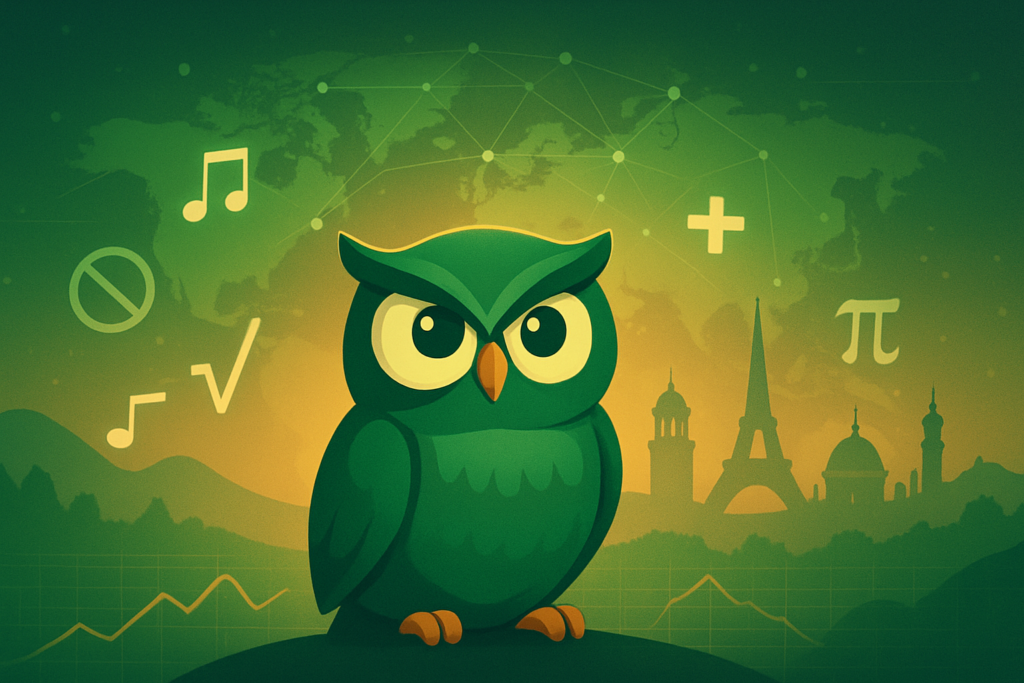
For investors, the key metric to watch over the next two quarters is not revenue, but Daily Active User (DAU) acceleration. If the "Free AI" strategy brings in tens of millions of new learners, the green owl will likely have the last laugh.
This content is intended for informational purposes only and is not financial advice.