Port Modernization, Coastal Protection, and Climate-Resilient Infrastructure Sustain Long-Term Global Demand
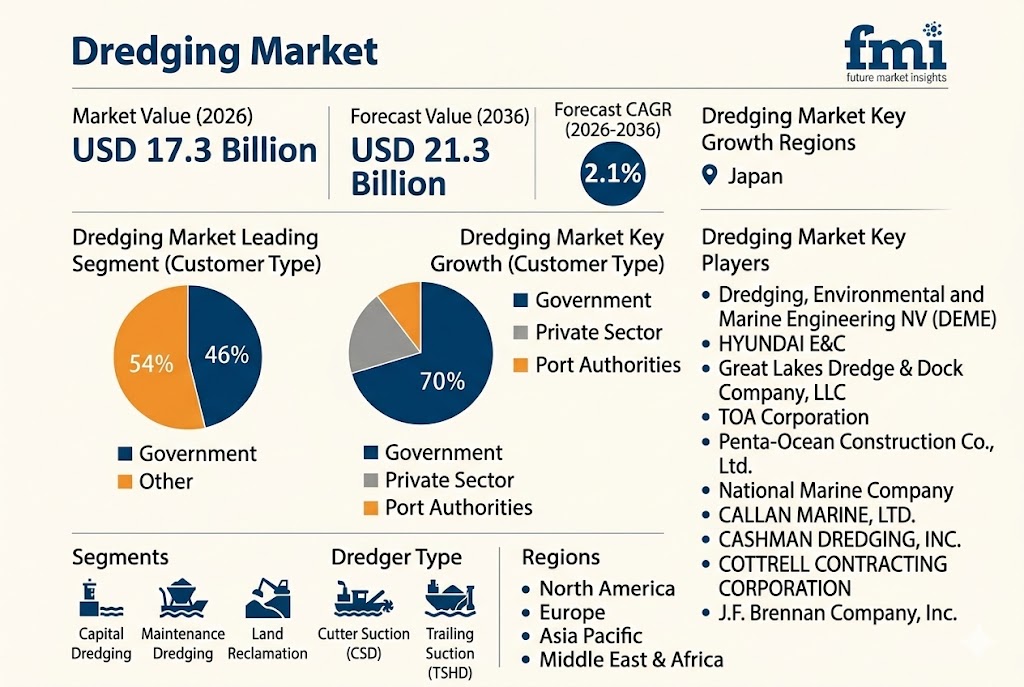
NEWARK, DE / ACCESS Newswire / February 27, 2026 / The global dredging market is entering a decade of measured, infrastructure-led expansion as governments and port authorities intensify investments in maritime trade corridors, coastal resilience, and inland waterway modernization. Valued at USD 17.3 billion in 2026, the market is forecast to reach USD 21.3 billion by 2036, progressing at a compound annual growth rate (CAGR) of 2.1%.
Dredging remains a foundational pillar of global infrastructure-supporting port deepening, shoreline stabilization, flood mitigation, and environmental remediation. As vessel sizes increase and trade volumes rebound across major economies, maintaining navigable waterways has become a strategic priority rather than a routine maintenance task.
Get Access of Report Sample: https://www.futuremarketinsights.com/reports/sample/rep-gb-4821
Market Snapshot (2026-2036)
Metric |
Value |
|---|---|
Market Value (2026) |
USD 17.3 Billion |
Forecast Value (2036) |
USD 21.3 Billion |
Projected CAGR |
2.1% |
Leading Customer Segment |
Government (46% Share) |
Leading Application |
Trade Maintenance (31% Share) |
Fastest Growing Region |
Japan |
Growth Forecast: Stable Expansion with Low Volatility
A peak-to-trough analysis indicates consistent and gradual expansion over the forecast period.
2026-2031: Market rises from USD 17.3 billion to USD 19.6 billion
2031-2036: Market grows further to USD 21.3 billion
Growth remains steady, driven primarily by long-term port modernization projects and regular maintenance dredging activities. Unlike cyclical construction sectors, dredging benefits from recurring operational demand due to natural sedimentation processes that continuously reduce channel depths.
What Is Driving Demand?
1. Expansion of Maritime Trade Infrastructure
Global shipping networks are adapting to larger vessels requiring deeper drafts and expanded berths. Continuous dredging ensures operational efficiency in major logistics hubs.
2. Government-Led Infrastructure Investment
Government entities account for 46% of total demand, reflecting their responsibility for:
Port expansion and modernization
Inland waterway development
Flood defense systems
Coastal erosion management
Environmental restoration initiatives
3. Climate Resilience & Coastal Protection
Rising sea levels and increased storm intensity are pushing nations to strengthen shoreline defenses, increasing demand for protective dredging projects.
4. Environmental Remediation
Growing regulatory emphasis on water quality has elevated demand for sediment removal and ecosystem restoration.
Leading Market Segments
By Customer Type
Government - 46% Share (Dominant Segment)
O&G Companies
Mining Companies
Renewable Energy Companies
Others
Governments remain the largest buyers due to ongoing public works and coastal management responsibilities.
By Application
Trade Maintenance - 31% Share (Leading Segment)
Trade Activity Expansion
Energy Infrastructure
Urban Development
Coastal Protection
Leisure & Others
Trade maintenance leads as ports must remain operational regardless of broader economic cycles.
Regional Outlook: Asia Gains Momentum
Japan - 5.7% CAGR
Japan emerges as the fastest-growing market. As an island economy reliant on maritime trade, Japan prioritizes navigational channel maintenance, port modernization, and flood prevention infrastructure.
China - 5.1% CAGR
China's position as the world's largest trading nation fuels port deepening and land reclamation activities. Ongoing coastal urbanization further strengthens demand.
India - 4.4% CAGR
India's long coastline and maritime expansion initiatives, including inland waterway upgrades, are supporting steady dredging investments.
Germany - 3.8% CAGR
Germany continues to invest in maintaining North Sea and Baltic Sea port competitiveness while strengthening flood protection systems.
France - 2.1% CAGR
France sees moderate but stable demand, driven by ongoing port modernization and environmental compliance initiatives.
Key Market Dynamics
Primary Growth Drivers
Port expansion to accommodate mega vessels
Inland waterway modernization
Offshore energy and seabed preparation
Climate resilience infrastructure
Government infrastructure funding
Market Restraints
Lengthy environmental permitting processes
Sediment disposal regulations
High capital investment in advanced dredging vessels
Skilled labor shortages
Emerging Trends
Precision dredging technologies using sonar mapping
GPS-enabled automation systems
Beneficial reuse of dredged materials
Low-emission and hybrid dredging fleets
Integrated coastal zone management strategies
Competitive Landscape: Specialized Expertise Defines Leaders
The dredging market remains highly specialized, with technical expertise and fleet capability forming key competitive differentiators.
Major Industry Participants
Dredging, Environmental and Marine Engineering NV (DEME)
HYUNDAI E&C
Great Lakes Dredge & Dock Company, LLC
TOA Corporation
Penta-Ocean Construction Co., Ltd.
National Marine Company
CALLAN MARINE, LTD.
CASHMAN DREDGING, INC.
COTTRELL CONTRACTING CORPORATION
J.F. Brennan Company, Inc.
Market leaders compete through:
Advanced fleet modernization
Environmentally responsible dredging techniques
Turnkey project delivery models
Regulatory navigation expertise
Cost optimization through operational efficiency
Strategic Outlook: Essential Infrastructure, Predictable Growth
Unlike high-volatility construction segments, dredging remains a mission-critical service industry tied to global trade continuity and climate adaptation strategies. Natural sedimentation ensures recurring maintenance demand, while long-term infrastructure planning provides multi-year project visibility.
As governments balance economic competitiveness with environmental sustainability, companies capable of delivering precision dredging solutions within strict regulatory frameworks will secure long-term contracts.
By 2036, dredging will remain an indispensable enabler of maritime trade, coastal protection, and resilient infrastructure-solidifying its role as a stable yet strategically vital component of global infrastructure development.
For an in-depth analysis of evolving formulation trends and to access the complete strategic outlook for the Dredging Market through 2036, Full Report Request: https://www.futuremarketinsights.com/reports/dredging-market
Related Reports:
Dredging Equipment Market- https://www.futuremarketinsights.com/reports/dredging-equipment-market
Laser Vibrometer Market- https://www.futuremarketinsights.com/reports/laser-vibrometer-market
Fiberglass Centrifugal Fan Market- https://www.futuremarketinsights.com/reports/fiberglass-centrifugal-fan-market
About Future Market Insights (FMI)
Future Market Insights (FMI) is a leading provider of market intelligence and consulting services, serving clients in over 150 countries. Headquartered in Delaware, USA, with a global delivery center in India and offices in the UK and UAE, FMI delivers actionable insights to businesses across industries including automotive, technology, consumer products, manufacturing, energy, and chemicals.
An ESOMAR-certified research organization, FMI provides custom and syndicated market reports and consulting services, supporting both Fortune 1,000 companies and SMEs. Its team of 300+ experienced analysts ensures credible, data-driven insights to help clients navigate global markets and identify growth opportunities.
For Press & Corporate Inquiries:
Rahul Singh
AVP - Marketing and Growth Strategy
Future Market Insights, Inc.
+91 8600020075
For Sales - sales@futuremarketinsights.com
For Media - Rahul.singh@futuremarketinsights.com
For web - https://www.futuremarketinsights.com/
SOURCE: Future Market Insights, Inc.
View the original press release on ACCESS Newswire