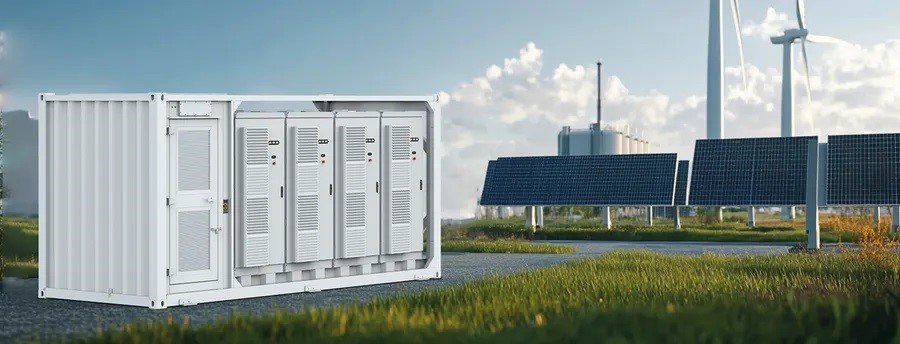
At the grid scale, renewables don’t fail because the sun sets or the wind calms — they fail because the rest of the system wasn’t designed to absorb variability as routine rather than exceptional. Large-scale battery energy storage changes that baseline: it converts intermittency into a series of manageable, often profitable services. Below I move through that space with a technician’s attention to trade-offs and an operator’s eye for what actually gets built, not what looks good on a slide.
From volatility to dispatchability: the core shift
Solar and wind outputs are stochastic on multiple timescales: seconds (gusts, cloud edges), minutes (ramping), hours (diurnal cycles), and seasons. Batteries operate across that spectrum. At short timescales they act like extremely fast governors, arresting frequency deviations and shaving ramp rates. At longer timescales they act like virtual fuel tanks: storing surplus generation for later discharge, firming output, and reducing curtailment.
This is not theoretical. Two capabilities matter most:
l Power capability (MW): how fast the asset can inject or absorb power.
l Energy capacity (MWh): how long it can sustain that power.
Design decisions that conflate the two — e.g., “big MW is always better” — are the source of many project failures. A 50 MW inverter with only 5 MWh of storage will be excellent at momentary grid support but useless for multi-hour firming.
Grid-forming vs grid-following: why the control mode matters
Batteries interface with the grid through inverters. Inverter control architecture is a crucial technical boundary.
l Grid-following inverters synchronize to an existing voltage and frequency reference. They excel when inertia and a strong grid reference exist, providing fast but dependent support.
l Grid-forming inverters actively establish voltage and frequency, behaving like virtual synchronous machines. They can support weak grids and enable microgrids or islanded operation.
When renewables displace synchronous machines, grid-forming capability becomes more than a feature — it is an operational necessity in weak areas. Projects that specify only grid-following control discover operational limits when large portions of local generation are inverter-based.
Practical consequence
An array that pairs several 2 MW inverters with a moderate energy store can be reconfigured in control to provide grid-forming services at the feeder level during contingencies. That’s a software change, but it requires in-spec hardware and validated controls — not an improvisation.
Curtailment reduction and capacity firming
Curtailment occurs when available renewable generation exceeds local demand or export capacity. A well-sited storage asset reduces curtailment in two ways:
1.Absorb excess generation during periods of low demand and export congestion.
2.Time-shift delivery to periods of higher value, improving effective capacity factors.
Capacity firming — guaranteeing a steady quantity of output over a defined window — is the commercial product that enables renewables to compete with dispatchable plants. A utility-scale battery can convert a variable resource into a contractable capacity block for hours at a time, reducing the need for expensive peaker plants.
Transmission deferral and congestion management
Large batteries distributed across a network can defer transmission upgrades by alleviating peak flows and smoothing ramping that would otherwise stress lines and transformers. But they can also create new congestion if not coordinated: simultaneous charging by multiple storage systems responding to the same signal defeats the benefit. Effective grid integration depends on coordination protocols and visibility, not just asset deployment.
Frequency and voltage control as revenue streams
Batteries are uniquely suited to provide fast frequency response (FFR), synthetic inertia, and dynamic voltage support. These services are technically demanding but commercially attractive because:
l They require rapid, precise power changes.
l They can be delivered repeatedly with low marginal cost (aside from cycling wear).
A storage plant can be configured to reserve a small fraction of its power capacity for FFR while using the remainder for energy arbitrage or peak shaving — a multi-revenue approach that improves economics substantially.
Sizing in a world of competing objectives
Sizing a large-scale system is a multi-objective optimization: minimize curtailment, maximize revenue from ancillary services, provide firm capacity, and limit degradation. A concrete example helps.
Suppose a project intends to pair with a 50 MW PV plant to reduce midday curtailment and provide 1-hour firming for evening ramps. A common sizing outcome is:
l 10–20% of the PV MW in energy capacity (i.e., 5–10 MWh) for short-term smoothing and FFR.
l 20–50% for multi-hour shifting depending on local demand and market prices.
These are heuristics, not rules; they shift with tariff design, capacity markets, and the local shape of demand.
Interconnection and protection — practical friction points
Interconnection is where the rubber meets the utility pole. Challenges include:
l Protection coordination: inverter fault contribution differs from synchronous machines and may require relay setting changes.
l Short-circuit considerations: high storage penetration can alter fault levels and relay performance.
l Ride-through and fault-ride-through testing to match grid codes.
Projects with robust pre-commissioning tests, real-time telemetry sharing with the utility, and staged commissioning avoid the longest delays. In other words: plan for bureaucracy as you would for cabling.
Degradation, lifecycle economics, and operational strategy
Cycling accelerates capacity fade. But not all cycles are equal: depth of discharge, C-rate (charge/discharge speed), and temperature dominate degradation. Economics should translate wear into a $/kWh cost and compare that cost to the expected revenue per cycle from energy, capacity, and ancillary services.
This leads to pragmatic operational rules:
l Preserve shallow cycles for frequency response and fast revenue.
l Use deeper cycles for predictable, high-value shifting events.
l Maintain a reserve margin for contingencies and to comply with grid codes.
Case patterns: behind-the-meter vs grid-scale
Behind-the-meter storage optimizes site-level economics: demand charge reduction, resiliency, and limited export. Grid-scale storage targets system-level objectives: congestion management, capacity markets, and transmission deferral. Hybrid projects that straddle both models — e.g., co-located storage providing both local resiliency and grid services under an aggregator contract — capture the most value but require the cleanest control hierarchies and commercial contracts.
The human and institutional layer
Technical capability is necessary but insufficient. Successful integration requires:
l Transparent telemetry and control sharing with grid operators,
l Clear commercial constructs for valuing firming and flexibility,
l Trained operators who understand inverter behaviour during faults and contingencies.
Utilities and developers that invest in these relationships and institutional processes avoid the “we built it, now no one will dispatch it” problem.
Final thought — storage is a systems answer, not a single-device fix
Large-scale batteries are powerful because they change the problem statement. They allow planners to think in time as well as space. But they also expose the grid’s rigidity: protection logic, market design, and operational culture. The task for engineers and policymakers is to treat storage as a systems enabler — specifying controls, markets, and institutional practices that let the technology do what it does best.
And a practical note for spec writers and buyers: don’t specify storage by container count alone. A single modular object like a 1 MWh battery cabinet is a useful procurement unit, but integration success depends more on how those cabinets are networked, controlled, and governed at the utility interface than on the cabinet spec itself.