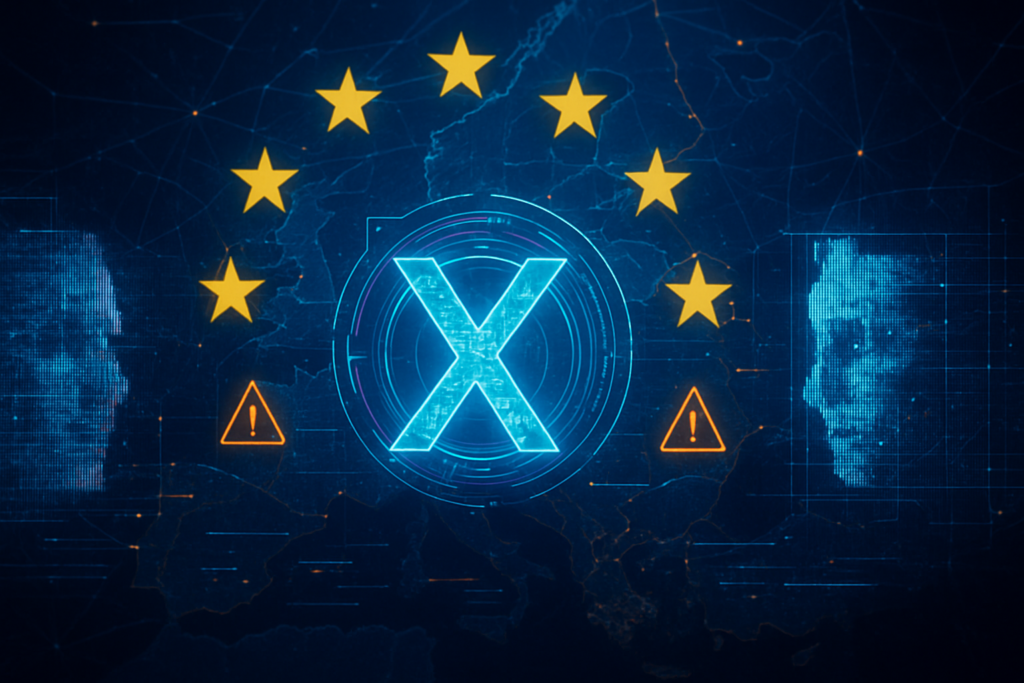
The European Commission has officially opened formal proceedings against X Corp (NASDAQ: X) and its artificial intelligence subsidiary, xAI, marking a pivotal moment in the enforcement of the world’s most stringent AI regulations. On January 26, 2026, EU regulators announced an expanded investigation into Grok, the platform’s native AI assistant, following a widespread surge in non-consensual intimate imagery (NCII) and sexually explicit deepfakes circulating on the platform. This move signifies the first major clash between Elon Musk’s AI ambitions and the newly operational legal framework of the European Union’s AI Act and Digital Services Act (DSA).
This inquiry represents a significant escalation from previous monitoring efforts. By triggering formal proceedings, the Commission now has the power to demand internal data, conduct onsite inspections, and impose interim measures—including the potential suspension of Grok’s image-generation features within the EU. The investigation centers on whether X failed to implement sufficient guardrails to prevent its generative tools from being weaponized for gender-based violence, potentially placing the company in breach of systemic risk obligations that carry fines of up to 6% of global annual revenue.
The Technical Gap: Systemic Risk in the Era of Grok-3
The investigation specifically targets the technical architecture of Grok’s latest iterations, including the recently deployed Grok-3. Under the EU AI Act, which became fully applicable to General-Purpose AI (GPAI) models in August 2025, any model trained with a total compute exceeding 10^25 FLOPs is automatically classified as possessing "systemic risk." Grok’s integration of high-fidelity image generation—powered by advanced diffusion techniques—has been criticized by researchers for its "relaxed" safety filters compared to competitors like OpenAI’s DALL-E or Google's (NASDAQ: GOOGL) Imagen.
Technical assessments from the EU AI Office suggest that Grok’s safeguards against generating realistic human likenesses in compromising positions were easily bypassed using simple "jailbreaking" prompts or subtle semantic variations. Unlike more restrictive models that use multiple layers of negative prompting and real-time image analysis, Grok’s approach has focused on "absolute free speech," which regulators argue has translated into a lack of proactive content moderation. Furthermore, the probe is examining X’s recent decision to replace its core recommendation algorithms with Grok-driven systems, which the Commission fears may be unintentionally amplifying deepfake content by prioritizing "engagement-heavy" controversial media.
Initial reactions from the AI research community have been divided. While some proponents of open AI development argue that the EU’s intervention stifles innovation and creates a "walled garden" for AI, safety researchers at organizations like the Center for AI Safety (CAIS) have lauded the move. They point out that Grok’s perceived lack of rigorous red-teaming for social harms provided a "path of least resistance" for bad actors looking to create pornographic deepfakes of public figures and private citizens alike.
A High-Stakes Legal Battle for Tech Giants
The outcome of this inquiry will have profound implications for the competitive landscape of the AI industry. X Corp is currently facing a dual-threat legal environment: the DSA regulates the platform’s dissemination of illegal content, while the AI Act regulates the underlying model’s development. This puts X in a precarious position compared to competitors like Microsoft (NASDAQ: MSFT), which has spent billions on safety alignment for its Copilot suite, and Meta Platforms Inc. (NASDAQ: META), which has leaned heavily into transparency and open-source documentation to appease European regulators.
In a controversial strategic move in July 2025, xAI signed the voluntary EU AI Code of Practice but notably only committed to the "Safety and Security" chapter, opting out of transparency and copyright clauses. This "partial compliance" strategy backfired, as it drew immediate scrutiny from the EU AI Office. If found liable for "prohibited practices" under Article 5 of the AI Act—specifically for deploying a manipulative system that enables harms like gender-based violence—X could face additional penalties of up to €35 million or 7% of its global turnover, whichever is higher.
The financial risk is compounded by X’s recent history with the Commission; the company was already hit with a €120 million fine in December 2025 for unrelated DSA violations regarding its "blue check" verification system and lack of advertising transparency. For startups and smaller AI labs, the Grok case serves as a warning: the cost of "moving fast and breaking things" in the AI space now includes the risk of being effectively banned from one of the world's largest digital markets.
Redefining Accountability in the Broader AI Landscape
This investigation is the first real-world test of the "Systemic Risk" doctrine introduced by the EU. It fits into a broader global trend where regulators are moving away from reactive content moderation and toward proactive model governance. The focus on sexually explicit deepfakes is particularly significant, as it addresses a growing societal concern over the "nudification" of the internet. By targeting the source of the generation—Grok—rather than just the users who post the content, the EU is establishing a precedent that AI developers are partially responsible for the downstream uses of their technology.
The Grok inquiry also highlights the friction between the libertarian "frontier AI" philosophy championed by xAI and the precautionary principles of European law. Critics of the EU approach argue that this level of oversight will lead to a fragmented internet, where the most powerful AI tools are unavailable to European citizens. However, proponents argue that without these checks, the digital ecosystem will be flooded with non-consensual imagery that undermines public trust and harms the safety of women and marginalized groups.
Comparisons are already being drawn to the landmark privacy cases involving the GDPR, but the AI Act's focus on "systemic harm" goes deeper into the actual weights and biases of the models. The EU is effectively arguing that a model capable of generating high-fidelity pornographic deepfakes is inherently "unsafe by design" if it cannot differentiate between consensual and non-consensual imagery.
The Future of Generative Guardrails
In the coming months, the EU Commission is expected to demand that X implement "interim measures," which might include a mandatory "kill switch" for Grok’s image generation for all users within the EU until a full audit is completed. On the horizon is the August 2026 deadline for full deepfake labeling requirements under the AI Act, which will mandate that all AI-generated content be cryptographically signed or visibly watermarked.
X has already begun to respond, stating on January 14, 2026, that it has restricted image editing and blocked certain keywords related to "revealing clothing" for real people. However, regulators have signaled these measures are insufficient. Experts predict that the next phase of the battle will involve "adversarial auditing," where the EU AI Office conducts its own "red-teaming" of Grok-3 to see if the model can still be manipulated into producing illegal content despite X's new filters.
Beyond the EU, the UK’s regulator, Ofcom, launched a parallel investigation on January 12, 2026, under the Online Safety Act. This coordinated international pressure suggests that X may be forced to overhaul Grok’s core architecture or risk a permanent retreat from the European and British markets.
Conclusion: A Turning Point for Platform Liability
The EU’s formal inquiry into Grok marks a definitive end to the "wild west" era of generative AI. The key takeaway for the industry is clear: platform accountability is no longer limited to the posts a company hosts, but extends to the tools it provides. This case will determine whether the AI Act has the "teeth" necessary to force multi-billion-dollar tech giants to prioritize safety over rapid deployment and uninhibited engagement.
In the history of AI development, the 2026 Grok probe will likely be remembered as the moment the legal definition of "safe AI" was first tested in a court of law. For X Corp, the stakes could not be higher; a failure to satisfy the Commission could result in a crippling financial blow and the loss of its most innovative features in the European market. In the coming weeks, all eyes will be on the EU AI Office as it begins the process of deconstructing Grok’s safety layers—a process that will set the standard for every AI company operating on the global stage.
This content is intended for informational purposes only and represents analysis of current AI developments.
TokenRing AI delivers enterprise-grade solutions for multi-agent AI workflow orchestration, AI-powered development tools, and seamless remote collaboration platforms.
For more information, visit https://www.tokenring.ai/.