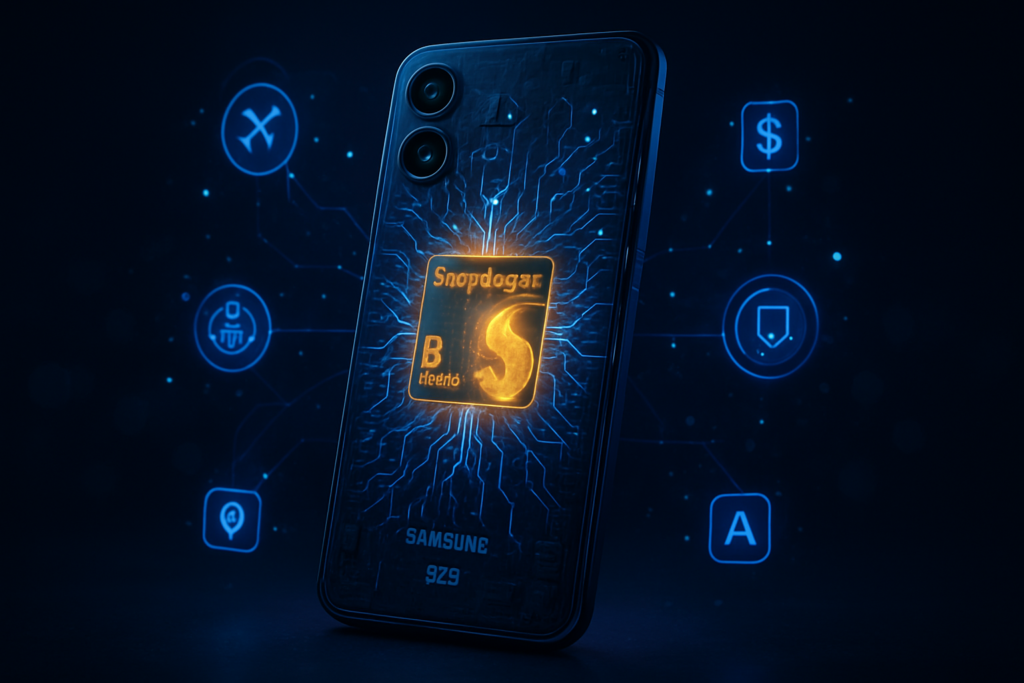
As we enter the first weeks of 2026, the tech industry is standing on the precipice of the most significant shift in mobile computing since the introduction of the smartphone itself. The upcoming launch of the Samsung (KRX:005930) Galaxy S26 series, powered by the newly unveiled Qualcomm (NASDAQ: QCOM) Snapdragon 8 Gen 5—now branded as the Snapdragon 8 Elite Gen 5—marks the definitive transition from cloud-dependent generative AI to fully autonomous "Edge AI." For the first time, smartphones are no longer just windows into powerful remote data centers; they are the data centers.
This development effectively ends the "Cloud Trilemma," where users previously had to choose between the high latency of remote processing, the privacy risks of uploading personal data, and the subscription costs associated with high-tier AI services. With the S26, complex reasoning, multi-step planning, and deep document analysis occur entirely on-device. This move toward localized "Agentic AI" signifies a world where your phone doesn't just answer questions—it understands intent and executes tasks across your digital life without a single packet of data leaving the hardware.
Technical Prowess: The 100 TOPS Threshold and the End of Latency
At the heart of this leap is the Snapdragon 8 Gen 5, a silicon marvel that has officially crossed the 100 TOPS (Trillions of Operations Per Second) threshold for its Hexagon Neural Processing Unit (NPU). This represents a nearly 50% increase in AI throughput compared to the previous year's hardware. More importantly, the architecture has been optimized for "Local Reasoning," utilizing INT2 and INT4 quantization techniques that allow massive Large Language Models (LLMs) to run at a staggering 220 tokens per second. To put this in perspective, this is faster than the average human can read, enabling near-instantaneous, fluid interaction with on-device intelligence.
The technical implications extend beyond raw speed. The Galaxy S26 features a 32k context window on-device, allowing the AI to "read" and remember the details of a 50-page PDF or a month’s worth of text messages to provide context-aware assistance. This is supported by Samsung’s One UI 8.5, which introduces a "unified action layer." Unlike previous generations where AI was a separate app or a voice assistant like Bixby, the new system uses the Snapdragon’s NPU to watch and learn from user interactions in real-time, performing "onboard training" that stays strictly local to the device's secure enclave.
Industry Disruption: The Shift from Cloud Rents to Hardware Sovereignty
The rise of high-performance Edge AI creates a seismic shift in the competitive landscape of Silicon Valley. For years, companies like Google (NASDAQ: GOOGL) and Microsoft (NASDAQ: MSFT) have banked on cloud-based AI subscriptions as a primary revenue driver. However, as Qualcomm and Samsung move the "Inference Gap" to the device itself, the strategic advantage shifts back to hardware manufacturers. If a user can run a "Gemini-class" reasoning model locally on their S26 for free, the incentive to pay for a monthly cloud AI subscription evaporates.
This puts immense pressure on Apple (NASDAQ: AAPL), whose A19 Pro chip is rumored to prioritize power efficiency over raw NPU throughput. While Apple Intelligence has long focused on privacy, the Snapdragon 8 Gen 5’s ability to run more complex, multi-modal reasoning models locally gives Samsung a temporary edge in the "Agentic" space. Furthermore, the emergence of MediaTek (TWSE:2454) and its Dimensity 9500 series—which supports 1-bit quantization for extreme efficiency—suggests that the race to the edge is becoming a multi-front war, forcing major AI labs to optimize their frontier models for mobile silicon or risk irrelevance.
Privacy, Autonomy, and the New Social Contract of Data
The wider significance of the Galaxy S26’s Edge AI capabilities cannot be overstated. By moving reasoning models locally, we are entering an era of "Privacy by Default." In 2024 and 2025, the primary concern for enterprise and individual users was the "leakage" of sensitive information into training sets for major AI models. In 2026, the Galaxy S26 acts as a personal vault. Financial planning, medical triage suggestions, and private correspondence are analyzed by a model that has no connection to the internet, essentially making the device an extension of the user’s own cognition.
However, this breakthrough also brings new challenges. As devices become more autonomous—capable of booking flights, managing bank transfers, and responding to emails on a user's behalf—the industry must grapple with "Agentic Accountability." If an on-device AI makes a mistake in a local reasoning chain that results in a financial loss, the lack of a cloud audit trail could complicate consumer protections. Nevertheless, the move toward Edge AI is a milestone comparable to the transition from mainframes to personal computers, decentralizing power from a few hyper-scalers back to the individual.
The Horizon: From Text to Multi-Modal Autonomy
Looking ahead, the success of the S26 is expected to trigger a wave of "AI-native" hardware developments. Industry experts predict that by late 2026, we will see the first true "Zero-UI" devices—wearables and glasses that rely entirely on the local reasoning capabilities pioneered by the Snapdragon 8 Gen 5. These devices will likely move beyond text and image generation into real-time multi-modal understanding, where the AI "sees" the world through the camera and reasons about it in real-time to provide augmented reality overlays.
The next hurdle for engineers will be managing the thermal and battery constraints of running 100 TOPS NPUs for extended periods. While the S26 has made strides in efficiency, truly "always-on" reasoning will require even more radical breakthroughs in silicon photonics or neuromorphic computing. Experts at firms like TokenRing AI suggest that the next two years will focus on "Collaborative Edge AI," where your phone, watch, and laptop share a single localized "world model" to provide a seamless, private, and hyper-intelligent digital ecosystem.
Closing Thoughts: A Landmark Year for Mobile Intelligence
The launch of the Samsung Galaxy S26 and the Qualcomm Snapdragon 8 Gen 5 represents the official maturity of the AI era. We have moved past the novelty of chatbots and entered the age of the autonomous digital companion. This development is a testament to the incredible pace of semiconductor innovation, which has managed to shrink the power of a 2024-era data center into a device that fits in a pocket.
As the Galaxy S26 hits shelves in the coming months, the world will be watching to see how "Agentic AI" changes daily habits. The key takeaway is clear: the cloud is no longer the limit. The most powerful AI in the world is no longer "out there"—it's in your hand, it's offline, and it's uniquely yours.
This content is intended for informational purposes only and represents analysis of current AI developments.
TokenRing AI delivers enterprise-grade solutions for multi-agent AI workflow orchestration, AI-powered development tools, and seamless remote collaboration platforms.
For more information, visit https://www.tokenring.ai/.