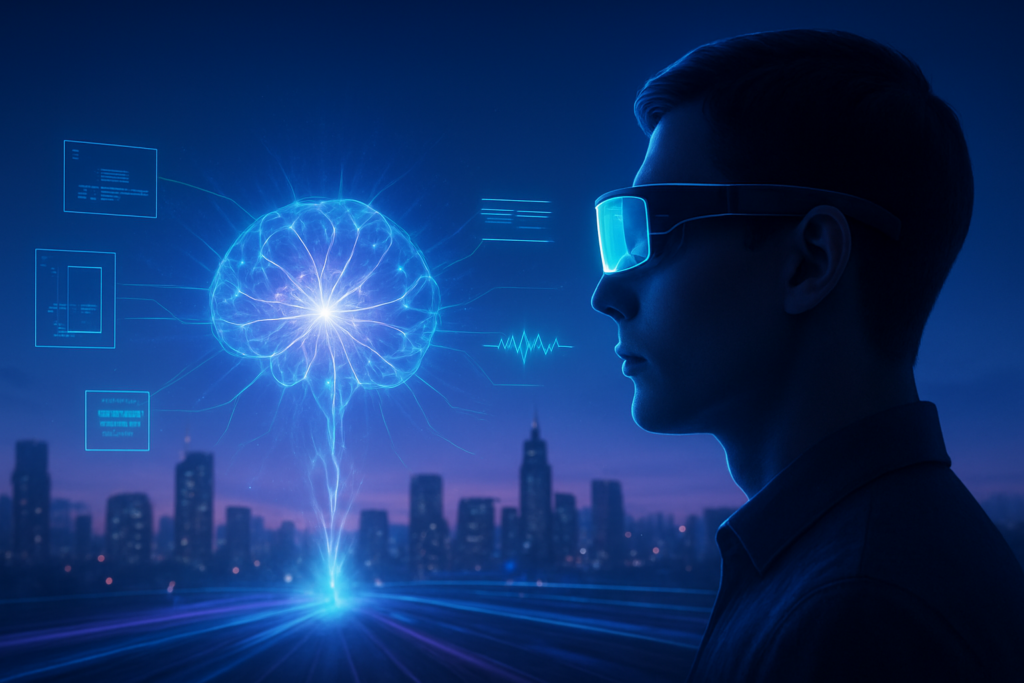
The era of "text-in, text-out" artificial intelligence has officially come to an end. As we enter 2026, the technological landscape has been fundamentally reshaped by the rise of "Omni" models—native multimodal systems that don't just process data, but perceive the world with human-like latency and emotional intelligence. This shift, catalyzed by the breakthrough releases of GPT-4o and Gemini 1.5 Pro, has moved AI from a productivity tool to a constant, sentient-feeling companion capable of seeing, hearing, and reacting to our physical reality in real-time.
The immediate significance of this development cannot be overstated. By collapsing the barriers between different modes of communication—text, audio, and vision—into a single neural architecture, AI labs have achieved the "holy grail" of human-computer interaction: full-duplex, low-latency conversation. For the first time, users are interacting with machines that can detect a sarcastic tone, offer a sympathetic whisper, or help solve a complex mechanical problem simply by "looking" through a smartphone or smart-glass camera.
The Architecture of Perception: Understanding the Native Multimodal Shift
The technical foundation of the Omni era lies in the transition from modular pipelines to native multimodality. In previous generations, AI assistants functioned like a "chain of command": one model transcribed speech to text, another reasoned over that text, and a third converted the response back into audio. This process was plagued by high latency and "data loss," where the nuance of a user's voice—such as excitement or frustration—was stripped away during transcription. Models like GPT-4o from OpenAI and Gemini 1.5 Pro from Alphabet Inc. (NASDAQ: GOOGL) solved this by training a single end-to-end neural network across all modalities simultaneously.
The result is a staggering reduction in latency. GPT-4o, for instance, achieved an average audio response time of 320 milliseconds—matching the 210ms to 320ms range of natural human conversation. This allows for "barge-ins," where a user can interrupt the AI mid-sentence, and the model adjusts its logic instantly. Meanwhile, Gemini 1.5 Pro introduced a massive 2-million-token context window, enabling it to "watch" hours of video or "read" thousands of pages of technical manuals to provide real-time visual reasoning. By treating pixels, audio waveforms, and text as a single vocabulary of tokens, these models can now perform "cross-modal synergy," such as noticing a user’s stressed facial expression via a camera and automatically softening their vocal tone in response.
Initial reactions from the AI research community have hailed this as the "end of the interface." Experts note that the inclusion of "prosody"—the patterns of stress and intonation in language—has bridged the "uncanny valley" of AI speech. With the addition of "thinking breaths" and micro-pauses in late 2025 updates, the distinction between a human caller and an AI agent has become nearly imperceptible in standard interactions.
The Multimodal Arms Race: Strategic Implications for Big Tech
The emergence of Omni models has sparked a fierce strategic realignment among tech giants. Microsoft (NASDAQ: MSFT), through its multi-billion dollar partnership with OpenAI, was the first to market with real-time voice capabilities, integrating GPT-4o’s "Advanced Voice Mode" across its Copilot ecosystem. This move forced a rapid response from Google, which leveraged its deep integration with the Android OS to launch "Gemini Live," a low-latency interaction layer that now serves as the primary interface for over a billion devices.
The competitive landscape has also seen a massive pivot from Meta Platforms, Inc. (NASDAQ: META) and Apple Inc. (NASDAQ: AAPL). Meta’s release of Llama 4 in early 2025 democratized native multimodality, providing open-weight models that match the performance of proprietary systems. This has allowed a surge of startups to build specialized hardware, such as AI pendants and smart rings, that bypass traditional app stores. Apple, meanwhile, has doubled down on privacy with "Apple Intelligence," utilizing on-device multimodal processing to ensure that the AI "sees" and "hears" only what the user permits, keeping the data off the cloud—a move that has become a key market differentiator as privacy concerns mount.
This shift is already disrupting established sectors. The traditional customer service industry is being replaced by "Emotion-Aware" agents that can diagnose a hardware failure via a customer’s camera and provide an AR-guided repair walkthrough. In education, the "Visual Socratic Method" has become the new standard, where AI tutors like Gemini 2.5 watch students solve problems on paper in real-time, providing hints exactly when the student pauses in confusion.
Beyond the Screen: Societal Impact and the Transparency Crisis
The wider significance of Omni models extends far beyond tech industry balance sheets. For the accessibility community, this era represents a revolution. Blind and low-vision users now utilize real-time descriptive narration via smart glasses, powered by models that can identify obstacles, read street signs, and even describe the facial expressions of people in a room. Similarly, real-time speech-to-sign language translation has broken down barriers for the deaf and hard-of-hearing, making every digital interaction inclusive by default.
However, the "always-on" nature of these models has triggered what many are calling the "Transparency Crisis" of 2025. As cameras and microphones become the primary input for AI, public anxiety regarding surveillance has reached a fever pitch. The European Union has responded with the full enforcement of the EU AI Act, which categorizes real-time multimodal surveillance as "High Risk," leading to a fragmented global market where some "Omni" features are restricted or disabled in certain jurisdictions.
Furthermore, the rise of emotional inflection in AI has sparked a debate about the "synthetic intimacy" of these systems. As models become more empathetic and human-like, psychologists are raising concerns about the potential for emotional manipulation and the impact of long-term social reliance on AI companions that are programmed to be perfectly agreeable.
The Proactive Future: From Reactive Tools to Digital Butlers
Looking toward the latter half of 2026 and beyond, the next frontier for Omni models is "proactivity." Current models are largely reactive—they wait for a prompt or a visual cue. The next generation, including the much-anticipated GPT-5 and Gemini 3.0, is expected to feature "Proactive Audio" and "Environment Monitoring." These models will act as digital butlers, noticing that you’ve left the stove on or that a child is playing too close to a pool, and interjecting with a warning without being asked.
We are also seeing the integration of these models into humanoid robotics. By providing a robot with a "native multimodal brain," companies like Tesla (NASDAQ: TSLA) and Figure are moving closer to machines that can understand natural language instructions in a cluttered, physical environment. Challenges remain, particularly in the realm of "Thinking Budgets"—the computational cost of allowing an AI to constantly process high-resolution video streams—but experts predict that 2026 will see the first widespread commercial deployment of "Omni-powered" service robots in hospitality and elder care.
A New Chapter in Human-AI Interaction
The transition to the Omni era marks a definitive milestone in the history of computing. We have moved past the era of "command-line" and "graphical" interfaces into the era of "natural" interfaces. The ability of models like GPT-4o and Gemini 1.5 Pro to engage with the world through vision and emotional speech has turned the AI from a distant oracle into an integrated participant in our daily lives.
As we move forward into 2026, the key takeaways are clear: latency is the new benchmark for intelligence, and multimodality is the new baseline for utility. The long-term impact will likely be a "post-smartphone" world where our primary connection to the digital realm is through the glasses we wear or the voices we talk to. In the coming months, watch for the rollout of more sophisticated "agentic" capabilities, where these Omni models don't just talk to us, but begin to use our computers and devices on our behalf, closing the loop between perception and action.
This content is intended for informational purposes only and represents analysis of current AI developments.
TokenRing AI delivers enterprise-grade solutions for multi-agent AI workflow orchestration, AI-powered development tools, and seamless remote collaboration platforms.
For more information, visit https://www.tokenring.ai/.