On January 16, 2026, the United States federal government officially entered the most aggressive phase of its domestic technology strategy with the implementation of the "Winning the Race: America’s AI Action Plan." This landmark initiative represents a fundamental pivot in national policy, shifting from the safety-centric regulatory frameworks of the previous several years toward a doctrine of "Sovereign AI Infrastructure." By prioritizing domestic supply chain security and massive capital mobilization, the plan aims to ensure that the U.S. remains the undisputed epicenter of artificial intelligence development for the next century.
The announcement marks the culmination of a flurry of executive actions and trade agreements finalized in the first weeks of 2026. Central to this strategy is the belief that AI compute is no longer just a commercial commodity but a critical national resource. To secure this resource, the government has launched a multi-front campaign involving 25% tariffs on imported high-end silicon, a historic $250 billion semiconductor trade deal with Taiwan, and the federal designation of "Winning Sites" for massive AI data centers. This "America First" approach signals a new era of industrial policy, where the federal government and tech giants are deeply intertwined in the pursuit of computational dominance.
Securing the Stack: Tariffs, Trade, and the New American Foundry
The technical core of the 2026 US AI Action Plan focuses on "resharing" the entire AI stack, from raw silicon to frontier models. On January 14, a landmark proclamation under Section 232 of the Trade Expansion Act imposed a 25% tariff on high-end AI chips produced abroad, specifically targeting the H200 and newer architectures from NVIDIA Corporation (NASDAQ: NVDA) and the MI325X from Advanced Micro Devices, Inc. (NASDAQ: AMD). To mitigate the immediate cost to domestic AI scaling, the plan includes a strategic exemption: these tariffs do not apply to chips imported specifically for use in U.S.-based data centers, effectively forcing manufacturers to choose between higher costs or building on American soil.
Complementing the tariffs is the historic US-Taiwan Semiconductor Trade Deal signed on January 15. This agreement facilitates a staggering $250 billion in direct investment from Taiwanese firms, led by Taiwan Semiconductor Manufacturing Company (NYSE: TSM), to build advanced AI and energy production capacity within the United States. To support this massive reshoring effort, the U.S. government has pledged $250 billion in federal credit guarantees, significantly lowering the financial risk for domestic chip manufacturing and advanced packaging facilities.
Technically, this differs from the 2023 National AI Initiative by moving beyond research grants and into large-scale infrastructure deployment. A prime example is "Lux," the first dedicated "AI Factory for Science" deployed by the Department of Energy at Oak Ridge National Laboratory. This $1 billion supercomputer, a public-private partnership involving AMD, Oracle Corporation (NYSE: ORCL), and Hewlett Packard Enterprise (NYSE: HPE), utilizes the latest AMD Instinct MI355X GPUs. Unlike previous supercomputers designed for general scientific simulation, Lux is architected specifically for training and running large-scale foundation models, marking a shift toward sovereign AI capabilities.
The Rise of Project Stargate and the Industry Reshuffle
The industry implications of the 2026 Action Plan are profound, favoring companies that align with the "Sovereign AI" vision. The most ambitious project under this new framework is "Project Stargate," a $500 billion joint venture between OpenAI, SoftBank Group Corp. (TYO:9984), Oracle, and the UAE-based MGX. This initiative aims to build a nationwide network of advanced AI data centers. The first flagship facility is set to break ground in Abilene, Texas, benefiting from streamlined federal permitting and land leasing policies established in the July 2025 Executive Order on Accelerating Federal Permitting of Data Center Infrastructure.
For tech giants like Microsoft Corporation (NASDAQ: MSFT) and Oracle, the plan provides a significant competitive advantage. By partnering with the federal government on "Winning Sites"—such as the newly designated federal land in Paducah, Kentucky—these companies gain access to expedited energy connections and tax incentives that are unavailable to foreign competitors. The Department of Energy’s Request for Offer (RFO), due January 30, 2026, has sparked a bidding war among cloud providers eager to operate on federal land where nuclear and natural gas energy sources are being fast-tracked to meet the immense power demands of AI.
However, the plan also introduces strategic challenges. The new Department of Commerce regulations published on January 13 allow the export of advanced chips like the Nvidia H200 to international markets, but only after exporters certify that domestic supply orders are prioritized first. This "America First" supply chain mandate ensures that U.S. labs always have first access to the fastest silicon, potentially creating a "compute gap" between domestic firms and their global rivals.
A Geopolitical Pivot: From Safety to Dominance
The 2026 US AI Action Plan represents a stark departure from the 2023 Executive Order (EO 14110), which focused heavily on AI safety, ethics, and mandatory reporting of red-teaming results. The new plan effectively rescinds many of these requirements, arguing that "regulatory unburdening" is essential to win the global AI race. The focus has shifted from "Safe and Trustworthy AI" to "American AI Dominance." This has sparked debate within the AI research community, as safety advocates worry that the removal of oversight could lead to the deployment of unpredictable frontier models.
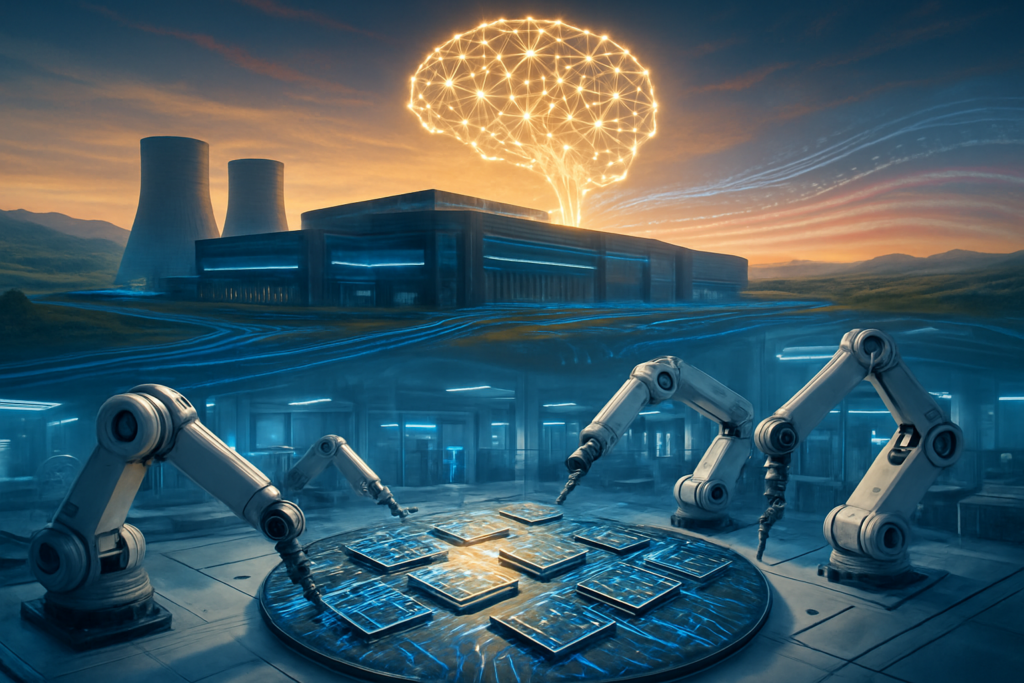
Geopolitically, the plan treats AI compute as a national security asset on par with nuclear energy or oil reserves. By leveraging federal land and promoting "Energy Dominance"—including the integration of small modular nuclear reactors (SMRs) and expanded gas production for data centers—the U.S. is positioning itself as the only nation capable of supporting the multi-gigawatt power requirements of future AGI systems. This "Sovereign AI" trend is a direct response to similar moves by China and the EU, but the scale of the U.S. investment—measured in the hundreds of billions—dwarfs previous milestones.
Comparisons are already being drawn to the Manhattan Project and the Space Race. Unlike those state-run initiatives, however, the 2026 plan relies on a unique hybrid model where the government provides the land, the permits, and the trade protections, while the private sector provides the capital and the technical expertise. This public-private synergy is designed to outpace state-directed economies by harnessing the market incentives of Silicon Valley.
The Road to 2030: Future Developments and Challenges
In the near term, the industry will be watching the rollout of the four federal "Winning Sites" for data center infrastructure. The January 30 deadline for the Paducah, KY site will serve as a bellwether for the level of private sector interest in the government’s land-leasing model. If successful, experts predict similar initiatives for federal lands in the Southwest, where solar and geothermal energy could be paired with AI infrastructure.
Long-term, the challenge remains the massive energy demand. While the plan fast-tracks nuclear and gas, the environmental impact and the timeline for building new power plants could become a bottleneck by 2028. Furthermore, while the tariffs are designed to force reshoring, the complexity of the semiconductor supply chain means that "total independence" is likely years away. The success of the US-Taiwan deal will depend on whether TSM can successfully transfer its most advanced manufacturing processes to U.S. soil without significant delays.
Experts predict that if the 2026 Action Plan holds, the U.S. will possess over 60% of the world’s Tier-1 AI compute capacity by 2030. This would create a "gravitational pull" for global talent, as the best researchers and engineers flock to the locations where the most powerful models are being trained.
Conclusion: A New Chapter in the History of AI
The launch of the 2026 US AI Action Plan is a defining moment in the history of technology. It marks the point where AI policy moved beyond the realm of digital regulation and into the world of hard infrastructure, global trade, and national sovereignty. By securing the domestic supply chain and building out massive sovereign compute capacity, the United States is betting its future on the idea that computational power is the ultimate currency of the 21st century.
Key takeaways from this month's announcements include the aggressive use of tariffs to force domestic manufacturing, the shift toward a "deregulated evaluation" framework to speed up innovation, and the birth of "Project Stargate" as a symbol of the immense capital required for the next generation of AI. In the coming weeks, all eyes will be on the Department of Energy as it selects the first private partners for its federally-backed AI factories. The race for AI dominance has entered a new, high-stakes phase, and the 2026 Action Plan has set the rules of the game.
This content is intended for informational purposes only and represents analysis of current AI developments.
TokenRing AI delivers enterprise-grade solutions for multi-agent AI workflow orchestration, AI-powered development tools, and seamless remote collaboration platforms.
For more information, visit https://www.tokenring.ai/.