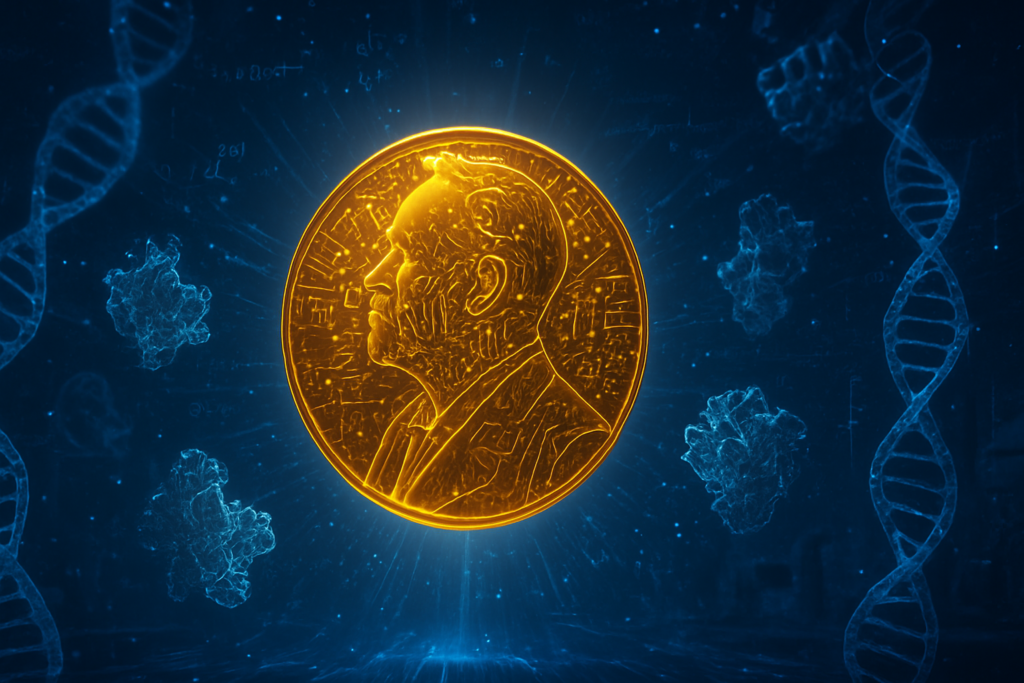
The history of science is often measured in centuries, yet in October 2024, the timeline of human achievement underwent a tectonic shift that is only now being fully understood in early 2026. By awarding the Nobel Prizes in both Physics and Chemistry to pioneers of artificial intelligence, the Royal Swedish Academy of Sciences did more than honor five individuals; it formally integrated AI into the bedrock of the natural sciences. The dual recognition of John Hopfield and Geoffrey Hinton in Physics, followed immediately by Demis Hassabis, John Jumper, and David Baker in Chemistry, signaled the end of the "human-alone" era of discovery and the birth of a new, hybrid scientific paradigm.
This "Nobel Prize Moment" served as the ultimate validation for a field that, only a decade ago, was often dismissed as mere "pattern matching." Today, as we look back from the vantage point of January 2026, those awards are viewed as the starting gun for an industrial revolution in the laboratory. The immediate significance was profound: it legitimized deep learning as a rigorous scientific instrument, comparable in impact to the invention of the microscope or the telescope, but with the added capability of not just seeing the world, but predicting its fundamental behaviors.
From Neural Nets to Protein Folds: The Technical Foundations
The 2024 Nobel Prize in Physics recognized the foundational work of John Hopfield and Geoffrey Hinton, who bridged the gap between statistical physics and computational learning. Hopfield’s 1982 development of the "Hopfield network" utilized the physics of magnetic spin systems to create associative memory—allowing machines to recover distorted patterns. Geoffrey Hinton expanded this using statistical physics to create the Boltzmann machine, a stochastic model that could learn the underlying probability distribution of data. This transition from deterministic systems to probabilistic learning was the spark that eventually ignited the modern generative AI boom.
In the realm of Chemistry, the prize awarded to Demis Hassabis and John Jumper of Google DeepMind, alongside David Baker, focused on the "protein folding problem"—a grand challenge that had stumped biologists for 50 years. AlphaFold, the AI system developed by Hassabis and Jumper, uses deep learning to predict a protein’s 3D structure from its linear amino acid sequence with near-perfect accuracy. While traditional methods like X-ray crystallography or cryo-electron microscopy could take months or years and cost hundreds of thousands of dollars to solve a single structure, AlphaFold can do so in minutes. To date, it has predicted nearly all 200 million known proteins, a feat that would have taken centuries using traditional experimental methods.
The technical brilliance of these achievements lies in their shift from "direct observation" to "predictive modeling." David Baker’s work with the Rosetta software furthered this by enabling "de novo" protein design—the creation of entirely new proteins that do not exist in nature. This allowed scientists to move from studying the biological world as it is, to designing biological tools as they should be to solve specific problems, such as neutralizing new viral strains or breaking down environmental plastics. Initial reactions from the research community were a mix of awe and debate, as traditionalists grappled with the reality that computer science had effectively "colonized" the Nobel categories of Physics and Chemistry.
The TechBio Gold Rush: Industry and Market Implications
The Nobel validation triggered a massive strategic pivot among tech giants and specialized AI laboratories. Alphabet Inc. (NASDAQ: GOOGL) leveraged the win to transform its research-heavy DeepMind unit into a commercial powerhouse. By early 2025, its subsidiary Isomorphic Labs had secured over $2.9 billion in milestone-based deals with pharmaceutical titans like Eli Lilly (NYSE: LLY) and Novartis (NYSE: NVS). The "Nobel Halo" allowed Alphabet to position itself not just as a search company, but as the world's premier "TechBio" platform, drastically reducing the time and capital required for drug discovery.
Meanwhile, NVIDIA (NASDAQ: NVDA) cemented its status as the indispensable infrastructure of this new era. Following the 2024 awards, NVIDIA’s market valuation soared past $5 trillion by late 2025, driven by the explosive demand for its Blackwell and Rubin GPU architectures. These chips are no longer seen merely as AI trainers, but as "digital laboratories" capable of running exascale molecular simulations. NVIDIA’s launch of specialized microservices like BioNeMo and its Earth-2 climate modeling initiative created a "software moat" that has made it nearly impossible for biotech startups to operate without being locked into the NVIDIA ecosystem.
The competitive landscape saw a fierce "generative science" counter-offensive from Microsoft (NASDAQ: MSFT) and OpenAI. In early 2025, Microsoft Research unveiled MatterGen, a model that generates new inorganic materials with specific desired properties—such as heat resistance or electrical conductivity—rather than merely screening existing ones. This has directly disrupted traditional materials science sectors, with companies like BASF and Johnson Matthey now using Azure Quantum Elements to design proprietary battery chemistries in a fraction of the historical time. The arrival of these "generative discovery" tools has created a clear divide: companies with an "AI-first" R&D strategy are currently seeing up to 3.5 times higher ROI than their traditional competitors.
The Broader Significance: A New Scientific Philosophy
Beyond the stock tickers and laboratory benchmarks, the Nobel Prize Moment of 2024 represented a philosophical shift in how humanity understands the universe. It confirmed that the complexities of biology and materials science are, at their core, information problems. This has led to the rise of "AI4Science" (AI for Science) as the dominant trend of the mid-2020s. We have moved from an era of "serendipitous discovery"—where researchers might stumble upon a new drug or material—to an era of "engineered discovery," where AI models map the entire "possibility space" of a problem before a single test tube is even touched.
However, this transition has not been without its concerns. Geoffrey Hinton, often called the "Godfather of AI," used his Nobel platform to sound an urgent alarm regarding the existential risks of the very technology he helped create. His warnings about machines outsmarting humans and the potential for "uncontrolled" autonomous agents have sparked intense regulatory debates throughout 2025. Furthermore, the "black box" nature of some AI discoveries—where a model provides a correct answer but cannot explain its reasoning—has forced a reckoning within the scientific method, which has historically prioritized "why" just as much as "what."
Comparatively, the 2024 Nobels are being viewed in the same light as the 1903 and 1911 prizes awarded to Marie Curie. Just as those awards marked the transition into the atomic age, the 2024 prizes marked the transition into the "Information Age of Matter." The boundaries between disciplines are now permanently blurred; a chemist in 2026 is as likely to be an expert in equivariant neural networks as they are in organic synthesis.
Future Horizons: From Digital Models to Physical Realities
Looking ahead through the remainder of 2026 and beyond, the next frontier is the full integration of AI with physical laboratory automation. We are seeing the rise of "Self-Driving Labs" (SDLs), where AI models not only design experiments but also direct robotic systems to execute them and analyze the results in a continuous, closed-loop cycle. Experts predict that by 2027, the first fully AI-designed drug will enter Phase 3 clinical trials, potentially reaching the market in record-breaking time.
In the near term, the impact on materials science will likely be the most visible to consumers. The discovery of new solid-state electrolytes using models like MatterGen has put the industry on a path toward electric vehicle batteries that are twice as energy-dense as current lithium-ion standards. Pilot production for these "AI-designed" batteries is slated for late 2026. Additionally, the "NeuralGCM" hybrid climate models are now providing hyper-local weather and disaster predictions with a level of accuracy that was computationally impossible just 24 months ago.
The primary challenge remaining is the "governance of discovery." As AI allows for the rapid design of new proteins and chemicals, the risk of dual-use—where discovery is used for harm rather than healing—has become a top priority for global regulators. The "Geneva Protocol for AI Discovery," currently under debate in early 2026, aims to create a framework for tracking the synthesis of AI-generated biological designs.
Conclusion: The Silicon Legacy
The 2024 Nobel Prizes were the moment AI officially grew up. By honoring the pioneers of neural networks and protein folding, the scientific establishment admitted that the future of human knowledge is inextricably linked to the machines we have built. This was not just a recognition of past work; it was a mandate for the future. AI is no longer a "supporting tool" like a calculator; it has become the primary driver of the scientific engine.
As we navigate the opening months of 2026, the key takeaway is that the "Nobel Prize Moment" has successfully moved AI from the realm of "tech hype" into the realm of "fundamental infrastructure." The most significant impact of this development is not just the speed of discovery, but the democratization of it—allowing smaller labs with high-end GPUs to compete with the massive R&D budgets of the past. In the coming months, keep a close watch on the first clinical data from Isomorphic Labs and the emerging "AI Treaty" discussions in the UN; these will be the next markers in a journey that began when the Nobel Committee looked at a line of code and saw the future of physics and chemistry.
This content is intended for informational purposes only and represents analysis of current AI developments.
TokenRing AI delivers enterprise-grade solutions for multi-agent AI workflow orchestration, AI-powered development tools, and seamless remote collaboration platforms.
For more information, visit https://www.tokenring.ai/.