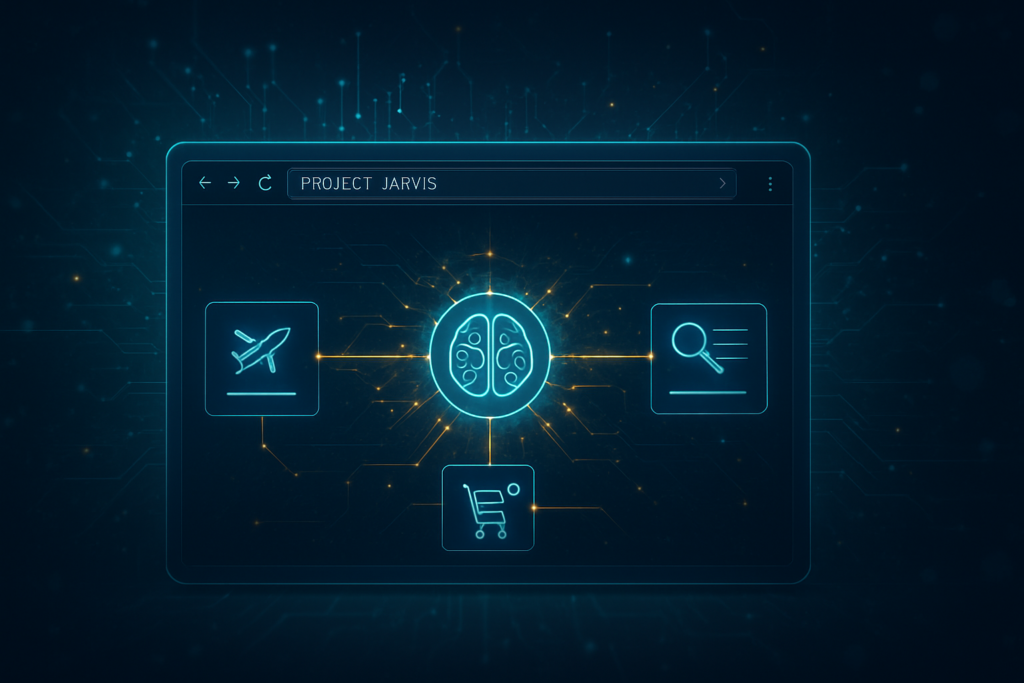
In late 2024, a brief technical slip-up on the Chrome Web Store offered the world its first glimpse into the future of the internet. A prototype extension titled "Project Jarvis" was accidentally published by Google, describing itself as a "helpful companion that surfs the web with you." While the extension was quickly pulled, the leak confirmed what many had suspected: Alphabet Inc. (NASDAQ: GOOGL) was moving beyond simple chatbots and into the realm of "Computer-Using Agents" (CUAs) capable of taking over the browser to perform complex, multi-step tasks on behalf of the user.
Fast forward to today, January 1, 2026, and that accidental leak is now recognized as the opening salvo in a war for the "AI-first" browser. What began as a experimental extension has evolved into a foundational layer of the Chrome ecosystem, fundamentally altering how billions of people interact with the web. By moving from a model of "Search and Click" to "Command and Complete," Google has effectively turned the world's most popular browser into an autonomous agent that handles everything from grocery shopping to deep-dive academic research without the user ever needing to touch a scroll bar.
The Vision-Action Loop: Inside the Jarvis Architecture
Technically, Project Jarvis represented a departure from the "API-first" approach of early AI integrations. Instead of relying on specific back-end connections to websites, Jarvis was built on a "vision-action loop" powered by the Gemini 2.0 and later Gemini 3.0 multimodal models. This allowed the AI to "see" the browser window exactly as a human does. By taking frequent screenshots and processing them through Gemini’s vision capabilities, the agent could identify buttons, interpret text fields, and navigate complex UI elements like drop-down menus and calendars. This approach allowed Jarvis to work on virtually any website, regardless of whether that site had built-in AI support.
The capability of Jarvis—now largely integrated into the "Gemini in Chrome" suite—is defined by its massive context window, which by mid-2025 reached upwards of 2 million tokens. This enables the agent to maintain "persistent intent" across dozens of tabs. For example, a user can command the agent to "Find a flight to Tokyo under $900 in March, cross-reference it with my Google Calendar for conflicts, and find a hotel near Shibuya with a gym." The agent then navigates Expedia, Google Calendar, and TripAdvisor simultaneously, synthesizing the data and presenting a final recommendation or even completing the booking after a single biometric confirmation from the user.
Initial reactions from the AI research community in early 2025 were a mix of awe and apprehension. Experts noted that while the vision-based approach bypassed the need for fragile web scrapers, it introduced significant latency and compute costs. However, Google’s optimization of "distilled" Gemini models specifically for browser tasks significantly reduced these hurdles by the end of 2025. The introduction of "Project Mariner"—the high-performance evolution of Jarvis—saw success rates on the WebVoyager benchmark jump to over 83%, a milestone that signaled the end of the "experimental" phase for agentic AI.
The Agentic Arms Race: Market Positioning and Disruption
The emergence of Project Jarvis forced a rapid realignment among tech giants. Alphabet Inc. (NASDAQ: GOOGL) found itself in a direct "Computer-Using Agent" (CUA) battle with Anthropic and Microsoft (NASDAQ: MSFT)-backed OpenAI. While Anthropic’s "Computer Use" feature for Claude 3.5 Sonnet focused on a platform-agnostic approach—allowing the AI to control the entire operating system—Google doubled down on the browser. This strategic focus leveraged Chrome's 65% market share, turning the browser into a defensive moat against the rise of "Answer Engines" like Perplexity.
This shift has significantly disrupted the traditional search-ad model. As agents began to "consume" the web on behalf of users, the traditional "blue link" economy faced an existential crisis. In response, Google pivoted toward "Agentic Commerce." By late 2025, Google began monetizing the actions performed by Jarvis, taking small commissions on transactions completed through the agent, such as flight bookings or retail purchases. This move allowed Google to maintain its revenue streams even as traditional search volume began to fluctuate in the face of AI-driven automation.
Furthermore, the integration of Jarvis into the Chrome architecture served as a regulatory defense. Following various antitrust rulings regarding search defaults, Google’s transition to an "AI-first browser" allowed it to offer a vertically integrated experience that competitors could not easily replicate. By embedding the agent directly into the browser's "Omnibox" (the address bar), Google ensured that Gemini remained the primary interface for the "Action Web," making the choice of a default search engine increasingly irrelevant to the end-user experience.
The Death of the Blue Link: Ethical and Societal Implications
The wider significance of Project Jarvis lies in the transition from the "Information Age" to the "Action Age." For decades, the internet was a library where users had to find and synthesize information themselves. With the mainstreaming of agentic AI throughout 2025, the internet has become a service economy where the browser acts as a digital concierge. This fits into a broader trend of "Invisible Computing," where the UI begins to disappear, replaced by natural language intent.
However, this shift has not been without controversy. Privacy advocates have raised significant concerns regarding the "vision-based" nature of Jarvis. For the agent to function, it must effectively "watch" everything the user does within the browser, leading to fears of unprecedented data harvesting. Google addressed this in late 2025 by introducing "On-Device Agentic Processing," which keeps the visual screenshots of a user's session within the local hardware's secure enclave, only sending anonymized metadata to the cloud for complex reasoning.
Comparatively, the launch of Jarvis is being viewed by historians as a milestone on par with the release of the first graphical web browser, Mosaic. While Mosaic allowed us to see the web, Jarvis allowed us to put the web to work. The "Agentic Web" also poses challenges for web developers and small businesses; if an AI agent is the one visiting a site, traditional metrics like "time on page" or "ad impressions" become obsolete, forcing a total rethink of how digital value is measured and captured.
Beyond the Browser: The Future of Autonomous Workflows
Looking ahead, the evolution of Project Jarvis is expected to move toward "Multi-Agent Swarms." In these scenarios, a Jarvis-style browser agent will not work in isolation but will coordinate with other specialized agents. For instance, a "Research Agent" might gather data in Chrome, while a "Creative Agent" drafts a report in Google Docs, and a "Communication Agent" schedules a meeting to discuss the findings—all orchestrated through a single user prompt.
In late 2025, Google teased "Antigravity," an agent-first development environment that uses the Jarvis backbone to allow AI to autonomously plan, code, and test software directly within a browser window. This suggests that the next frontier for Jarvis is not just consumer shopping, but professional-grade software engineering and data science. Experts predict that by 2027, the distinction between "using a computer" and "directing an AI" will have effectively vanished for most office tasks.
The primary challenge remaining is "hallucination in action." While a chatbot hallucinating a fact is a minor nuisance, an agent hallucinating a purchase or a flight booking can have real-world financial consequences. Google is currently working on "Verification Loops," where the agent must provide visual proof of its intended action before the final execution, a feature expected to become standard across all CUA platforms by the end of 2026.
A New Chapter in Computing History
Project Jarvis began as a leaked extension, but it has ended up as the blueprint for the next decade of human-computer interaction. By successfully integrating Gemini into the very fabric of the Chrome browser, Alphabet Inc. has successfully navigated the transition from a search company to an agent company. The significance of this development cannot be overstated; it represents the first time that AI has moved from being a "consultant" we talk to, to a "worker" that acts on our behalf.
As we enter 2026, the key takeaways are clear: the browser is no longer a passive window, but an active participant in our digital lives. The "AI-first" strategy has redefined the competitive landscape, placing a premium on "action" over "information." For users, this means a future with less friction and more productivity, though it comes at the cost of increased reliance on a few dominant AI ecosystems.
In the coming months, watch for the expansion of Jarvis-style agents into mobile operating systems and the potential for "Cross-Platform Agents" that can jump between your phone, your laptop, and your smart home. The era of the autonomous agent is no longer a leak or a rumor—it is the new reality of the internet.
This content is intended for informational purposes only and represents analysis of current AI developments.
TokenRing AI delivers enterprise-grade solutions for multi-agent AI workflow orchestration, AI-powered development tools, and seamless remote collaboration platforms. For more information, visit https://www.tokenring.ai/.