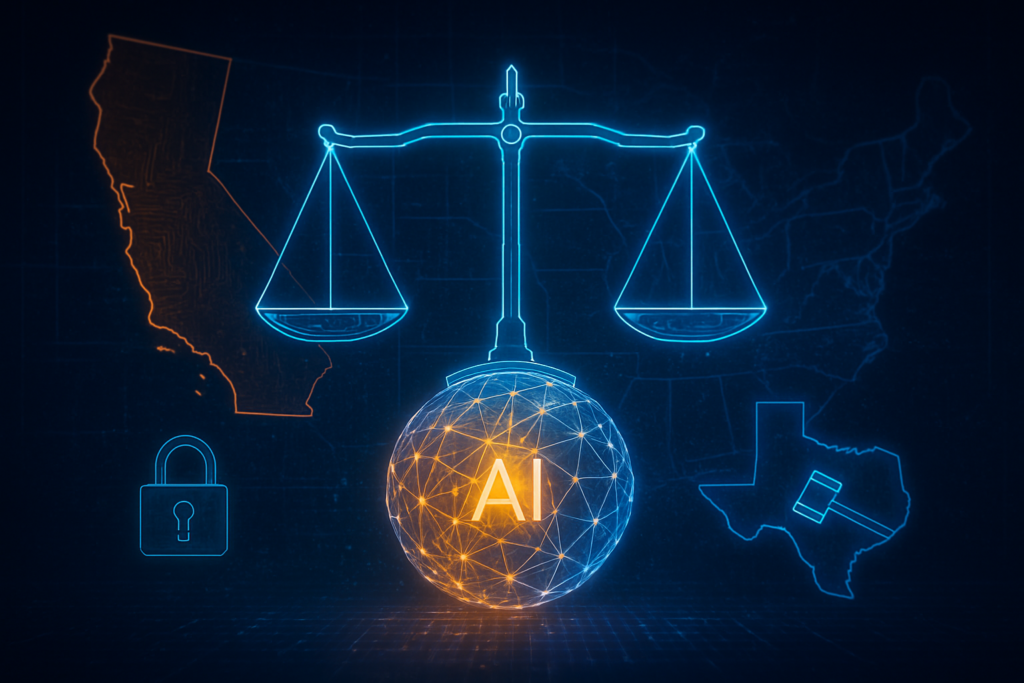
SAN FRANCISCO & AUSTIN – January 1, 2026, marks a historic shift in the American technological landscape as two of the nation’s most influential states officially implement landmark artificial intelligence regulations. California’s Transparency in Frontier Artificial Intelligence Act (TFAIA) and Texas’s Responsible Artificial Intelligence Governance Act (RAIGA) both went into effect at midnight, creating a dual-pillar regulatory environment that forces the world’s leading AI labs to navigate a complex web of safety, transparency, and consumer protection mandates.
The simultaneous activation of these laws represents the first major attempt by states to rein in "frontier" AI models—systems with unprecedented computing power and capabilities. While California focuses on preventing "catastrophic risks" like cyberattacks and biological weaponization, Texas has taken an intent-based approach, targeting AI-driven discrimination and ensuring human oversight in critical sectors like healthcare. However, the immediate significance of these laws is shadowed by a looming constitutional crisis, as the federal government prepares to challenge state authority in what is becoming the most significant legal battle over technology since the dawn of the internet.
Technical Mandates and the "Frontier" Threshold
California’s TFAIA, codified as SB 53, introduces the most rigorous technical requirements ever imposed on AI developers. The law specifically targets "frontier models," defined as those trained using more than 10^26 floating-point operations (FLOPs)—a threshold that encompasses the latest iterations of models from Alphabet Inc. (NASDAQ: GOOGL), Microsoft Corp. (NASDAQ: MSFT), and OpenAI. Under this act, developers with annual revenues exceeding $500 million must now publish a "Frontier AI Framework." This document is not merely a summary but a detailed technical blueprint outlining how the company identifies and mitigates risks such as model "escape" or the autonomous execution of high-level cyberwarfare.
In addition to the framework, California now requires a "kill switch" capability for these massive models and mandates that "critical safety incidents" be reported to the California Office of Emergency Services (OES) within 15 days of discovery. This differs from previous voluntary commitments by introducing civil penalties of up to $1 million per violation. Meanwhile, a companion law (AB 2013) requires developers to post high-level summaries of the data used to train these models, a move aimed at addressing long-standing concerns regarding copyright and data provenance in generative AI.
Texas’s RAIGA (HB 149) takes a different technical path, prioritizing "interaction transparency" over compute thresholds. The Texas law mandates that any AI system used in a governmental or healthcare capacity must provide a "clear and conspicuous" notice to users that they are interacting with an automated system. Technically, this requires developers to implement metadata tagging and user-interface modifications that were previously optional. Furthermore, Texas has established a 36-month "Regulatory Sandbox," allowing companies to test innovative systems with limited liability, provided they adhere to the NIST AI Risk Management Framework, effectively making the federal voluntary standard a "Safe Harbor" requirement within state lines.
Big Tech and the Cost of Compliance
The implementation of these laws has sent ripples through Silicon Valley and the burgeoning AI hubs of Austin. For Meta Platforms Inc. (NASDAQ: META), which has championed an open-source approach to AI, California’s safety mandates pose a unique challenge. The requirement to ensure that a model cannot be used for catastrophic harm is difficult to guarantee once a model’s weights are released publicly. Meta has been among the most vocal critics, arguing that state-level mandates stifle the very transparency they claim to promote by discouraging open-source distribution.
Amazon.com Inc. (NASDAQ: AMZN) and Nvidia Corp. (NASDAQ: NVDA) are also feeling the pressure, albeit in different ways. Amazon’s AWS division must now ensure that its cloud infrastructure provides the necessary telemetry for its clients to comply with California’s incident reporting rules. Nvidia, the primary provider of the H100 and B200 chips used to cross the 10^26 FLOP threshold, faces a shifting market where developers may begin optimizing for "sub-frontier" models to avoid the heaviest regulatory burdens.
The competitive landscape is also shifting toward specialized compliance. Startups that can offer "Compliance-as-a-Service"—tools that automate the generation of California’s transparency reports or Texas’s healthcare reviews—are seeing a surge in venture interest. Conversely, established AI labs are finding their strategic advantages under fire; the "move fast and break things" era has been replaced by a "verify then deploy" mandate that could slow the release of new features in the U.S. market compared to less-regulated regions.
A Patchwork of Laws and the Federal Counter-Strike
The broader significance of January 1, 2026, lies in the "patchwork" problem. With California and Texas setting vastly different priorities, AI developers are forced into a "dual-compliance" mode that critics argue creates an interstate commerce nightmare. This fragmentation was the primary catalyst for the "Ensuring a National Policy Framework for Artificial Intelligence" Executive Order signed by the Trump administration in late 2025. The federal government argues that AI is a matter of national security and international competitiveness, asserting that state laws like TFAIA are an unconstitutional overreach.
Legal experts point to two primary battlegrounds: the First Amendment and the Commerce Clause. The Department of Justice (DOJ) AI Litigation Task Force has already signaled its intent to sue California, arguing that the state's transparency reports constitute "compelled speech." In Texas, the conflict is more nuanced; while the federal government generally supports the "Regulatory Sandbox" concept, it opposes Texas’s ability to regulate out-of-state developers whose models merely "conduct business" within the state. This tension echoes the historic battles over California’s vehicle emission standards, but with the added complexity of a technology that moves at the speed of light.
Compared to previous AI milestones, such as the release of GPT-4 or the first AI Act in Europe, the events of today represent a shift from what AI can do to how it is allowed to exist within a democratic society. The clash between state-led safety mandates and federal deregulatory goals suggests that the future of AI in America will be decided in the courts as much as in the laboratories.
The Road Ahead: 2026 and Beyond
Looking forward, the next six months will be a period of "regulatory discovery." The first "Frontier AI Frameworks" are expected to be filed in California by March, providing the public with its first deep look into the safety protocols of companies like OpenAI. Experts predict that these filings will be heavily redacted, leading to a second wave of litigation over what constitutes a "trade secret" versus a "public safety disclosure."
In the near term, we may see a "geographic bifurcation" of AI services. Some companies have already hinted at "geofencing" certain high-power features, making them unavailable to users in California or Texas to avoid the associated liability. However, given the economic weight of these two states—representing the 1st and 2nd largest state economies in the U.S.—most major players will likely choose to comply while they fight the laws in court. The long-term challenge remains the creation of a unified federal law that can satisfy both the safety concerns of California and the pro-innovation stance of the federal government.
Conclusion: A New Era of Accountability
The activation of TFAIA and RAIGA on this first day of 2026 marks the end of the "Wild West" era for artificial intelligence in the United States. Whether these laws survive the inevitable federal challenges or are eventually preempted by a national standard, they have already succeeded in forcing a level of transparency and safety-first thinking that was previously absent from the industry.
The key takeaway for the coming months is the "dual-track" reality: developers will be filing safety reports with state regulators in Sacramento and Austin while their legal teams are in Washington D.C. arguing for those same regulations to be struck down. As the first "critical safety incidents" are reported and the first "Regulatory Sandboxes" are populated, the world will be watching to see if this state-led experiment leads to a safer AI future or a stifled technological landscape.
This content is intended for informational purposes only and represents analysis of current AI developments.
TokenRing AI delivers enterprise-grade solutions for multi-agent AI workflow orchestration, AI-powered development tools, and seamless remote collaboration platforms.
For more information, visit https://www.tokenring.ai/.