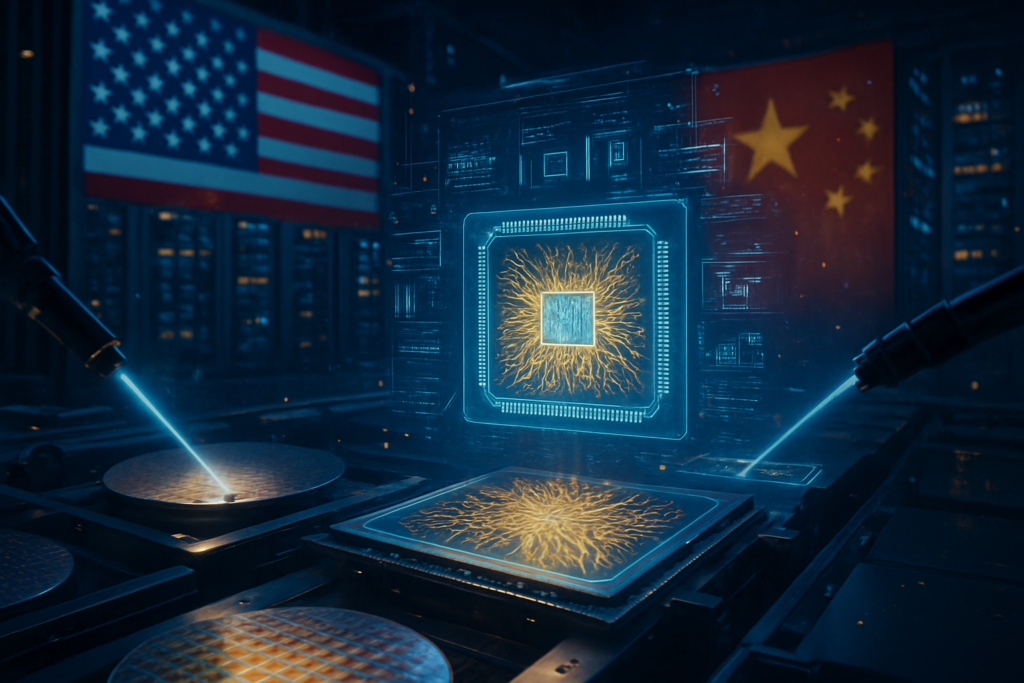
In a landmark decision that reshapes the global technology landscape, the Office of the United States Trade Representative (USTR) officially concluded its Section 301 investigation into China’s semiconductor industry today, December 23, 2025. The investigation, which has been the subject of intense geopolitical speculation for over a year, formally branded Beijing’s state-backed semiconductor expansion as "unreasonable" and "actionable." While the findings justify immediate and severe trade penalties, the U.S. government has opted for a strategic "trade truce," scheduling a new wave of aggressive tariffs to take effect on June 23, 2027.
This 18-month "reprieve" period serves as a high-stakes cooling-off window, intended to allow American companies to further decouple their supply chains from Chinese foundries while providing the U.S. with significant diplomatic leverage. The announcement marks a pivotal escalation in the ongoing "Chip War," signaling that the battle for technological supremacy has moved beyond high-end AI processors into the "legacy" chips that power everything from electric vehicles to medical devices.
The Section 301 Verdict: Legacy Dominance as a National Threat
The USTR’s final report details a systematic effort by the Chinese government to achieve global dominance in the semiconductor sector through non-market policies. The investigation highlighted massive state subsidies, forced technology transfers, and intellectual property infringement as the primary drivers behind the rapid growth of companies like SMIC (HKG: 0981). Unlike previous trade actions that focused almost exclusively on cutting-edge 3nm or 5nm processes used in high-end AI, this new investigation focuses heavily on "foundational" or "legacy" chips—typically 28nm and above—which are increasingly produced in China.
Technically, the U.S. is concerned about the "overconcentration" of these foundational chips in a single geography. While these chips are not as sophisticated as the latest AI silicon, they are the "workhorses" of the modern economy. The USTR findings suggest that China’s ability to flood the market with low-cost, state-subsidized legacy chips poses a structural threat to the viability of Western chipmakers who cannot compete on price alone. To counter this, the U.S. has set the current additional duty rate for these chips at 0% for the reprieve period, with a final, likely substantial, rate to be announced 30 days before the June 2027 implementation. This comes on top of the 50% tariffs that were already enacted on January 1, 2025.
Industry Impact: NVIDIA’s Waiver and the TSMC Safe Haven
The immediate reaction from the tech sector has been one of cautious relief mixed with long-term anxiety. NVIDIA (NASDAQ: NVDA), the current titan of the AI era, received a surprising one-year waiver as part of this announcement. In a strategic pivot, the administration will allow NVIDIA to continue shipping its H200 AI chips to the Chinese market, provided the company pays a 25% "national security fee" on each unit. This move is seen as a pragmatic attempt to maintain American dominance in the AI software layer while still collecting revenue from Chinese demand.
Meanwhile, TSMC (NYSE: TSM) appears to have successfully insulated itself from the worst of the fallout. Through its massive $100 billion to $200 billion investment in Arizona-based fabrication plants, the Taiwanese giant has secured a likely exemption from the "universal" tariffs being considered under the parallel Section 232 national security investigation. Rumors circulating in Washington suggest that the U.S. may even facilitate a deal for TSMC to take a significant minority stake in Intel (NASDAQ: INTC), further anchoring the world’s most advanced manufacturing capabilities on American soil. Intel, for its part, continues to benefit from CHIPS Act subsidies but faces the daunting task of diversifying its revenue away from China, which still accounts for nearly 30% of its business.
The Broader AI Landscape: Security vs. Inflation
The 2027 tariff deadline is not just a trade policy; it is a fundamental reconfiguration of the AI infrastructure map. By targeting the legacy chips that facilitate the sensors, power management, and connectivity of AI-integrated hardware, the U.S. is attempting to ensure that the entire "AI stack"—not just the brain—is free from adversarial influence. This fits into a broader trend of "technological sovereignty" where nations are prioritizing supply chain security over the raw efficiency of globalized trade.
However, the wider significance of these trade actions includes a looming inflationary threat. Industry analysts warn that if the 2027 tariffs are set at the 100% to 300% levels previously threatened, the cost of downstream electronics could skyrocket. S&P Global estimates that a 25% tariff on semiconductors could add over $1,100 to the cost of a single vehicle in the U.S. by 2027. This creates a difficult balancing act for the government: protecting the domestic chip industry while preventing a surge in consumer prices for products like laptops, medical equipment, and telecommunications gear.
The Road to 2027: Rare Earths and Diplomatic Maneuvers
Looking ahead, the 18-month reprieve is widely viewed as a "truce" following the Busan Summit in October 2025. This window provides a crucial period for negotiations regarding China’s own restrictions on rare earth metals like gallium, germanium, and antimony—materials essential for semiconductor manufacturing. Experts predict that the final tariff rates announced in 2027 will be directly tied to China's willingness to ease its export controls on these critical minerals.
Furthermore, the Department of Commerce is expected to conclude its broader Section 232 national security investigation by mid-2026. This could lead to "universal" tariffs on all semiconductor imports, though officials have hinted that companies committing to significant U.S.-based manufacturing will receive "safe harbor" status. The near-term focus for tech giants like Apple (NASDAQ: AAPL) will be the rapid reshoring of not just final assembly, but the sourcing of the thousands of derivative components that currently rely on the Chinese ecosystem.
A New Era of Managed Trade
The conclusion of the Section 301 investigation marks the end of the era of "blind engagement" in the semiconductor trade. By setting a hard deadline for 2027, the U.S. has effectively put the global tech industry on a "war footing," demanding a transition to more secure, albeit more expensive, supply chains. This development is perhaps the most significant milestone in semiconductor policy since the original CHIPS Act, as it moves the focus from building domestic capacity to actively dismantling reliance on foreign adversaries.
In the coming weeks, market watchers should look for the specific criteria the USTR will use to define "legacy" chips and any further waivers granted to U.S. firms. The long-term impact will likely be a bifurcated global tech market: one centered on a U.S.-led "trusted" supply chain and another centered on China’s state-subsidized ecosystem. As we move toward 2027, the ability of companies to navigate this geopolitical divide will be as critical to their success as the performance of the chips they design.
This content is intended for informational purposes only and represents analysis of current AI developments.
TokenRing AI delivers enterprise-grade solutions for multi-agent AI workflow orchestration, AI-powered development tools, and seamless remote collaboration platforms.
For more information, visit https://www.tokenring.ai/.