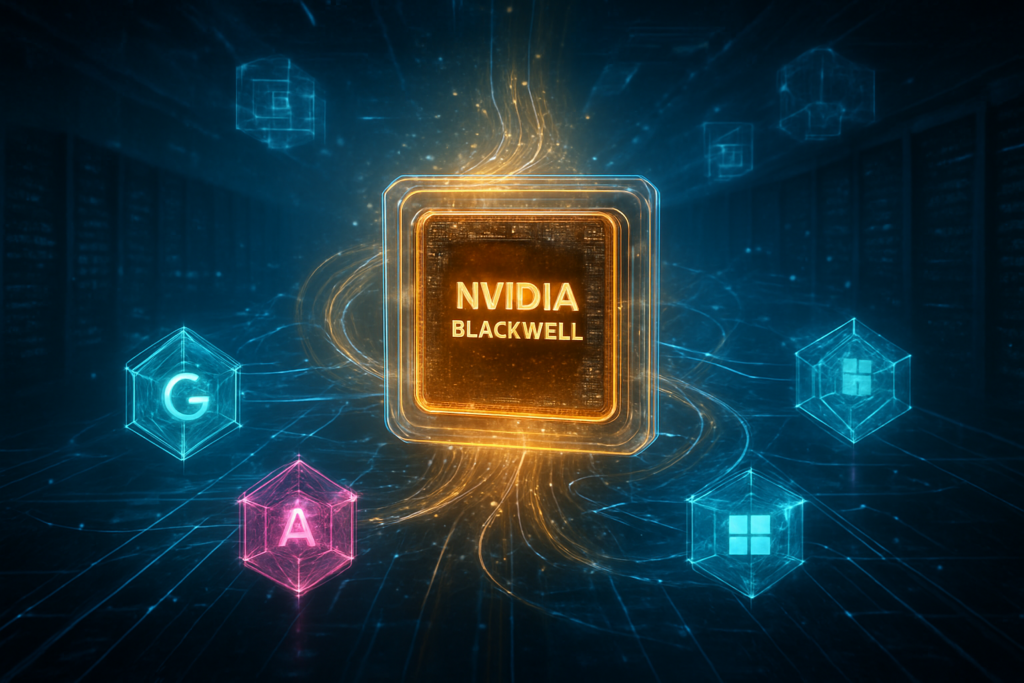
As we approach the end of 2025, the artificial intelligence hardware landscape has reached a fever pitch of competition. NVIDIA (NASDAQ: NVDA) continues to command the lion's share of the market with its Blackwell architecture, a powerhouse of silicon that has redefined the boundaries of large-scale model training and inference. However, the "NVIDIA Tax"—the high margins associated with the company’s proprietary hardware—has forced the world’s largest cloud providers to accelerate their own internal silicon programs.
While NVIDIA’s B200 and GB200 chips remain the gold standard for frontier AI research, a "great decoupling" is underway. Hyperscalers like Google (NASDAQ: GOOGL), Amazon (NASDAQ: AMZN), and Microsoft (NASDAQ: MSFT) are no longer content to be mere distributors of NVIDIA’s hardware. By deploying custom Application-Specific Integrated Circuits (ASICs) like Trillium, Trainium, and Maia, these tech giants are attempting to commoditize the inference layer of AI, creating a two-tier market where NVIDIA provides the "Ferrari" for training while custom silicon serves as the "workhorse" for high-volume, cost-sensitive production.
The Technical Supremacy of Blackwell
NVIDIA’s Blackwell architecture, specifically the GB200 NVL72 system, represents a monumental leap in data center engineering. Featuring 208 billion transistors and manufactured using a custom 4NP TSMC process, the Blackwell B200 is not just a chip, but the centerpiece of a liquid-cooled rack-scale computer. The most significant technical advancement lies in its second-generation Transformer Engine, which supports FP4 and FP6 precision. This allows the B200 to deliver up to 20 PetaFLOPS of compute, effectively providing a 30x performance boost for trillion-parameter model inference compared to the previous H100 generation.
Unlike previous architectures that focused primarily on raw FLOPS, Blackwell prioritizes interconnectivity. The NVLink 5 interconnect provides 1.8 TB/s of bidirectional throughput per GPU, enabling a cluster of 72 GPUs to act as a single, massive compute unit with 13.5 TB of HBM3e memory. This unified memory architecture is critical for the "Inference Scaling" trend of 2025, where models like OpenAI’s o1 require massive compute during the reasoning phase of an output. Industry experts have noted that while competitors are catching up in raw throughput, NVIDIA’s mature CUDA software stack and the sheer bandwidth of NVLink remain nearly impossible to replicate in the short term.
The Hyperscaler Counter-Offensive
Despite NVIDIA’s technical lead, the strategic shift toward custom silicon has reached a critical mass. Google’s latest TPU v7, codenamed "Ironwood," was unveiled in late 2025 as the first chip explicitly designed to challenge Blackwell in the inference market. Utilizing an Optical Circuit Switch (OCS) fabric, Ironwood can scale to 9,216-chip Superpods, offering a 4.6 PetaFLOPS FP8 performance that rivals the B200. More importantly, Google claims Ironwood provides a 40–60% lower Total Cost of Ownership (TCO) for its Gemini models, allowing the company to offer "two cents per million tokens"—a price point NVIDIA-based clouds struggle to match.
Amazon and Microsoft are following similar paths of vertical integration. Amazon’s Trainium2 (Trn2) has already proven its mettle by powering the training of Anthropic’s Claude 4, demonstrating that frontier models can indeed be built without NVIDIA hardware. Meanwhile, Microsoft has paired its Maia 100 and the upcoming Maia 200 (Braga) with custom Cobalt 200 CPUs and Azure Boost DPUs. This "system-level" approach aims to optimize the entire data path, reducing the latency bottlenecks that often plague heterogeneous GPU clusters. For these companies, the goal isn't necessarily to beat NVIDIA on every benchmark, but to gain leverage and reduce the multi-billion-dollar capital expenditure directed toward Santa Clara.
The Inference Revolution and Market Shifts
The broader AI landscape in 2025 has seen a decisive shift: roughly 80% of AI compute spend is now directed toward inference rather than training. This transition plays directly into the hands of custom ASIC developers. While training requires the extreme flexibility and high-precision compute that NVIDIA excels at, inference is increasingly about "cost-per-token." In this commodity tier of the market, the specialized, energy-efficient designs of Amazon’s Inferentia and Google’s TPUs are eroding NVIDIA's dominance.
Furthermore, the rise of "Sovereign AI" has added a new dimension to the market. Countries like Japan, Saudi Arabia, and France are building national AI factories to ensure data residency and technological independence. While these nations are currently heavy buyers of Blackwell chips—driving NVIDIA’s backlog into mid-2026—they are also eyeing the open-source hardware movements. The tension between NVIDIA’s proprietary "closed" ecosystem and the "open" ecosystem favored by hyperscalers using JAX, XLA, and PyTorch is the defining conflict of the current hardware era.
Future Horizons: Rubin and the 3nm Transition
Looking ahead to 2026, the hardware wars will only intensify. NVIDIA has already teased its next-generation "Rubin" architecture, which is expected to move to a 3nm process and incorporate HBM4 memory. This roadmap suggests that NVIDIA intends to stay at least one step ahead of the hyperscalers in raw performance. However, the challenge for NVIDIA will be maintaining its high margins as "good enough" custom silicon becomes more capable.
The next frontier for custom ASICs will be the integration of "test-time compute" capabilities directly into the silicon. As models move toward more complex reasoning, the line between training and inference is blurring. We expect to see Amazon and Google announce 3nm chips in early 2026 that specifically target these reasoning-heavy workloads. The primary challenge for these firms remains the software; until the developer experience on Trainium or Maia is as seamless as it is on CUDA, NVIDIA’s "moat" will remain formidable.
A New Era of Specialized Compute
The dominance of NVIDIA’s Blackwell architecture in 2025 is a testament to the company’s ability to anticipate the massive compute requirements of the generative AI era. By delivering a 30x performance leap, NVIDIA has ensured that it remains the indispensable partner for any organization building frontier-scale models. Yet, the rise of Google’s Ironwood, Amazon’s Trainium2, and Microsoft’s Maia signals that the era of the "universal GPU" may be giving way to a more fragmented, specialized future.
In the coming months, the industry will be watching the production yields of the 3nm transition and the adoption rates of non-CUDA software frameworks. While NVIDIA’s financial performance remains record-breaking, the successful training of Claude 4 on Trainium2 proves that the "NVIDIA-only" era of AI is over. The hardware landscape is no longer a monopoly; it is a high-stakes chess match where performance, cost, and energy efficiency are the ultimate prizes.
This content is intended for informational purposes only and represents analysis of current AI developments.
TokenRing AI delivers enterprise-grade solutions for multi-agent AI workflow orchestration, AI-powered development tools, and seamless remote collaboration platforms.
For more information, visit https://www.tokenring.ai/.